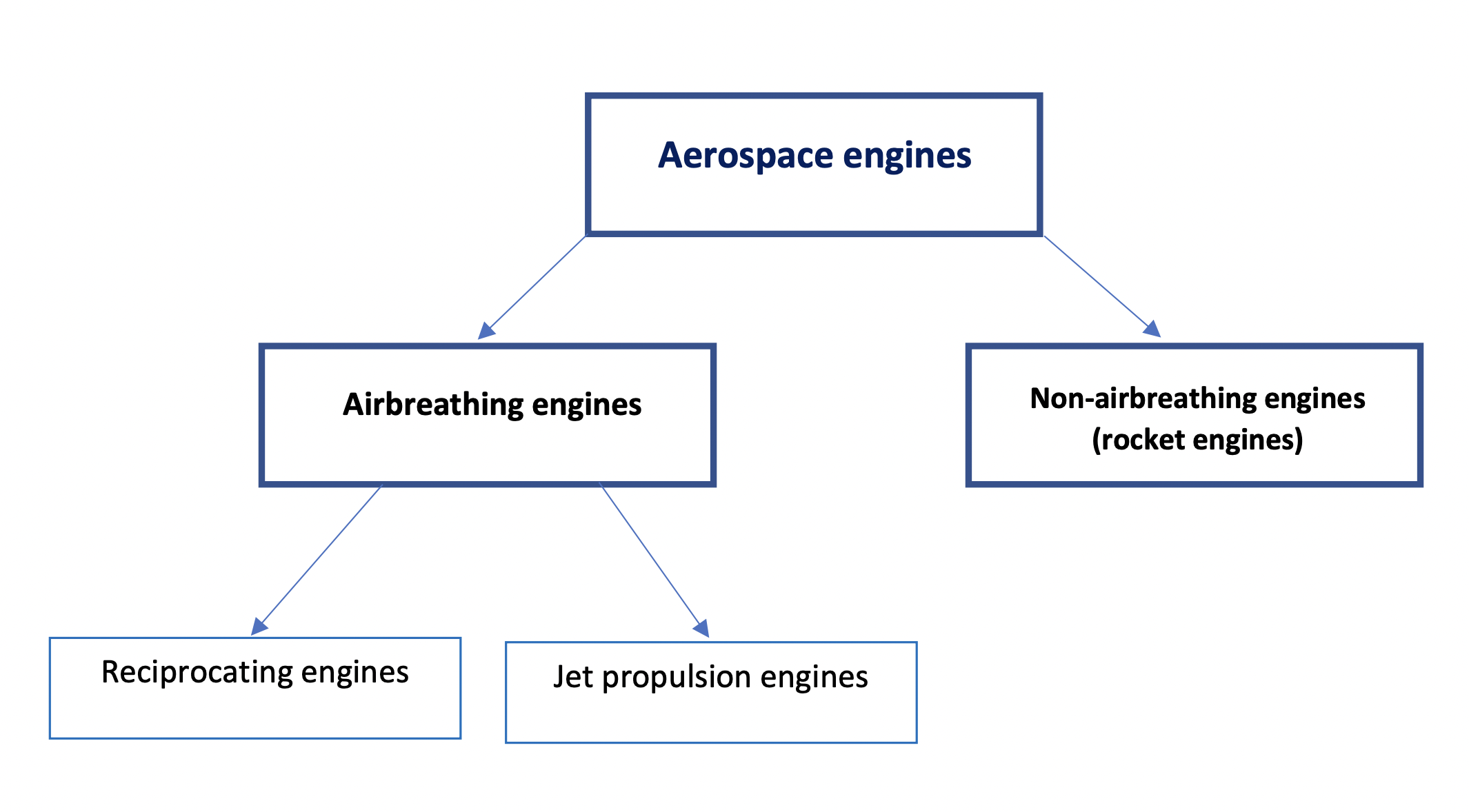
Airbreathing and non-airbreathing engines make up the two main categories of aerospace engines. For simplicity, Airbreathing engines (also known as airbreathers) function by utilizing the air that the aircraft is flying through, both as an oxidizer for the fuel in the combustion chamber and as a working fluid for thrust generation. Non-airbreathing engines are rocket engines in which the propellant gas is produced aboard the vehicle. A rocket engine is a type of jet propulsion system that generates thrust by ejecting stored substances known as a propellant.
Airbreathing engines are divided into 2 types: reciprocating engines and jet engines. The Wright brothers' first successful flight was propelled by a piston engine. Up until jet engines took over, it remained the predominant source of propulsion for aircraft. Piston engines with water-cooled engines were utilized from 1903 to 1908. Excess drag and weight created by liquid-cooled engines hampered airplane performance at the time. In 1908, liquid-cooled engines had been replaced by air-cooled ones, resulting in weight reductions of up 40%. However, the performance of these air-cooled engines fell short of expectations. To increase the efficiency of air-cooled aircraft, The National Advisory Committee for Aeronautics (NACA) created a cowling that encased the engine. This engine enclosure restricted the passage of air over the engine cylinders to air in contact with the cooling fins of the cylinders.
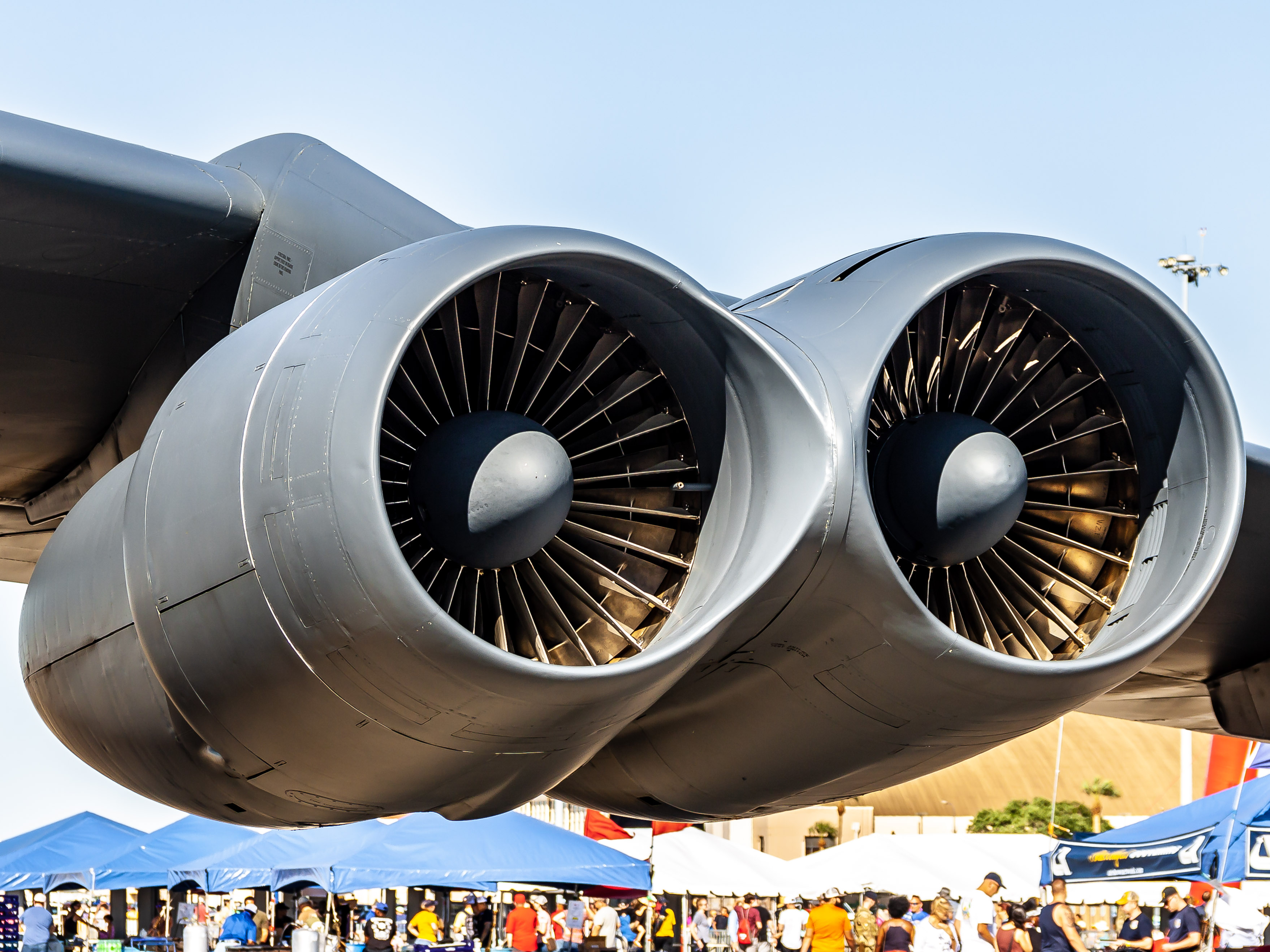
However, piston engines were much too heavy to compete with jet engines in terms of power output. The capacity to fly at greater altitudes and at faster speeds with simpler control is one of the most evident benefits of jet engines versus reciprocating engines. The increased airflow makes cooling less difficult. On the other hand, the continuous ignition system of the reciprocating engines is not required, spark plugs are only utilized for the startup. There is no need for a carburetor or a mixture control.
The first jet engines appeared in the 1940s, and during the next 60 years, they underwent enormous progress that has continued to this day. Whether they are turbojets, turbofans, or turboprops, the engines utilized in some aircraft applications are all collectively referred to as "jet engines."
Business Aviation Activity Climbs in May, Yet Argus Data Signals Cooling Momentum » United Airlines 767 Returns to Newark After Passenger's Bluetooth Named 'Bomb' Triggers Security Alert » Delta Reconsiders Its Long-Awaited Transcontinental Business Class Seat »

Comments (0)
Add Your Comment
SHARE
TAGS
INFORMATIONAL Aerospace EnginesAviationClassificationRECENTLY PUBLISHED
 Riyadh Air Takes Delivery of First Boeing 787 Dreamliners Ahead of Passenger Launch
Saudi Arabia's Riyadh Air received its first two Boeing 787-9 Dreamliners from its Boeing aircraft order book, setting the stage for the airline's long-anticipated commercial debut.
NEWS
READ MORE »
Riyadh Air Takes Delivery of First Boeing 787 Dreamliners Ahead of Passenger Launch
Saudi Arabia's Riyadh Air received its first two Boeing 787-9 Dreamliners from its Boeing aircraft order book, setting the stage for the airline's long-anticipated commercial debut.
NEWS
READ MORE »
 Iberia A350 Wingtip Strikes Fire Truck During Water Salute
An Iberia Airbus A350 sustained wingtip damage after striking a fire truck during a ceremonial water salute at Guayaquil (GYE) Airport.
NEWS
READ MORE »
Iberia A350 Wingtip Strikes Fire Truck During Water Salute
An Iberia Airbus A350 sustained wingtip damage after striking a fire truck during a ceremonial water salute at Guayaquil (GYE) Airport.
NEWS
READ MORE »
 United CEO: Engine Shortage Grounding 900 Aircraft Will Last "Many, Many Years"
United Airlines CEO Scott Kirby says roughly 900 jets sit idle globally due to an engine shortage expected to persist for years.
NEWS
READ MORE »
United CEO: Engine Shortage Grounding 900 Aircraft Will Last "Many, Many Years"
United Airlines CEO Scott Kirby says roughly 900 jets sit idle globally due to an engine shortage expected to persist for years.
NEWS
READ MORE »