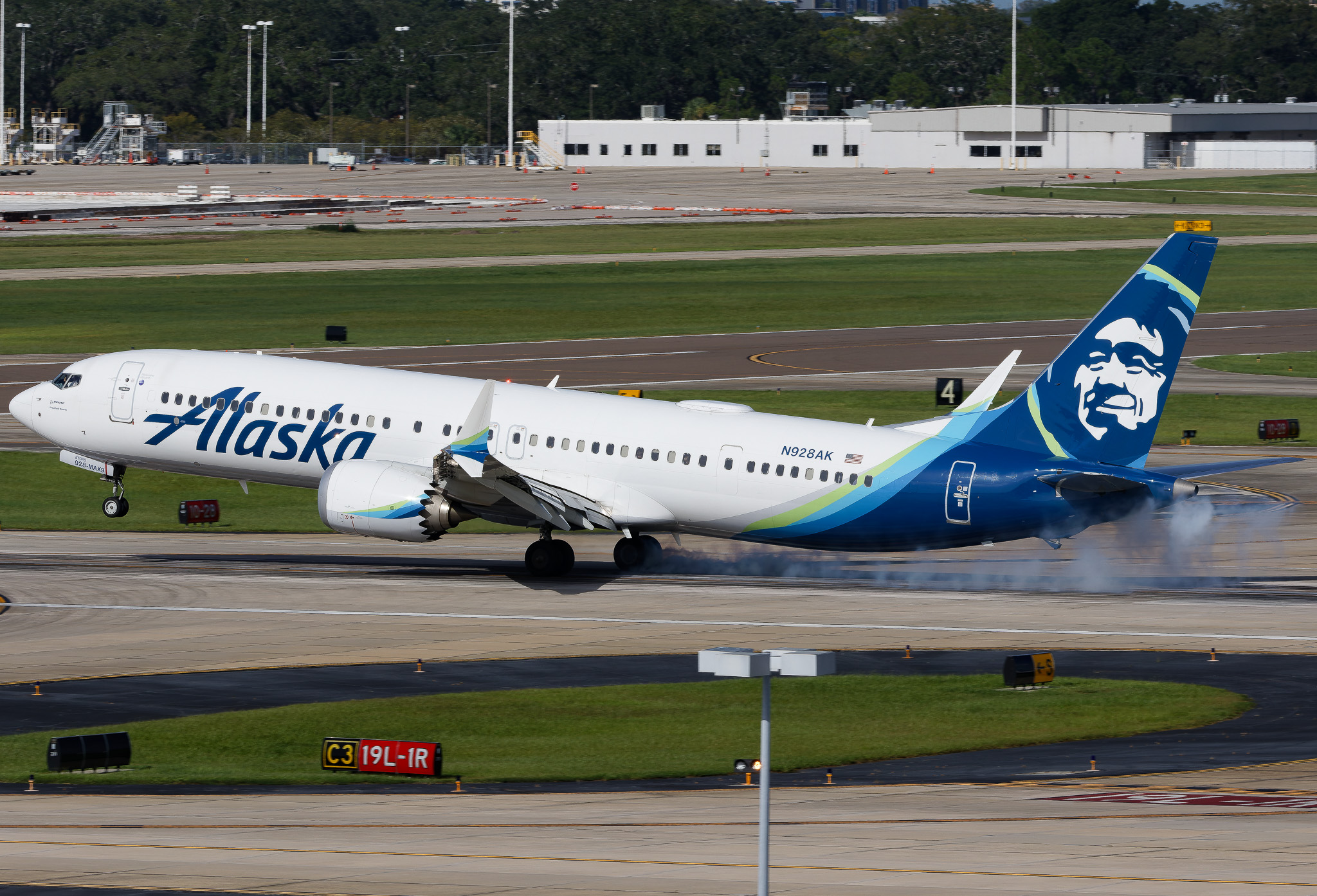

Federal investigators are currently dissecting a high-stakes "close call" at Newark Liberty International Airport (EWR) after an Alaska Airlines Boeing 737 MAX 9 and a FedEx Boeing 777F narrowly avoided a collision on Tuesday night. The incident, which occurred on March 17, 2026, has reignited intense scrutiny regarding air traffic control (ATC) staffing and the safety of intersecting runway operations at the nation’s most congested hubs.

A Split-Second Intervention
The conflict unfolded around 8:15 p.m. local time as two heavy-weights of the sky converged on the New Jersey airfield. Alaska Airlines Flight 294, arriving from Portland (PDX), was on final approach when an air traffic controller recognized a catastrophic trajectory: a FedEx Boeing 777 freighter, Flight 721 from Memphis (MEM), had also been cleared for an intersecting runway.
As the Alaska MAX 9 descended to a mere 150 feet above the tarmac, the controller issued an emergency "go-around" command. Preliminary radar data from Flightradar24 indicates that the Alaska jet overflew the FedEx widebody with a vertical separation of only 300 to 325 feet, a distance roughly equivalent to the length of a single football field.

Analysis: How Spirit Airlines Changed Airline Pricing, then Paid the Price
The Mechanics of the "Go-Around"
In aviation and operations, a go-around is a standard but high-workload maneuver in which a landing is aborted. Pilots transition the aircraft from a descent configuration to a full-power climb. While a routine part of pilot training, the proximity of the two aircraft in this instance pushed the boundaries of safety margins.
"An air traffic controller instructed Alaska Airlines Flight 294 to perform a go-around at Newark International Airport because FedEx Flight 721 was cleared for the final approach to an intersecting runway," the Federal Aviation Administration (FAA) confirmed in an official statement.
The carriers involved have since provided their assessments of the crew responses:
Alaska Airlines: "Air traffic control issued a go around to our aircraft, which our pilots are highly trained for."
FedEx: "Following instructions from air traffic control, the flight crew of FedEx flight 721 landed safely without incident at Newark Liberty International Airport Tuesday."

Investigating the Systemic Failure
The National Transportation Safety Board (NTSB) has launched a full investigation, which is expected to focus on the ATC communications and the "visual separation" protocols in place at the time. This incident follows a period of heightened concern after the fatal January 2025 mid-air collision near Reagan National Airport, which led the FAA to mandate stricter radar-backed separation for aircraft operating near major terminals.
Industry analysts are questioning whether the current EWR staffing levels contributed to the clearing of two aircraft for intersecting paths simultaneously. While the quick thinking of the controller prevented a disaster, the NTSB will look into why the conflict was allowed to develop in the first place.
Incident Flight Operations Data
The following table outlines the operational details for the two primary flights involved in the Newark runway conflict.
| Flight No. | Route | Departure Time | Arrival Time | Duration |
|---|---|---|---|---|
| AS 294 | Portland (PDX) – Newark (EWR) | 12:05 PM | 08:17 PM* | 5h 12m |
| FX 721 | Memphis (MEM) – Newark (EWR) | 05:40 PM | 08:15 PM | 1h 35m |
*Flight 294 landing time reflects the successful arrival following the go-around maneuver.
As the NTSB and FAA continue their deep dive into the telemetry and cockpit voice recorders, the Newark near-miss serves as a sobering reminder of the thin margins for error in modern aerospace management. The outcome of this probe may lead to new federal mandates regarding how intersecting runways are utilized during peak traffic windows.
Army Report Points to Systemic Failures in Deadly Black Hawk Collision Near Reagan National » FAA Orders Engine Repairs on Airbus A380 Fleet After Uncontained Failure » Southwest Airlines Blames Brief System Outage for Boarding Delays and Checked Bag Disruptions »

Comments (0)
Add Your Comment
TAGS
NEWS Alaska Airlines FedEx Aviation Safety Newark Airport EWR NTSB Boeing 737 MAX 9 777 Freighter Air Traffic Control Flights IncidentRECENTLY PUBLISHED
 6 Key Rules for Claiming Citizenship Status Through Your Parents or Grandparents
If you want to know about ancestry rights in Canadian citizenship law, you need to understand what has changed in the rules lately.
INFORMATIONAL
READ MORE »
6 Key Rules for Claiming Citizenship Status Through Your Parents or Grandparents
If you want to know about ancestry rights in Canadian citizenship law, you need to understand what has changed in the rules lately.
INFORMATIONAL
READ MORE »
 FlyUSA Opens 50,000-Square-Foot Owner-Exclusive Hangar and Lounge at Tampa International Airport
FlyUSA has opened a 50,000-square-foot private hangar and lounge at Tampa International Airport, serving aircraft owners and charter clients.
NEWS
READ MORE »
FlyUSA Opens 50,000-Square-Foot Owner-Exclusive Hangar and Lounge at Tampa International Airport
FlyUSA has opened a 50,000-square-foot private hangar and lounge at Tampa International Airport, serving aircraft owners and charter clients.
NEWS
READ MORE »
 Federal Grand Jury Indicts Passenger Duct-Taped to Seat on American Airlines Flight
A passenger restrained with duct tape after a violent outburst on an American Airlines flight to Newark faces federal charges and up to 20 years in prison.
NEWS
READ MORE »
Federal Grand Jury Indicts Passenger Duct-Taped to Seat on American Airlines Flight
A passenger restrained with duct tape after a violent outburst on an American Airlines flight to Newark faces federal charges and up to 20 years in prison.
NEWS
READ MORE »
More than just headlines.
Get unlimited ad-free access to in-depth aviation news, premium stories, and exclusive insights other sites don't cover.
- Ad-free browsing on AeroXplorer
- Unlimited access to premium and exclusive articles
- Higher photo upload limits & commissions on sales
- Free access to Jetstream Magazine on higher tiers
- Ad-free browsing
- Sell aviation photos with 60% commission
- First week free!
- Everything in Basic+
- Unlimited premium articles
- Sell aviation photos with 70% commission
- Free Digital subscription to Jetstream Magazine
- First week free!
- Everything in Basic+ and Pro
- Sell aviaiton photos with 80% commission
- Early access to exclusive stories
- Free Digital+Print subscription to Jetstream Magazine