Civil aviation authorities and flight crews operating across the Korean Peninsula and the Sea of Japan are once again confronting one of the most persistent and underreported safety hazards in commercial aviation: North Korea's relentless and overwhelmingly unannounced ballistic missile testing programme. The threat has sharpened dramatically this week, as Pyongyang fired ballistic missiles on consecutive days, while the backdrop of a newly tested, record-breaking ICBM engine raises the spectre of a full intercontinental ballistic missile launch that could carve dangerous trajectories through some of the world's busiest air corridors.
Back-to-Back Launches on April 7 and 8
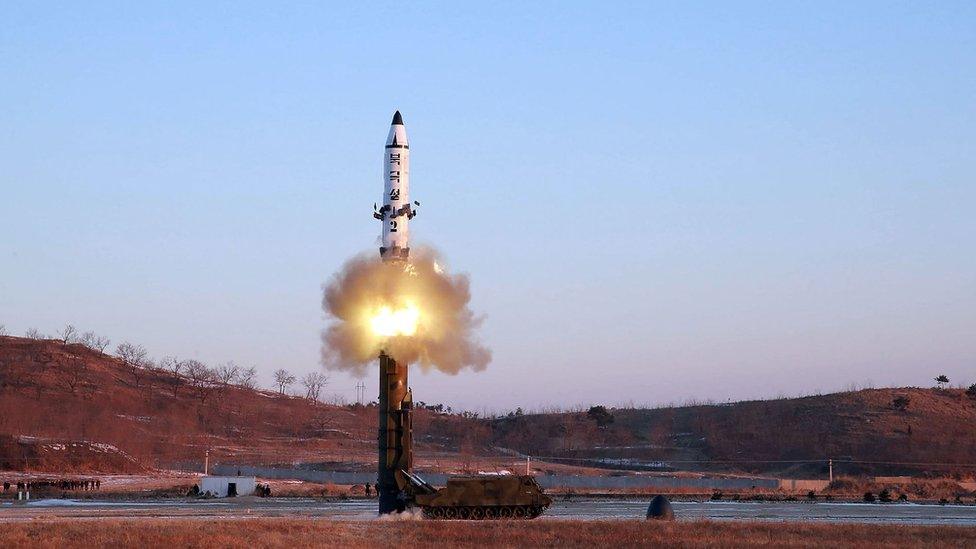
North Korea fired multiple short-range ballistic missiles toward the sea on Wednesday in its second launch event in two days, South Korea's military said, hours after a senior North Korean official released crude insults against Seoul's hopes for warmer relations. South Korea's Joint Chiefs of Staff said several missiles lifted off from North Korea's eastern coastal Wonsan area on Wednesday morning and flew about 240 kilometers each in a direction toward the North's eastern waters.
The launches did not stop there. Seoul later confirmed that an additional North Korean ballistic missile fired later Wednesday traveled more than 700 kilometers off the North's east coast. On the previous day, the South Korean military said it had also detected the launch of an unidentified projectile around North Korea's capital region. South Korean media reported that the previous projectile, also likely a ballistic missile, disappeared from South Korean military radar after exhibiting abnormal behaviour during the initial launch stage, indicating the launch ended in failure.
The Wednesday launches marked North Korea's fourth and fifth known ballistic missile tests this year, including a salvo of around 10 fired from the Sunan area in March.
The U.S. military was swift to assess the immediate danger to its assets. The U.S. Indo-Pacific Command said in a statement that the North Korean launches had not posed any immediate threat to U.S. personnel or territory, or to allies. However, for civil aviation, the picture is considerably more nuanced and carries a growing structural risk that goes beyond any single launch event.
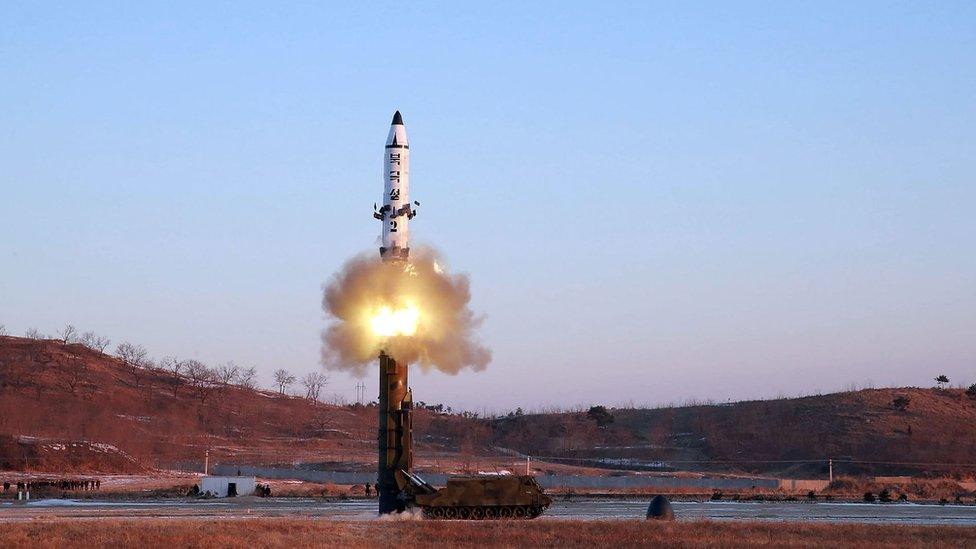
Photo: AFP
The Aviation Hazard Nobody Warns You About
What makes North Korea's missile programme uniquely dangerous for pilots is not merely the physical trajectory of the missiles, it is Pyongyang's chronic, deliberate failure to issue advance warning. The FAA's standing advisory notice is explicit: North Korea does not often issue NOTAMs or provide other adequate advanced warning that these hazardous activities are planned to occur in the Pyongyang FIR (ZKKP) before these test launches. Such no-notice missile launch activities pose a hazard to U.S. civil flight operations, including those operating on air routes B467 and G711.
Additional unannounced North Korean rocket or missile launches into the open-water areas of the Pyongyang FIR (ZKKP) are possible, particularly during periods of heightened political tension, during military training exercises, and associated with significant North Korean national anniversary dates.
Aviation safety analysts have highlighted that this is not a theoretical risk. The chances of a missile, or part of it, striking an aircraft are not as low as they may initially appear, particularly given that all the missile re-entries in recent years are occurring in quite a focused area over the Sea of Japan. The risk to overflying traffic is arguably greater from ballistic missiles than cruise missiles, because these can break up on re-entry to the atmosphere, meaning that a debris field of missile fragments passes through the airspace, not just one complete missile.
Compounding the risk is North Korea's own broken promise to the international community. Following talks with the US in early 2018, North Korea agreed with ICAO that it would provide adequate warning of all "activity hazardous to aviation" within its airspace. However, in May 2019 North Korea resumed launching missiles into the Sea of Japan, without providing any warning by NOTAM. That agreement has been treated by Pyongyang as worthless ever since.
The regulatory framework currently in place reflects this reality. These risks include, but are not limited to, extensive unannounced ballistic missile test launches associated with the DPRK's strategic weapons development activities, DPRK air defense and tactical aircraft capabilities that now cover the entire Pyongyang FIR (ZKKP), the DPRK's potential use of electronic warfare (EW) capabilities during periods of heightened tensions, and potential DPRK weapons of mass destruction (WMD) testing, which would likely increase inadvertent risks to civil aviation, both within and potentially beyond the Pyongyang FIR (ZKKP), if it were to occur.
The FAA has extended its flight prohibition, Special Federal Aviation Regulation (SFAR) No. 79, through September 18, 2028, barring U.S. operators from the Pyongyang FIR west of 132 degrees east longitude. However, as the FAA itself notes, some of North Korea's medium and short-range missiles are capable of flying beyond that boundary, meaning even compliant operators are not fully shielded.
The Bigger Threat Looming Behind the Short-Range Launches
Tuesday and Wednesday's short-range launches are alarming enough in isolation, but aviation and defence analysts are watching a far larger development on the horizon that has serious implications for flight safety across a much broader geographic area.
On March 29, 2026, North Korea conducted a ground-based test of a new high-thrust solid-fuel ICBM engine, one that significantly outperforms anything Pyongyang has previously demonstrated. Kim Jong Un observed a test of a high-thrust, solid-fuel engine and hailed it as a development to boost the country's strategic military capability, state media reported. The engine's maximum thrust is 2,500 kilonewtons, up from about 1,971 kilonewtons reported in a similar solid fuel engine test in September.
Analysts at 38 North, one of the most authoritative independent North Korea monitoring bodies, described the development in sobering terms. The advent of the new motor further muddles the outlook for the North's future solid ICBM force, raising questions as to whether there will be yet another new system in addition to the as-yet-untested Hwasong-20 (HS-20) revealed last fall, and whether that new system would supplant the HS-20 or even the prior HS-19, which has only been flown once.
South Korea's intelligence apparatus immediately connected the engine test to what may come next. South Korea's spy agency told lawmakers on Monday the engine test was likely related to an effort to build a more powerful solid-fuel intercontinental ballistic missile that can carry multiple nuclear warheads, according to lawmakers who attended the meeting. Experts say North Korea needs multi-warhead missiles to penetrate through U.S. missile defences, but doubt the country has mastered the technology needed to acquire such a weapon.
The strategic intent behind the engine upgrade is also linked to rapid-launch survivability. Possession of more powerful and efficient solid-fuel engines would allow North Korea to build smaller ICBMs that can be launched from submarines or land-based mobile launch trucks. This matters critically for civil aviation: solid-fuel missiles require no pre-launch fuelling, dramatically reducing the detection window that would allow aviation authorities to issue NOTAMs or redirect aircraft before a launch occurs.
The new engine, which has the thrust to lift a 255-tonne object, is likely to be installed on the Hwasong-20 ICBM, according to observers. "If confirmed, this engine would rank among the top globally," said Hong Min, a senior research fellow at the Korea Institute for National Unification.
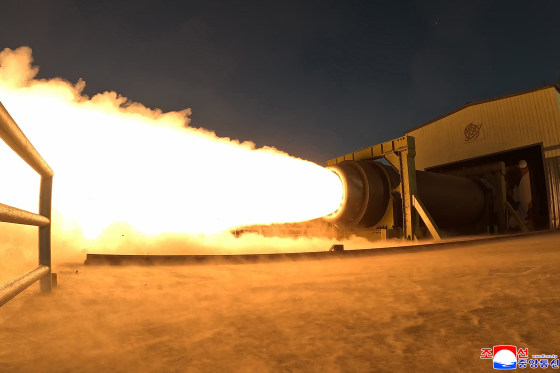
Photo: Korean Central News Agency/Korea News Service / The Associated Press
Kim Jong Un's Rhetoric and the Political Context
The technical escalation is playing out against a backdrop of sharpened political hostility. North Korea has refused to return to talks with South Korea and the U.S. and pushed to expand its nuclear arsenal since Kim Jong Un's diplomacy with U.S. President Donald Trump collapsed in 2019. North Korea has instead sought to strengthen ties with Russia, China and other countries embroiled in confrontations with the U.S.
Pyongyang's foreign ministry was unambiguous about its intentions. South Korea would always remain North Korea's "most hostile enemy state," said Jang Kum-chol, first vice minister at Pyongyang's Foreign Ministry. He derided South Korea as "world-startling fools" engaged in wishful thinking.
Kim Jong Un himself has framed the weapons programme in terms that directly reference the broader global security environment. As KCNA reported, Kim stated:
"To be honest, our such activity is clearly aimed at gradually putting the nuclear war deterrent on a highly developed basis. Why it is necessary is exemplified by the recent geopolitical crisis and complicated international events."
The back-to-back launches came after Pyongyang made it clear that it has no intention of improving ties with Seoul, whose government continues to express hopes of restoring long-dormant dialogue.

Analysis: How Spirit Airlines Changed Airline Pricing, then Paid the Price
A Chorus of International Condemnation
The international response has been swift and consistent, though observers note that such condemnation has done little to slow Pyongyang's pace of weapons development.
Japan's Defense Minister Shinjiro Koizumi said: "North Korea's series of actions, including repeated ballistic missile launches, threaten the peace and security of our region and the international community," adding that Japan was coordinating closely with the United States and South Korea.
The United Nations has repeatedly flagged the civil aviation risk embedded in North Korea's testing patterns. A senior UN official previously warned that unannounced launches posed "serious risks" to international civil aviation and maritime traffic, with the potential for unintended incidents, as North Korea had issued no safety alerts.
What Pilots and Operators Must Know Now
For flight crews and dispatchers operating across the region, the current situation demands active, not passive, risk management. The FAA advisory framework requires U.S. operators and airmen to report any observed launches directly: pilots must report any observed rocket or missile launches near the Korean Peninsula to the FAA at [email protected] or +1 202-267-3333.
Regional authorities have separately issued warnings and restrictions. South Korea, the Philippines and Japan have all issued airspace warnings by NOTAM due to the risk caused by falling debris. Japan's in particular is worth noting as it also suggests an anti-ballistic missile may be launched from several potential locations within the RJJJ/Fukuoka FIR to shoot down the craft if it enters Japanese airspace during launch.
The GPS interference picture adds another layer of operational complexity. Airspace safety is gradually deteriorating due to several factors: GPS Interference, North Korean space launches and missile tests, military drills, failed agreements with North Korea, and unusual balloon incidents. If operating in the RKRR/Incheon FIR, it is important to stay up to date with airspace risk.
An Accelerating Programme With No End in Sight
With North Korea's fourth and fifth known ballistic missile tests of 2026 now confirmed, and an untested next-generation ICBM, the Hwasong-20, potentially waiting in the wings, the trajectory for the remainder of the year is deeply concerning for both regional security and civil aviation safety.
There is speculation that a Hwasong-20 test launch could take place before a U.S.-China summit as a message directed at Washington. A full ICBM launch would create hazard zones vastly larger than those generated by the short-range tests seen this week, extending well beyond the Pyongyang FIR and into airspace currently considered safe.
For commercial aviation, this is not a story of distant geopolitics. It is a live operational hazard, unfolding in real time, across routes flown by millions of passengers. The absence of NOTAMs from Pyongyang is not a bureaucratic inconvenience; it is a structural threat to flight safety that regulators, airlines, and flight crews must treat with the urgency it demands.
Frontier Airlines Flight Attendant Restrains Passenger Who Lunged for Cabin Door During Atlanta Jet Bridge Delay » What the September NATS outage teaches passengers about flight compensation » NetJets Expands US Footprint With Three New Private Terminals and Larger Palm Beach Facility »

Comments (0)
Add Your Comment
TAGS
NEWS North Korea Ballistic Missile Aviation Safety NOTAM Korean Peninsula Airspace · Pyongyang FIR Sea of Japan Flight Safety Airspace Warning Korean Tensions Missile Debris Risk Civil Aviation RiskRECENTLY PUBLISHED
 Saab Weighs Canadian GlobalEye Production Line to Match Growing Surveillance Aircraft Orders
Saab is considering establishing GlobalEye production in Canada as demand for the airborne early warning aircraft climbs across NATO nations.
NEWS
READ MORE »
Saab Weighs Canadian GlobalEye Production Line to Match Growing Surveillance Aircraft Orders
Saab is considering establishing GlobalEye production in Canada as demand for the airborne early warning aircraft climbs across NATO nations.
NEWS
READ MORE »
 Lawmakers Press FAA to Suspend AI Air Traffic Control Tool at Washington-Area Airports
Senators and union leaders urge the FAA to pause an AI-driven air traffic management tool at DC airports, citing safety concerns.
NEWS
READ MORE »
Lawmakers Press FAA to Suspend AI Air Traffic Control Tool at Washington-Area Airports
Senators and union leaders urge the FAA to pause an AI-driven air traffic management tool at DC airports, citing safety concerns.
NEWS
READ MORE »
 Lufthansa Wins Bid for 44.9% Stake in TAP Air Portugal, Edging Out Air France-KLM
Portugal selects Lufthansa as preferred buyer for a 44.9% stake in TAP Air Portugal, beating competing offers from Air France-KLM and IAG.
NEWS
READ MORE »
Lufthansa Wins Bid for 44.9% Stake in TAP Air Portugal, Edging Out Air France-KLM
Portugal selects Lufthansa as preferred buyer for a 44.9% stake in TAP Air Portugal, beating competing offers from Air France-KLM and IAG.
NEWS
READ MORE »
More than just headlines.
Get unlimited ad-free access to in-depth aviation news, premium stories, and exclusive insights other sites don't cover.
- Ad-free browsing on AeroXplorer
- Unlimited access to premium and exclusive articles
- Higher photo upload limits & commissions on sales
- Free access to Jetstream Magazine on higher tiers
- Ad-free browsing
- Sell aviation photos with 60% commission
- First week free!
- Everything in Basic+
- Unlimited premium articles
- Sell aviation photos with 70% commission
- Free Digital subscription to Jetstream Magazine
- First week free!
- Everything in Basic+ and Pro
- Sell aviaiton photos with 80% commission
- Early access to exclusive stories
- Free Digital+Print subscription to Jetstream Magazine