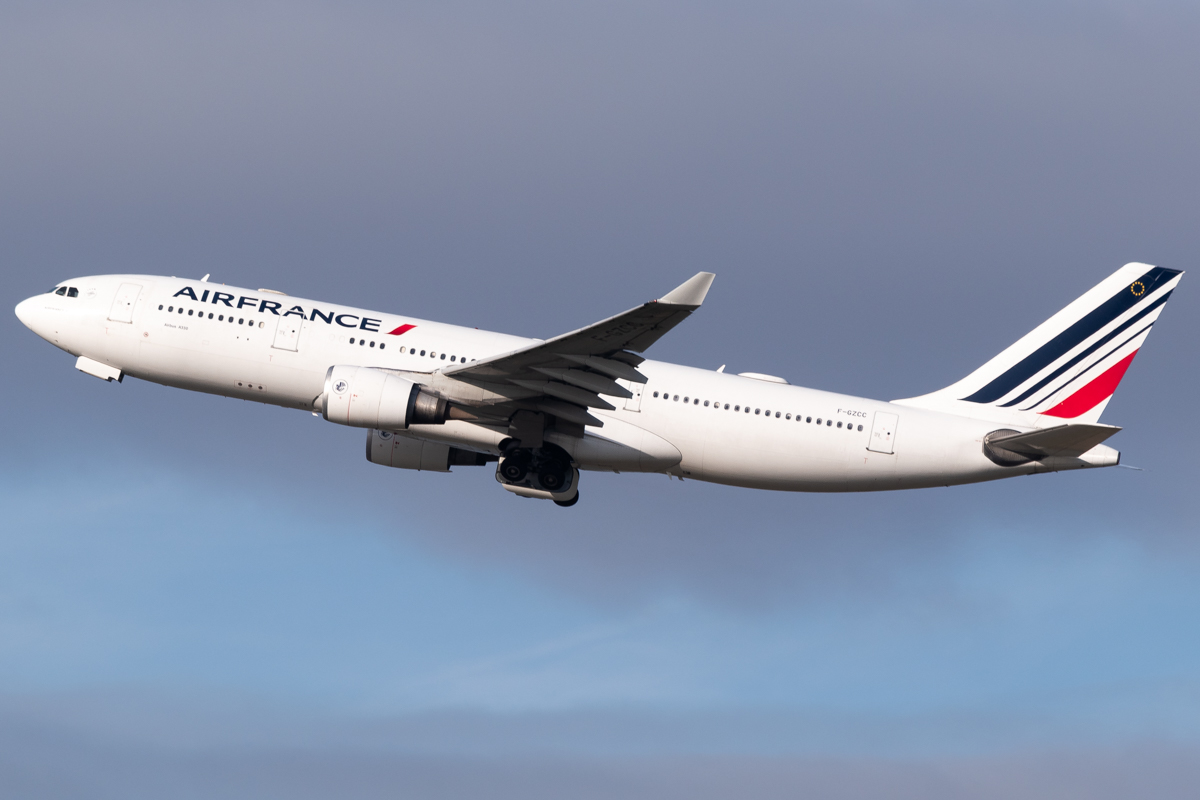

A Paris appeals court has today delivered one of the most consequential verdicts in the history of commercial aviation, finding both Airbus and Air France guilty of corporate manslaughter over the June 2009 crash of Air France Flight AF447; a disaster that killed all 228 people on board and remains the worst aviation accident in French history. The ruling, reached after 17 years of legal battle and a second full trial, reverses a 2023 acquittal and sends a judicial signal that has reverberated far beyond the courtroom.
The Paris Court of Appeal ruled on Thursday that both companies were “solely and entirely responsible for the crash of flight AF447” and ordered a payment of 225,000 euros ($261,720) for each passenger, the maximum fine possible for corporate manslaughter. The penalties are widely acknowledged to be token figures against the revenues of two of France's most powerful industrial institutions, but for the families who have spent nearly two decades seeking accountability, the conviction itself carries a weight that no fine can fully measure.
What Happened on June 1, 2009
On June 1, 2009, an Airbus A330 operating as Air France Flight 447 departed Rio de Janeiro, Brazil, bound for Paris. The aircraft crashed into the Atlantic Ocean at 02:14 local time during a storm, killing all 12 crew members and 216 passengers. Those on board were of 33 nationalities. The plane vanished from radar screens, and while the Brazilian Navy recovered some wreckage in the immediate aftermath, the black boxes were not retrieved until 2011 following a deep-sea search covering 10,000 square kilometers.
The court heard how a malfunction with the pitot tubes, which became blocked with ice crystals during a mid-Atlantic storm, caused alarms to sound in the plane's cockpit and the autopilot system to switch off. Technical experts highlighted how, after the instrument failed, the pilots put the plane into a climb that caused the aircraft to stall and then crash into the ocean. The sequence from the first sensor failure to impact lasted just four minutes and thirty seconds, an interval that became the defining focus of every subsequent investigation and legal proceeding.
There were no survivors among the 216 passengers and 12 crew on board the Airbus-built A330 aircraft, the dead including 72 French nationals and 58 Brazilians. Among those who perished were three young Irish women: Dr Aisling Butler, aged 26, from Roscrea, Co Tipperary; Dr Jane Deasy, aged 27, from Dublin; and Dr Eithne Walls, aged 28, from Co Down, all returning from a holiday in Brazil.
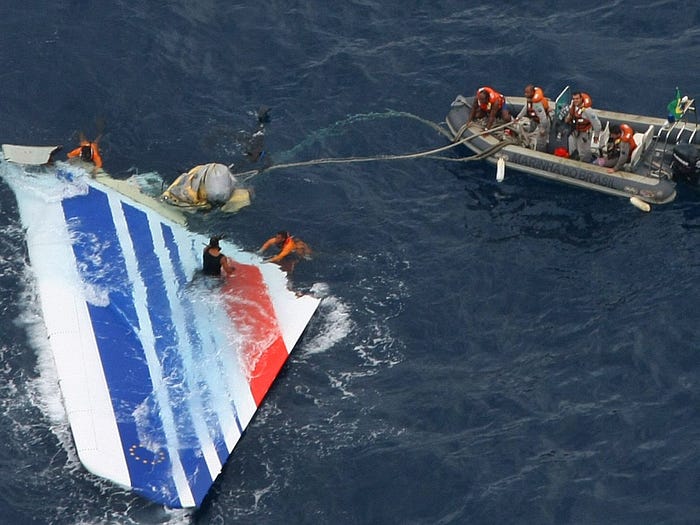
Photo: The Guardian
What Each Company Was Found Guilty Of
The court drew a clear distinction between the responsibilities of the two defendants. Air France was found guilty of having failed to provide pilot training and to adequately inform flight crews. The case against Air France centred on its failure to train pilots specifically for situations in which pitot tubes fail at high altitude, a known risk that the airline had not addressed through targeted simulation or procedural guidance. That gap proved fatal when the crew were confronted with a cascade of conflicting instrument readings in the dark, over the open Atlantic.
The case against Airbus focused on what the prosecution characterised as a systematic underestimation of a known technical vulnerability. The prosecution accused Airbus of "underestimating the seriousness of failures of the pitot probes." Lawyers for the families argued that both companies were aware of the problem with pitot tubes well before the accident but had not acted swiftly or decisively enough to protect the aircraft's crews.
A remarkably candid admission emerged during the trial from Air France's own legal representative. Pascal Weil, who represented Air France, said at the time that the company "had the means to conduct high-altitude training, but we did not do so because we sincerely believed it was unnecessary."
The Cockpit’s Next Revolution: When the Co-Pilot Is a Computer
A 17-Year Road to This Verdict
The legal path to Thursday's ruling has been tortuous. Investigating judges initially dropped all charges against both companies in 2019. A 2021 appeal court ruling then ordered a full criminal trial. The first criminal trial ran from October to December 2022 before a lower court acquitted both Airbus and Air France in April 2023, a verdict that devastated victims' families. Although prosecutors in 2023 had asked for the charges to be dropped, they had subsequently appealed. The eight-week appeal trial ran between September and December last year.
The tone set during the appeal proceedings was notably sharp. Prosecutor Rodolphe Juy-Birmann, speaking during the trial in November 2025, did not soften his language about how both corporations had conducted themselves throughout the years of litigation:
"Nothing has come of it; not a single word of sincere comfort. It's a rock-solid defence. One word sums up this whole circus: indecency."

Families Divided by Geography
The reaction to today's verdict was not uniform. In Paris, the families of those killed in the crash praised the ruling. Daniele Lamy, the head of an association of families of the victims, said the justice system had finally taken into account "the pain of the families."
"These prestigious firms will no longer be able to hide behind their self-satisfaction and technological pride," she added. But the mood was darker in Rio de Janeiro. "I feel as if my son had died today," said the head of an association of families of the victims in Brazil, adding he was outraged because no executive had been held accountable.
That final point carries particular weight. No individual has faced criminal prosecution over the crash. The pilots who flew AF447 died alongside the passengers they were trying to save.
Airbus Responds and Immediately Appeals
Airbus moved quickly after the verdict, announcing within hours that it would take the case to France's highest court. In a statement, Airbus said:
"Airbus wishes to express its deepest sympathies and unwavering support to the families and loved ones of the victims of this tragic accident."
“From the outset, Airbus has pursued a constant objective: to understand the facts, to seek the truth, to draw all necessary lessons, and to act responsibly to continue improving aviation safety.”
The statement added:
"Flight safety is the absolute priority for Airbus. It is at the heart of Airbus identity, its industrial operations, and the focus of all its employees, from aircraft design through to operation. This total commitment is owed to the millions of passengers and crew members who place their trust in Airbus aircraft every day."
The manufacturer noted that the Paris Court of Appeal's decision contradicts the submissions of the Public Prosecutor's Office at both stages of the proceedings, the dismissal order issued by the investigating judges in 2019, and the acquittal judgment handed down at first instance in 2023.
Any further appeals following the verdict will shift the focus away from the AF447 cockpit to points of law. This means the Court of Cassation will not re-examine the facts of the crash itself but instead scrutinise the legal framework and reasoning applied by the appeals court in reaching its guilty verdict. French lawyers have predicted this process could extend the proceedings for several more years, prolonging the legal ordeal for relatives.
The Industry Changes That Followed
Whatever the final legal outcome, AF447 has already reshaped commercial aviation in ways that endure. The AF447 tragedy triggered industry changes that endure today. Regulators and airlines tightened rules around pitot tube specifications and maintenance, and many carriers revised training programs to emphasize manual handling of high-altitude upsets when instruments disagree. The incident remains a case study in how a combination of technical failure and human factors can interact, prompting revisions in operational guidance and equipment certification practices.
The verdict closes a legal chapter that stretches back to the summer of 2009, but for many of the 228 families, no court ruling, and certainly no fine amounting to a few minutes of corporate revenue, can close the human one.
Air France Flight AF447
| Flight No. | Route | Departure Time | Arrival Time | Duration | Operating Days |
|---|---|---|---|---|---|
| AF447 | Rio de Janeiro Galeão (GIG) → Paris Charles de Gaulle (CDG) | 22:29 BRT, May 31, 2009 (01:29 UTC, Jun 1) | Did not arrive — crashed 02:14 UTC, Jun 1 | Flight ended ~4h 45m after departure; scheduled ~11h | Regular scheduled service (Air France long-haul) |
Aircraft: Airbus A330-203, registration F-GZCP. 216 passengers and 12 crew on board; 228 fatalities, no survivors. The aircraft disappeared from radar over the South Atlantic at 02:14 UTC on June 1, 2009. The flight data recorders (black boxes) were not recovered until May 2011, following a deep-sea search covering 10,000 sq km. The route is operated today as AF445/AF446 (Paris CDG–Rio de Janeiro GIG return service), using updated Airbus A350-900 aircraft.
Post Tags:
3-Word Headline:
Frontier Airlines Flight Attendant Restrains Passenger Who Lunged for Cabin Door During Atlanta Jet Bridge Delay » US State Department Warns of Threats to Airlines and Airports in Saudi Arabia Following Deadly Houthi Attacks » British Airways Flight to Chicago Forces Emergency Descent After Cabin Pressure Failure »

Comments (0)
Add Your Comment
TAGS
NEWS Air France Flight AF447 Airbus Air France Corporate Manslaughter Paris Court of Appeal Pitot Tubes Airbus A330 Rio-Paris Crash 2009 Aviation Safety Aviation Law Court of Cassation Daniele Lamy Entraide et Solidarite AF447 Atlantic Ocean Crash France Aviation Disaster Flight Safety Pilot Training Aviation InvestigationRECENTLY PUBLISHED
 United 777 Diverts to Dublin After Cockpit Windscreen Cracks Over the Atlantic
A United Airlines Boeing 777 bound for Milan made a steep descent and diverted to Dublin after its cockpit windscreen cracked mid-flight.
NEWS
READ MORE »
United 777 Diverts to Dublin After Cockpit Windscreen Cracks Over the Atlantic
A United Airlines Boeing 777 bound for Milan made a steep descent and diverted to Dublin after its cockpit windscreen cracked mid-flight.
NEWS
READ MORE »
 Boeing's Touchscreen Flight Controls for 737 Draw Sharp Criticism from Pilots
Boeing's plan to introduce Touchscreen Control Display Units on the 737 has sparked backlash from pilots who warn of safety and usability concerns.
NEWS
READ MORE »
Boeing's Touchscreen Flight Controls for 737 Draw Sharp Criticism from Pilots
Boeing's plan to introduce Touchscreen Control Display Units on the 737 has sparked backlash from pilots who warn of safety and usability concerns.
NEWS
READ MORE »
 Southwest Airlines Blames Brief System Outage for Boarding Delays and Checked Bag Disruptions
Southwest Airlines confirms a brief technology outage disrupted boarding and checked bag operations, forcing gate agents to process travelers manually.
NEWS
READ MORE »
Southwest Airlines Blames Brief System Outage for Boarding Delays and Checked Bag Disruptions
Southwest Airlines confirms a brief technology outage disrupted boarding and checked bag operations, forcing gate agents to process travelers manually.
NEWS
READ MORE »
More than just headlines.
Get unlimited ad-free access to in-depth aviation news, premium stories, and exclusive insights other sites don't cover.
- Ad-free browsing on AeroXplorer
- Unlimited access to premium and exclusive articles
- Higher photo upload limits & commissions on sales
- Free access to Jetstream Magazine on higher tiers
- Ad-free browsing
- Sell aviation photos with 60% commission
- First week free!
- Everything in Basic+
- Unlimited premium articles
- Sell aviation photos with 70% commission
- Free Digital subscription to Jetstream Magazine
- First week free!
- Everything in Basic+ and Pro
- Sell aviaiton photos with 80% commission
- Early access to exclusive stories
- Free Digital+Print subscription to Jetstream Magazine