
Ask a group of pilots a simple question: Are halon fire extinguishers still allowed in aircraft?
You’ll probably hear something like: “No, halon was banned years ago.”
It’s a widely held belief. It’s also wrong.
Halon fire extinguishers are still legal in many parts of the world, including the United States, and they remain one of the most effective portable fire extinguishing agents available for aviation. Yet confusion about halon is everywhere—from hangar conversations to online pilot forums.
Learn More About Halon Fire Extinguishers.
So how did so many people get the story wrong?
The answer lies in a regulatory decision made more than 30 years ago.
Where the Confusion Started
Beginning in 1994, developed countries phased out the production of new halon under the Montreal Protocol, a global environmental treaty designed to protect the ozone layer.
The Protocol included the type of halon used in portable fire extinguishers, known as halon 1211. However, what it did not do was ban the use of halon itself.
Instead, the agreement created a system of recycling and reuse. Existing halon would be recovered, purified, and redistributed rather than newly manufactured.
That distinction matters.
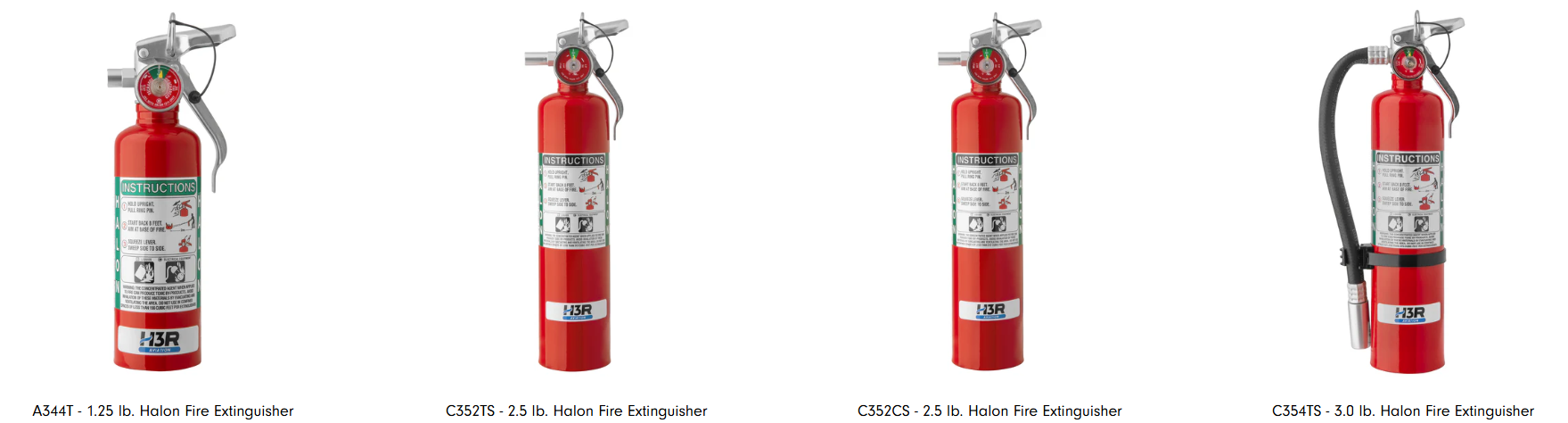
Portable fire extinguishers containing recycled halon 1211 have continued to be manufactured and sold ever since. In aviation, where the requirements for fire protection are unusually demanding, halon has remained the standard for portable extinguishers.
But somewhere along the way, “production banned” became “halon banned”—and the misunderstanding stuck.
Why Aviation Still Uses Halon
Aircraft fires are not like the fires you might encounter in a garage or kitchen.
Inside an aircraft, you’re dealing with a mix of risks: electrical fires behind instrument panels, flammable liquids, upholstery materials, and confined spaces where smoke and chemicals quickly become a problem.
Any extinguisher used in that environment needs to meet some strict criteria.
It has to be:
- effective on multiple fire types
- safe around electrical equipment
- clean (no residue that could damage avionics)
- compact enough to fit in a small cockpit or cabin
- light enough that it doesn’t add unnecessary weight.
Halon 1211 checks all those boxes.
It works by interrupting the chemical chain reaction that sustains combustion. Because it’s so efficient at doing that, relatively small amounts of the chemical agent can extinguish a fire quickly.

That efficiency is the reason halon extinguishers can deliver strong fire ratings while remaining smaller and lighter than most alternatives.
In aviation, where every pound matters, that advantage is significant.
The Patchwork of Global Rules
Part of the confusion surrounding halon comes from regional differences in regulations.
In the United States, halon extinguishers remain widely used and fully legal in aviation applications.
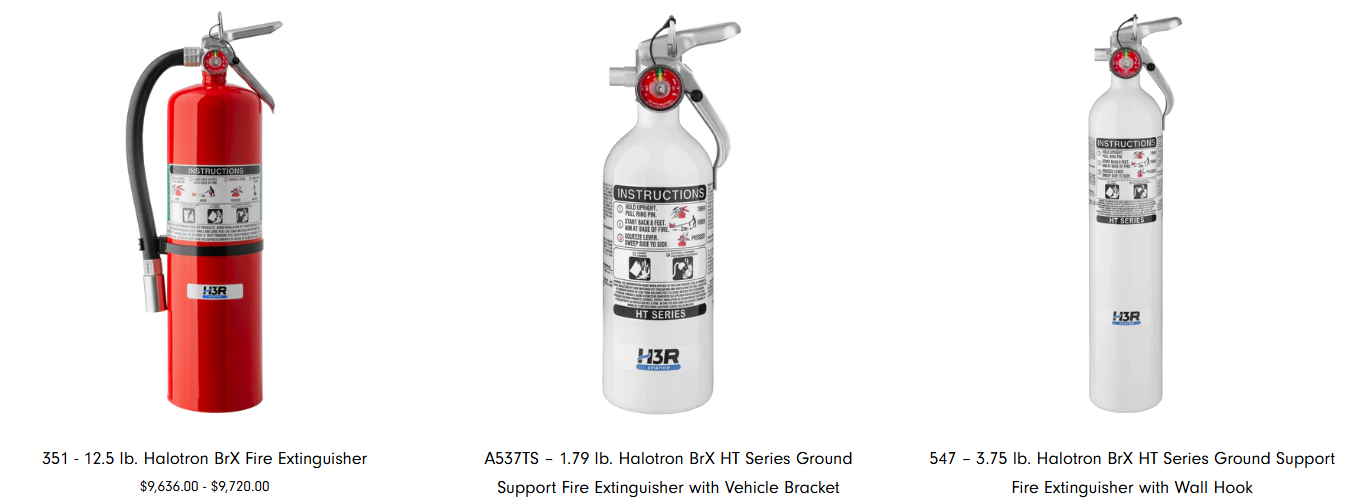
But some regions, notably the European Union and the United Kingdom, have banned the use of halon 1211. Instead, they suggest 2-BTP, marketed as Halotron BrX, as the approved replacement.
These regional rules have helped reinforce the perception that halon was banned everywhere.
It wasn’t.
Instead, the aviation industry today operates in a patchwork regulatory environment, where halon may still be widely used in one region but restricted in another.
Is the Supply Running Out?
Another common assumption is that halon must be disappearing since new production stopped decades ago.
The reality is more complicated.
When halon fire extinguishers are retired or replaced, the agent is usually recovered and recycled as required by law. That process has allowed halon to remain available long after manufacturing ended.
According to the United Nations Environment Program’s Fire Suppression Technical Options Committee, the global bank of Halon 1211 was estimated at roughly 20,000 metric tons in 2022.
Even by 2035, the committee projects that about 11,000 metric tons could still remain in circulation.

Analysis: How Spirit Airlines Changed Airline Pricing, then Paid the Price
That’s far more than earlier industry estimates suggested.
Industry recyclers say supply continues to meet demand without major price spikes.
The Alternatives And Their Tradeoffs
Several halon alternatives have been developed over the years, including agents marketed specifically as halon 1211 replacements.
But substitutes often involve compromises.
Because halon is extremely efficient at stopping combustion, many alternative agents require larger quantities of extinguishing agent to achieve the same fire rating.
That means bigger and heavier extinguishers.
In an office building or warehouse, that may not matter much. In a cockpit or small cabin, it can matter a lot.

Cost is another consideration. Some alternative extinguishers can cost several times more than halon units, depending on the specific agent and extinguisher size.
Those differences can influence purchasing decisions, especially in the general aviation market.
The Dry Chemical Problem
One unintended consequence of halon restrictions in some markets is the increased use of dry chemical extinguishers in aircraft.
That’s not ideal.
Dry chemical extinguishing powder is corrosive and can damage avionics and aircraft structures. Even worse, the discharge produces a dense cloud that can drastically reduce visibility in a confined cockpit.
In an aircraft emergency, obscuring the pilot’s vision may create as many problems as the fire itself.

For those reasons, aviation safety guidance has long cautioned against using dry chemical extinguishers inside aircraft whenever cleaner agents are available.
What Pilots Should Take Away
For aircraft owners and pilots trying to sort through the conflicting information about halon, the key points are fairly straightforward.
First, halon fire extinguishers were not banned worldwide. The 1994 Montreal Protocol stopped new production but allowed existing halon to remain in use through recycling.
Second, halon remains widely used in aviation because it offers excellent fire suppression performance in a compact, lightweight package.
Third, significant quantities of halon are still available through global recycling programs, and industry projections suggest supply should remain adequate for years.

How AI Quietly Became the Backbone of Today’s Aviation Industry
Finally, while alternative extinguishing agents exist—and may be required in certain regions—they often involve tradeoffs in size, weight, or cost.
A Persistent Aviation Tool
Few pieces of safety equipment in an aircraft are as simple as a portable fire extinguisher. Yet few have generated as much confusion as halon.
Three decades after production stopped, halon continues to occupy an unusual position in aviation: an older technology whose performance characteristics remain difficult to replace.
And despite what you may have heard around the hangar, it hasn’t gone away.
Virgin Atlantic Launches Nonstop Heathrow-Phuket Flights » FlyUSA Opens 50,000-Square-Foot Owner-Exclusive Hangar and Lounge at Tampa International Airport » Federal Grand Jury Indicts Passenger Duct-Taped to Seat on American Airlines Flight »

Comments (7)
 Highflyer1950
So I always thought that Halon displaces O2 via its chemical reaction and any person not on supplemental O2 would be at risk of asphyxiation. Empty hangars, engine nacelles, closed rooms, baggage compartments etc, would have excellent fire suppression. Although I believe most new hangars now have a foam fire retardant. IMO
John Stranger
The data center I worked in told us in the event the system went off and you could not make it to the doors “hold your breath and get out of the area”.
Stefan Sobol
Part of the idea was that halon could suppress a fire while still being safe for humans. However, that only works if the halon concentration in a space is correct. In some enclosed spaces, a higher than normal concentration of halon can disable humans.
I worked at one place that had halon extinguishers in areas that had large complements of electronic devices. In the event of a halon discharge, the spaces had to be manually checked for unconcious people in those areas.
Brian Maltby
Halon 1211 is also used in a number of other instances, such as in military applications, such as in submarines and other naval fleets. Also, Halon 1301, another halogenated hydro carbon that depletes the atmospheric ozone layer is still used in legacy military battle tanks.
Dave
I thought that halon was still being made in china?
James Whitaker
Wow and not a single mention of why the use of halon was banned, except in a few limited cases such as aviation. (For the Americans among you it is because Halon is a halogenated hydrocarbon and really, really bad for atmospheric pollution leading to damage to the ozone layer of the atmosphere.)
Chris Dieter
Protection of the ozone is very important. Outside of the EU, where recycled Halon 1211 use is still permitted to varying degrees, Halon 1211 remains a defensible environmental choice. No new Halon 1211 has been produced since 1994. What's in service is drawn from a fixed, shrinking recycled bank, not new manufacturing. It can't easily be destroyed either, doing so requires specialized high-temperature facilities, so the practical alternative to using it isn't "zero emissions," it's stockpiling an asset that eventually has to be dealt with anyway. Using it responsibly through reclaim and reuse is arguably better stewardship than letting it sit. Volume also matters: portable aviation extinguishers hold small charges and are very rarely discharged, which is part of why a recyclable bank still exists more than 30 years after production stopped. Halon 1211 is also meaningfully more weight-efficient than the alternatives, roughly 1.5 times as effective by weight (a 2.5 lb halon unit does the job of a 3.75 lb Halotron BrX unit), so aircraft carry lighter extinguishers and burn less fuel over their service life. Fires themselves also produce CO2, soot, and toxic combustion byproducts. The agent that suppresses fastest limits those emissions and, more importantly, saves lives. Nothing matches the effectiveness of Halon 1211.
Highflyer1950
So I always thought that Halon displaces O2 via its chemical reaction and any person not on supplemental O2 would be at risk of asphyxiation. Empty hangars, engine nacelles, closed rooms, baggage compartments etc, would have excellent fire suppression. Although I believe most new hangars now have a foam fire retardant. IMO
John Stranger
The data center I worked in told us in the event the system went off and you could not make it to the doors “hold your breath and get out of the area”.
Stefan Sobol
Part of the idea was that halon could suppress a fire while still being safe for humans. However, that only works if the halon concentration in a space is correct. In some enclosed spaces, a higher than normal concentration of halon can disable humans.
I worked at one place that had halon extinguishers in areas that had large complements of electronic devices. In the event of a halon discharge, the spaces had to be manually checked for unconcious people in those areas.
Brian Maltby
Halon 1211 is also used in a number of other instances, such as in military applications, such as in submarines and other naval fleets. Also, Halon 1301, another halogenated hydro carbon that depletes the atmospheric ozone layer is still used in legacy military battle tanks.
Dave
I thought that halon was still being made in china?
James Whitaker
Wow and not a single mention of why the use of halon was banned, except in a few limited cases such as aviation. (For the Americans among you it is because Halon is a halogenated hydrocarbon and really, really bad for atmospheric pollution leading to damage to the ozone layer of the atmosphere.)
Chris Dieter
Protection of the ozone is very important. Outside of the EU, where recycled Halon 1211 use is still permitted to varying degrees, Halon 1211 remains a defensible environmental choice. No new Halon 1211 has been produced since 1994. What's in service is drawn from a fixed, shrinking recycled bank, not new manufacturing. It can't easily be destroyed either, doing so requires specialized high-temperature facilities, so the practical alternative to using it isn't "zero emissions," it's stockpiling an asset that eventually has to be dealt with anyway. Using it responsibly through reclaim and reuse is arguably better stewardship than letting it sit. Volume also matters: portable aviation extinguishers hold small charges and are very rarely discharged, which is part of why a recyclable bank still exists more than 30 years after production stopped. Halon 1211 is also meaningfully more weight-efficient than the alternatives, roughly 1.5 times as effective by weight (a 2.5 lb halon unit does the job of a 3.75 lb Halotron BrX unit), so aircraft carry lighter extinguishers and burn less fuel over their service life. Fires themselves also produce CO2, soot, and toxic combustion byproducts. The agent that suppresses fastest limits those emissions and, more importantly, saves lives. Nothing matches the effectiveness of Halon 1211.
Add Your Comment
TAGS
NEWS Halon Fire Suppression H3R Aviation Fire Extinguishers Fire Safety FarnboroughRECENTLY PUBLISHED
 The End of Lufthansa's Four-Engine Era as Its Last Airbus A340-600 Lands in Frankfurt for the Final Time After 23 Years
Porter Airlines expands its international network from London, Ontario, deploying the Embraer E195-E2 on new routes for Canadian travelers.
NEWS
READ MORE »
The End of Lufthansa's Four-Engine Era as Its Last Airbus A340-600 Lands in Frankfurt for the Final Time After 23 Years
Porter Airlines expands its international network from London, Ontario, deploying the Embraer E195-E2 on new routes for Canadian travelers.
NEWS
READ MORE »
 Rolls-Royce Launches Serial Production of Pearl 10X Engine for Dassault's Falcon 10X
Rolls-Royce begins serial production of its Pearl 10X engine, powering Dassault's upcoming Falcon 10X ultra-long-range business jet.
NEWS
READ MORE »
Rolls-Royce Launches Serial Production of Pearl 10X Engine for Dassault's Falcon 10X
Rolls-Royce begins serial production of its Pearl 10X engine, powering Dassault's upcoming Falcon 10X ultra-long-range business jet.
NEWS
READ MORE »
 Austrian Airlines Flight Diverts to Sofia Under Fighter Escort After Bomb Threat
An Austrian Airlines flight from Tel Aviv to Vienna made an emergency landing in Sofia, Bulgaria, on Sunday, October 18, after a bomb threat against the aircraft.
NEWS
READ MORE »
Austrian Airlines Flight Diverts to Sofia Under Fighter Escort After Bomb Threat
An Austrian Airlines flight from Tel Aviv to Vienna made an emergency landing in Sofia, Bulgaria, on Sunday, October 18, after a bomb threat against the aircraft.
NEWS
READ MORE »
More than just headlines.
Get unlimited ad-free access to in-depth aviation news, premium stories, and exclusive insights other sites don't cover.
- Ad-free browsing on AeroXplorer
- Unlimited access to premium and exclusive articles
- Higher photo upload limits & commissions on sales
- Free access to Jetstream Magazine on higher tiers
- Ad-free browsing
- Sell aviation photos with 60% commission
- First week free!
- Everything in Basic+
- Unlimited premium articles
- Sell aviation photos with 70% commission
- Free Digital subscription to Jetstream Magazine
- First week free!
- Everything in Basic+ and Pro
- Sell aviaiton photos with 80% commission
- Early access to exclusive stories
- Free Digital+Print subscription to Jetstream Magazine