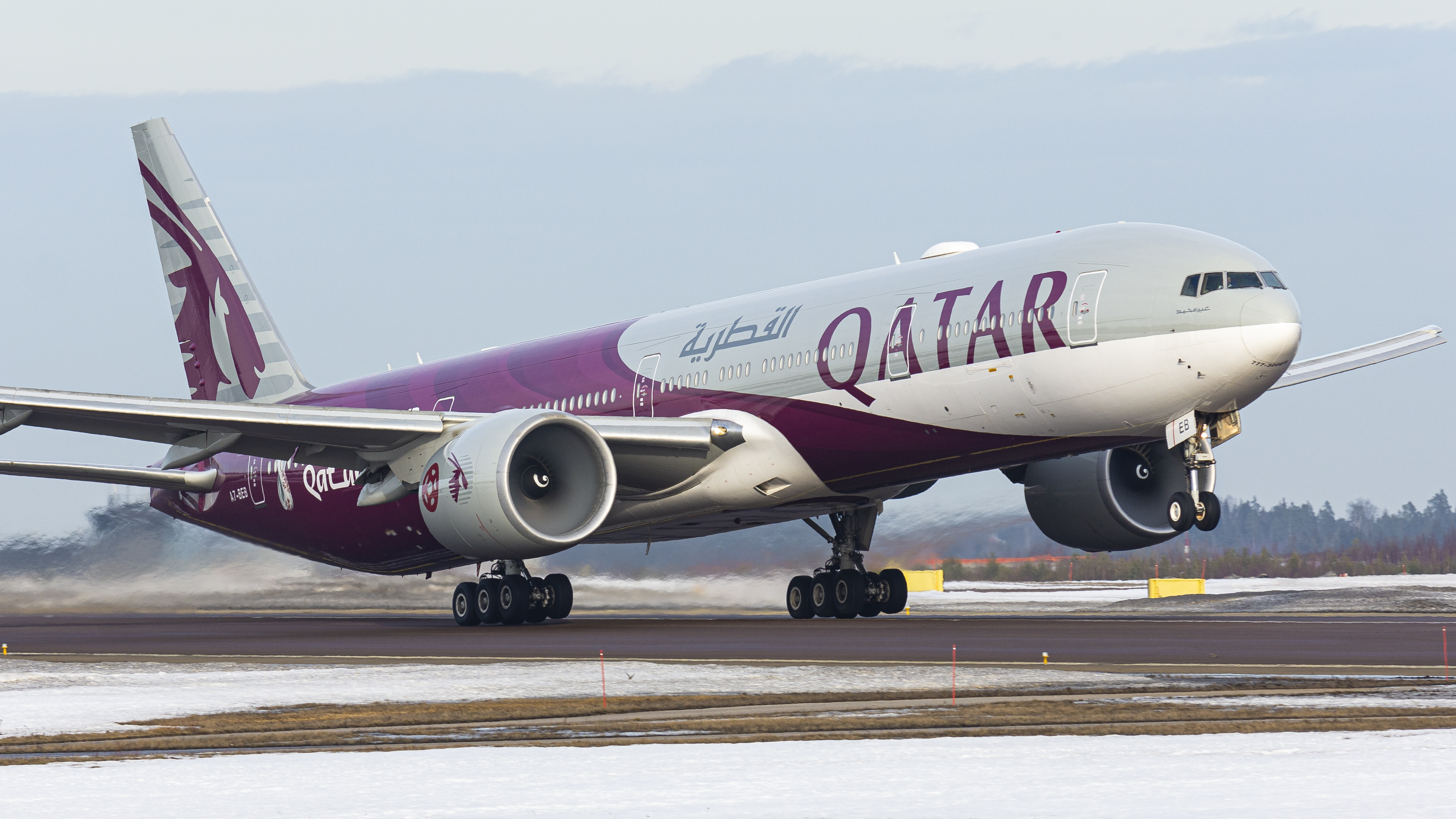

Qatar Airways has confirmed that it will cease flying to Philadelphia. The action comes as partner American Airlines moved its Doha flight from New York to Philadelphia. In response, the airline increased its New York frequency to thrice daily.

It is unclear precisely when Qatar's flag carrier will end its Philadelphia service. Flights are available until October 29th, the last day of the summer season. However, AeroRoutes states that the service will end on the 27th. Regardless, it appears that American Airlines will take over on October 30th as part of its winter schedule transition.
Having served the Pennsylvania hub since April 2014, Qatar Airways presently uses the Boeing 777-300ER on the 6,797-mile route. Operating daily, the planned winter schedule was to be as follows, with all times local:
| Flight No. | Dep. Airport | Dep. Time | Arr. Airport | Arr. Time | Flight Time |
| QR727 | DOH | 7:55 a.m. | PHL | 2:55 p.m. | 15h 0m |
| QR728 | PHL | 8:35 p.m. | DOH | 4:55 p.m. (+1) | 12h 20m |
The Journey’s End … Or Is It?

Of course, Philadelphia will remain a part of Qatar Airways' network, now as a codeshare flight operated by American. As such, the schedule is generally similar to ensure two-way connectivity to other flights at the Doha and Philadelphia hubs.
Using the lower-capacity Boeing 787-9 — which will help improve winter fares, loads, and performance — AA120 will depart Philadelphia at 20:55 and arrive at 17:30 the next day (12h 35m block). After staying overnight in the Middle East, AA121 will depart at 08:55 and return at 15:25 (14h 30m).
Route Performance History
According to US DOT T-100 data, Qatar Airways carried approximately 91,000 Philadelphia passengers between January and May 2023, with an average seat load factor of 85%. It was a time when the 777-300ER, A350-900, and A350-1000 were all used to varying degrees. While only one portion of its performance, SLF rose to over 91% in May.

Predictably, the point-to-point fraction of demand — passengers who did not connect in Philadelphia and Doha — was minuscule. Booking data suggests that there were barely 4,000 roundtrip passengers: 27 daily.
Some five percent of passengers began in Doha and connected to American Airlines flights in Philadelphia, while 29% transited in both Doha and Philadelphia. More passengers flew the Amritsar-Doha-Philadelphia-Toronto route than anywhere else.
The remaining 62% of passengers transferred flights in Doha, mainly to India, Pakistan, Saudi Arabia, Thailand, and the United Arab Emirates. Given the changes in Philadelphia, Doha is expected to have 113 departing passenger flights to the United States each week this winter (about 226 roundtrips) with 12 destinations served non-stop.
Southwest Airlines Considers Boeing 787 Order for Long-Haul International Expansion » NetJets Expands US Footprint With Three New Private Terminals and Larger Palm Beach Facility » Delta Passenger Arrested After Allegedly Stealing Airport Tug »

Comments (0)
Add Your Comment
TAGS
ROUTES Qatar Qatar Airways Doha Philadelphia American American Airlines OneWorld Partner Airlines Routes New YorkRECENTLY PUBLISHED
 What the September NATS outage teaches passengers about flight compensation
What does the NATS outage mean for flight compensation? Learn when UK passengers can claim and their rights to refunds, meals and accommodation.
INFORMATIONAL
READ MORE »
What the September NATS outage teaches passengers about flight compensation
What does the NATS outage mean for flight compensation? Learn when UK passengers can claim and their rights to refunds, meals and accommodation.
INFORMATIONAL
READ MORE »
 NetJets Expands US Footprint With Three New Private Terminals and Larger Palm Beach Facility
NetJets announces exclusive-use terminals in Dallas, Washington, and Palm Beach, expanding private aviation infrastructure across key US markets.
NEWS
READ MORE »
NetJets Expands US Footprint With Three New Private Terminals and Larger Palm Beach Facility
NetJets announces exclusive-use terminals in Dallas, Washington, and Palm Beach, expanding private aviation infrastructure across key US markets.
NEWS
READ MORE »
 Army Report Points to Systemic Failures in Deadly Black Hawk Collision Near Reagan National
A new Army report identifies systemic failures behind the January collision between a UH-60L Black Hawk and American Airlines Flight 5342 near Washington.
NEWS
READ MORE »
Army Report Points to Systemic Failures in Deadly Black Hawk Collision Near Reagan National
A new Army report identifies systemic failures behind the January collision between a UH-60L Black Hawk and American Airlines Flight 5342 near Washington.
NEWS
READ MORE »
More than just headlines.
Get unlimited ad-free access to in-depth aviation news, premium stories, and exclusive insights other sites don't cover.
- Ad-free browsing on AeroXplorer
- Unlimited access to premium and exclusive articles
- Higher photo upload limits & commissions on sales
- Free access to Jetstream Magazine on higher tiers
- Ad-free browsing
- Sell aviation photos with 60% commission
- First week free!
- Everything in Basic+
- Unlimited premium articles
- Sell aviation photos with 70% commission
- Free Digital subscription to Jetstream Magazine
- First week free!
- Everything in Basic+ and Pro
- Sell aviaiton photos with 80% commission
- Early access to exclusive stories
- Free Digital+Print subscription to Jetstream Magazine