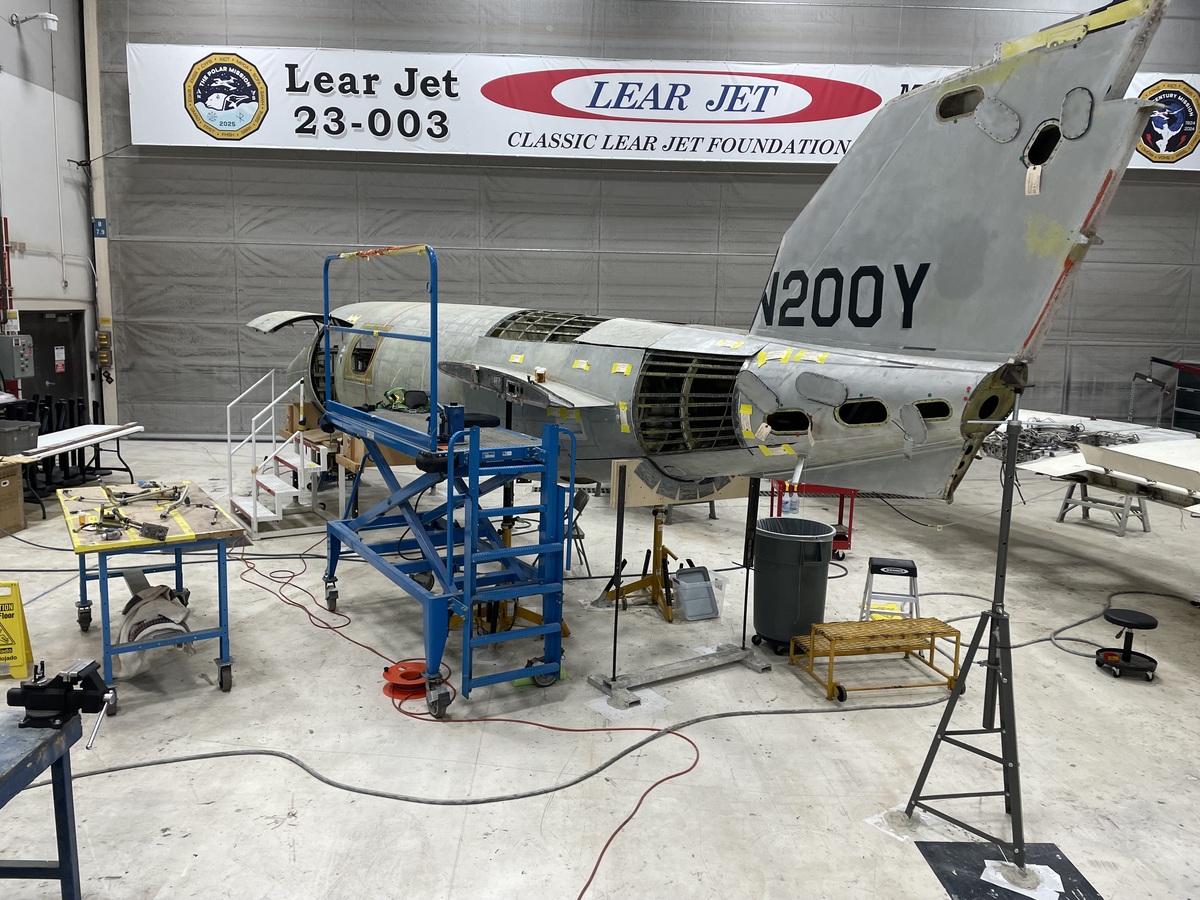
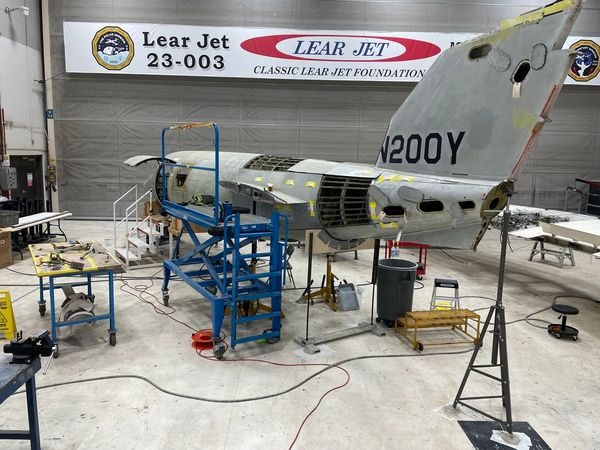
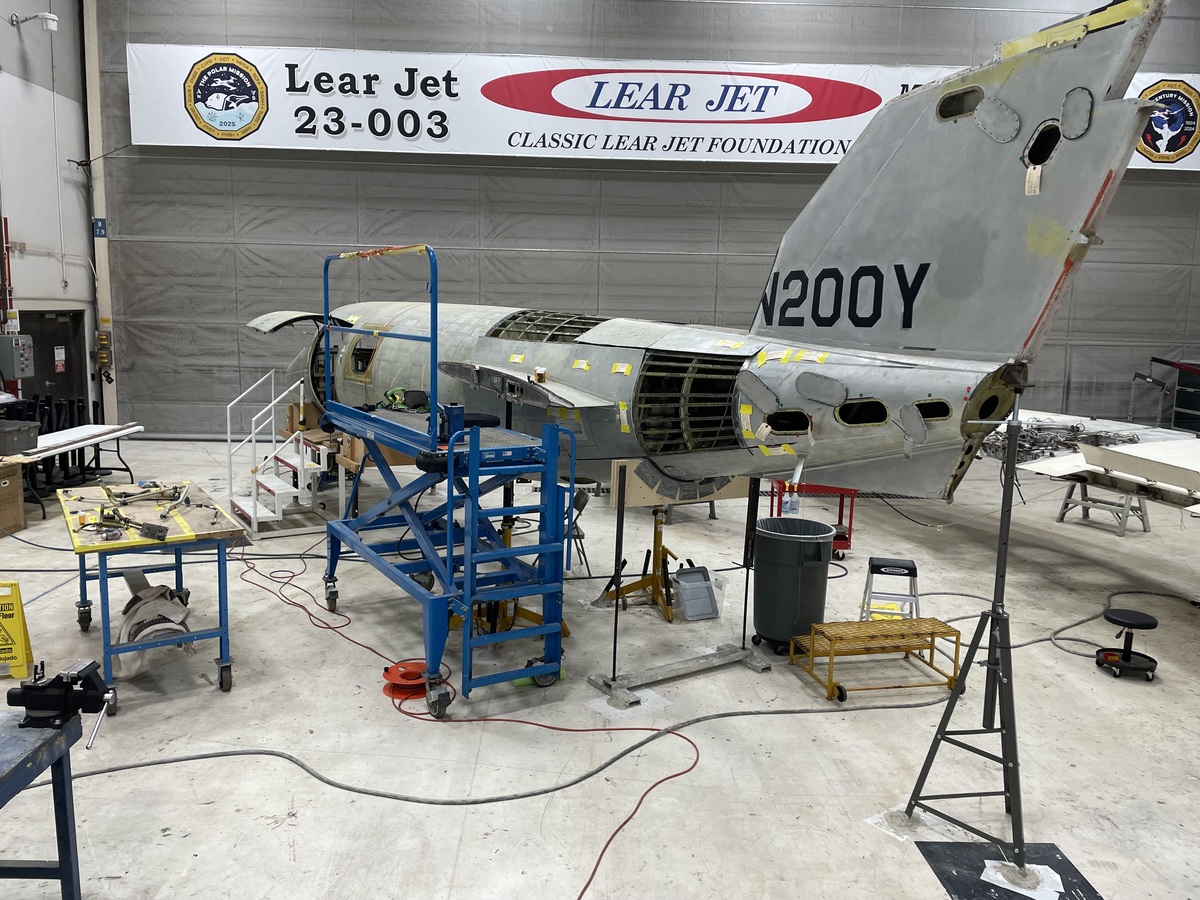
In a hangar in Wichita, Kansas, a bare aluminum fuselage sits on jacks, stripped down to little more than its skeleton. To those who have had the chance to see the aircraft in between work sessions, it might look like junk.
But to the volunteers, the “skeleton” feels closer to a relic, one that they’ve spent thousands of hours trying to bring back to the sky.
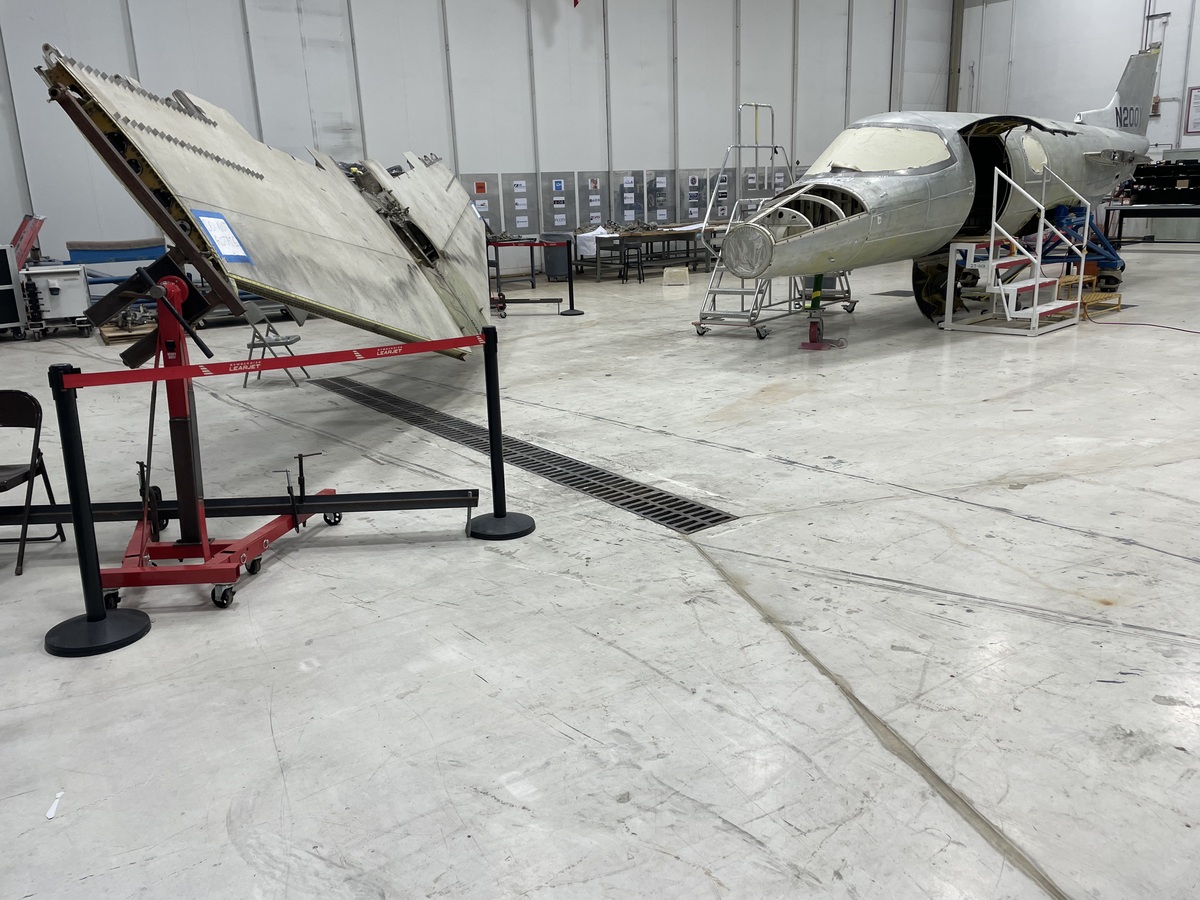
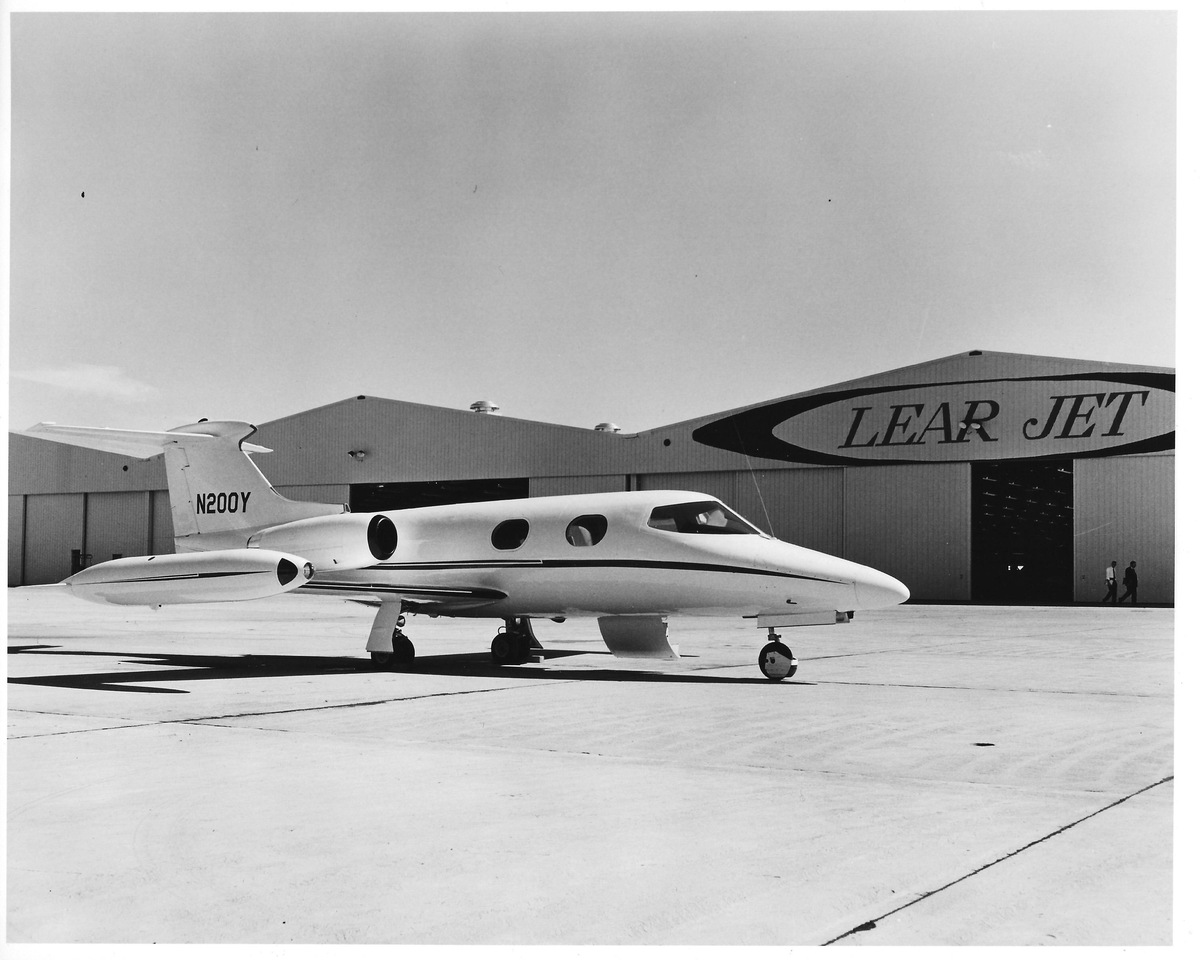
The airplane is Lear Jet 23-003, the first purpose-built business jet ever assembled. The people working on it are part of the Classic Lear Jet Foundation (CLJF), a Wichita-based 501(c)(3) non-profit with a single, ambitious mission: to make this 62-year-old aircraft airworthy again.

Only Way Out: Private Aviation in a Region at War
A Phone Call
In early 2022, a retired Lear Jet engineer got a call out of the blue asking whether he’d be interested in buying a Lear Jet. That aircraft was 23-003, then sitting in Bartow, Florida. He looped in a handful of other Lear Jet veterans, and together they decided the aircraft was worth saving.
Chris Marshall, a Board Member at the Foundation, recounted his experience from that day: “We applied the voltage to the power plug and went in, and the avionics woke up – it was just like it had maybe been parked the day before. We got in the cockpit, and all the electronics came on, and it was acting like it was ready to go.”
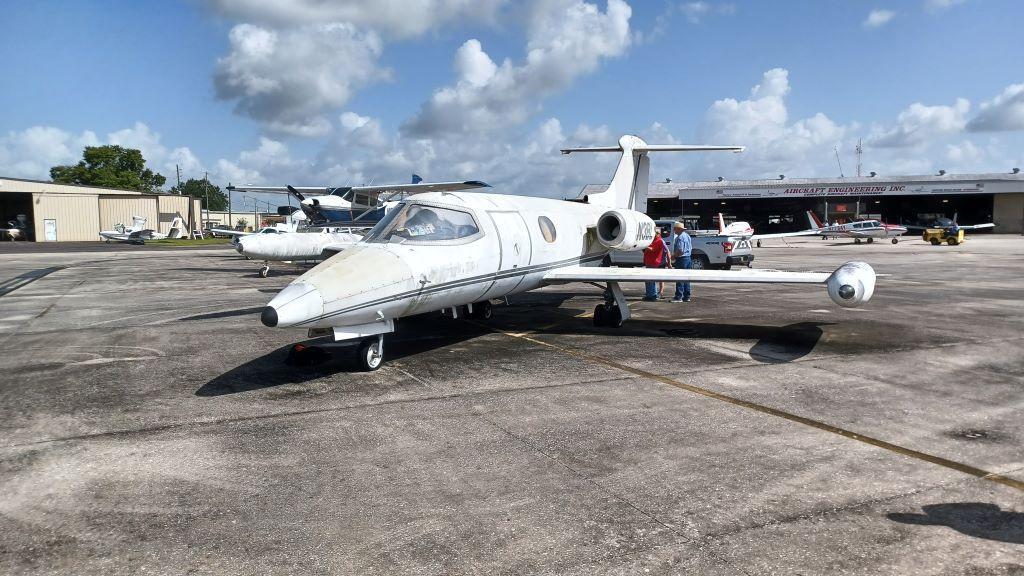
By early 2023, a crew had disassembled the jet and loaded it on a flatbed to be driven back to Wichita, the city where it was originally built.
The organization itself was incorporated that September, but the real work didn’t begin until the fall of 2024, once a long-term hosting agreement was finally in place. Since then, volunteers have stripped the paint, gutted the interior, cleared out decades-old spray foam insulation, and run X-ray and other non-destructive inspections to see exactly what they are working with.
The tally so far? 2,747 man-hours and counting, on an airplane that is, for now, still but a shell.
A Growing List of Partners
Working to restore a jet from this time means chasing down components that haven’t been manufactured in decades. The Foundation has leaned on a network of partners to make this possible.
International Turbine Industries in Michigan is overhauling the engines. Dodson International Parts – visited by Foundation leadership in Rantoul, Kansas, this past June – is supplying spare parts, including a donor fuselage and wing. Embry-Riddle Aeronautical University signed a formal agreement in May 2026 to rebuild the landing gear. And hydraulic actuators from that same system were recently handed off to Noble Jet for testing.
The Shape of Disaster: The Plane That Kept Falling Apart Mid-Air
One of CLJF’s board members, Larry Thimmesch, is a Wichita native with a resume spanning Boeing, Lear Jet, Bell Helicopter, and GE Aviation’s work on China’s COMAC C919. He also serves as an executive at Incora, a supply chain firm that keeps the volunteers stocked with wiring, fasteners, and switches.
Why So Much Devotion?
The obsession makes more sense once you understand what 23-003 represents. Bill Lear, who never finished high school but held more than 150 patents and won the Collier Trophy, built and certified the original Lear Jet Model 23 largely with his own money, effectively inventing the business jet category in the process.
“The Learjet was a phenomenon in the market for the first several years,” said Rick Rowe, At-Large Board Member and PR Director at CLJF. “The next manufacturer in Wichita that responded with any kind of a similar product was Cessna, and it was eight years later. So for those first eight years, the Learjet was the market phenomenon.”
The tail number that once graced 23-003, N200Y, later ended up on a different Lear Jet, the one Arnold Palmer flew around the world in 1976 to mark America’s Bicentennial. Both aircraft, it turns out, were bought new by the same Cincinnati collector, a coincidence that ties 23-003 directly into one of Lear Jet’s most famous publicity stunts.
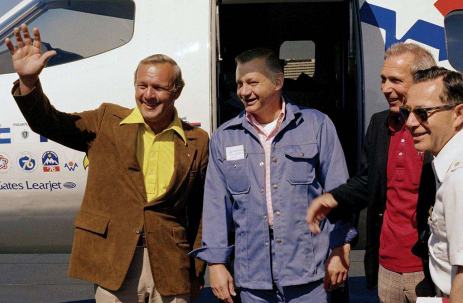
Now, decades later, that same registration has found its way back to 23-003, which is being restored to wear the N200Y markings once again.
A Living History
For CLJF’s volunteers, the restoration has a deeper meaning beyond the metal. Many of the people donating their time spent entire careers working for Lear Jet, and the Foundation sees the project as a way of making sure that work isn’t forgotten.
Marshall put it plainly: “Those folks who spent careers of 35-40 years working for Lear Jet don’t want their work and contributions to the aviation world to be forgotten. So we’re remembering that, and we’re remembering those lessons to honor the people who worked so hard to make the company as important as it was.”
The Foundation frames the restoration as a tribute to that workforce first, and to the airplane second. Bringing 23-003 back to the air is a way of honoring the people who built Wichita into a business jet manufacturing hub, and of using Bill Lear’s own story as a case study in entrepreneurship for the next generation of aeronautical engineers.
Looking Ahead
None of this happens without volunteers, and the Foundation is candid about what it still needs: certified A&P mechanics to sign off on maintenance, a project manager to help steer the restoration, and help tracking down old service bulletins and modification kits.
Volunteers come from every corner of the aviation world; some are retired Lear Jet employees, while others have never worked in the industry at all.

The Cockpit’s Next Revolution: When the Co-Pilot Is a Computer
Funding comes from donations, memberships, and a recently relaunched online store, with all profits from merchandise sales going directly toward the restoration. For an organization built around a single airplane, the ambitions are notably public-facing: school visits, museum partnerships, and steady updates meant to keep the community invested in watching 23-003 fly again.
Whether that happens in a few years or in the next decade, the Foundation’s volunteers seem unbothered by the timeline. As said by Rowe, “When 23-003 takes off for its second first flight, it will be a message to the rest of the world that things can come back to life.”
For those attending the Farnborough Airshow this week, you can learn more about the Classic Lear Jet Foundation at Stand #4605 or by visiting https://www.classiclear.org/.
Lufthansa Wins Bid for 44.9% Stake in TAP Air Portugal, Edging Out Air France-KLM » Qantas Grounds Plane After Passengers Report Bedbug Bites on Flight » Rolls-Royce Launches Serial Production of Pearl 10X Engine for Dassault's Falcon 10X »

Comments (4)
 Richard
James, I am the Learjet historian and show that the only Lear Jet to be assigned N3BL was 23-003, the 3rd built and the very first Lear Jet delivered to a customer. The very same Lear Jet that we are restoring to flight status.
James Ellsworth
Richard; Do you have any owners history of 3BL. National Jets out of Ft.Lauderda.e had the aircraft around 1980 but may not have owned it; could have been leased I guess. Jim
James Ellsworth
It's been a while ago so my memory ain't what it used to be but in 1980 I worked for Bob Graf in Ft Lauderdale as a copilot and mechanic on the Learjets he owned. National Jets just down the street had an old Lear, #3BL. I was told that was the #3 Lear but that seems wrong now. Looking at the pics reminds me of the many demates I participated in at Graf Jets. I believe Mr Graf and Donald Dunkin were the first two salesmen for Learjet and the stories Mr Graf told of flying single pilot around the Midwest to sell these new aircraft were enlightening.
Phil
This warms my heart. Almost 50 years ago I logged about 700 hours flying freight in Lear 23's, S/N's: -026, -037 and -097. I didn't make much money, but those planes sure taught me how to fly a jet!
Richard
James, I am the Learjet historian and show that the only Lear Jet to be assigned N3BL was 23-003, the 3rd built and the very first Lear Jet delivered to a customer. The very same Lear Jet that we are restoring to flight status.
James Ellsworth
Richard; Do you have any owners history of 3BL. National Jets out of Ft.Lauderda.e had the aircraft around 1980 but may not have owned it; could have been leased I guess. Jim
James Ellsworth
It's been a while ago so my memory ain't what it used to be but in 1980 I worked for Bob Graf in Ft Lauderdale as a copilot and mechanic on the Learjets he owned. National Jets just down the street had an old Lear, #3BL. I was told that was the #3 Lear but that seems wrong now. Looking at the pics reminds me of the many demates I participated in at Graf Jets. I believe Mr Graf and Donald Dunkin were the first two salesmen for Learjet and the stories Mr Graf told of flying single pilot around the Midwest to sell these new aircraft were enlightening.
Phil
This warms my heart. Almost 50 years ago I logged about 700 hours flying freight in Lear 23's, S/N's: -026, -037 and -097. I didn't make much money, but those planes sure taught me how to fly a jet!
Add Your Comment
TAGS
STORIES Wichita Lear Jet Learjet 23-003 Aviation History Aircraft Restoration History Restoration Maintenance MRORECENTLY PUBLISHED
 Phillips 66 Aviation Donates $23,928 to CAN in Support of Cancer Patient Flights
Phillips 66 Aviation presented a $23,928 check to Corporate Angel Network at NBAA-BACE 2026, supporting free flights for cancer patients on corporate aircraft.
NEWS
READ MORE »
Phillips 66 Aviation Donates $23,928 to CAN in Support of Cancer Patient Flights
Phillips 66 Aviation presented a $23,928 check to Corporate Angel Network at NBAA-BACE 2026, supporting free flights for cancer patients on corporate aircraft.
NEWS
READ MORE »
 Aegis Air Bets on By-the-Seat Private Jet Flights From Miami to Caracas
A new US start-up is testing whether Caracas can support its own private jet shuttle. Aegis Air, a virtual carrier founded this year, is due to start by-the-seat flights between Miami and the Venezuelan capital today, 20 October, aboard a 16-seat Embraer E135.
NEWS
READ MORE »
Aegis Air Bets on By-the-Seat Private Jet Flights From Miami to Caracas
A new US start-up is testing whether Caracas can support its own private jet shuttle. Aegis Air, a virtual carrier founded this year, is due to start by-the-seat flights between Miami and the Venezuelan capital today, 20 October, aboard a 16-seat Embraer E135.
NEWS
READ MORE »
 Ambulances Meet Eurowings Jet From Rhodes After Passengers Feel Unwell in Flight
A Eurowings Airbus landed in Düsseldorf on Sunday evening, October 18, to a large emergency response, after several people on board suddenly became unwell on the way from Rhodes.
NEWS
READ MORE »
Ambulances Meet Eurowings Jet From Rhodes After Passengers Feel Unwell in Flight
A Eurowings Airbus landed in Düsseldorf on Sunday evening, October 18, to a large emergency response, after several people on board suddenly became unwell on the way from Rhodes.
NEWS
READ MORE »
More than just headlines.
Get unlimited ad-free access to in-depth aviation news, premium stories, and exclusive insights other sites don't cover.
- Ad-free browsing on AeroXplorer
- Unlimited access to premium and exclusive articles
- Higher photo upload limits & commissions on sales
- Free access to Jetstream Magazine on higher tiers
- Ad-free browsing
- Sell aviation photos with 60% commission
- First week free!
- Everything in Basic+
- Unlimited premium articles
- Sell aviation photos with 70% commission
- Free Digital subscription to Jetstream Magazine
- First week free!
- Everything in Basic+ and Pro
- Sell aviaiton photos with 80% commission
- Early access to exclusive stories
- Free Digital+Print subscription to Jetstream Magazine