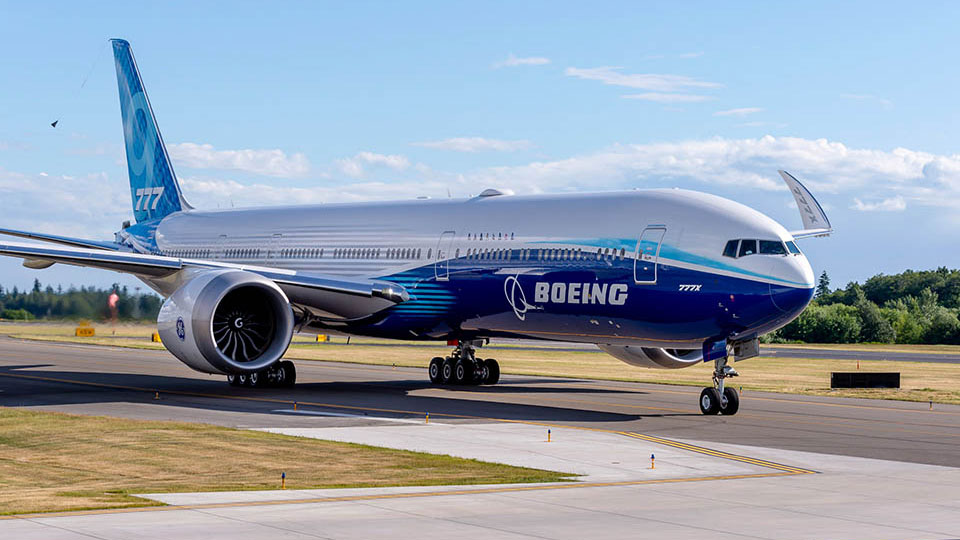
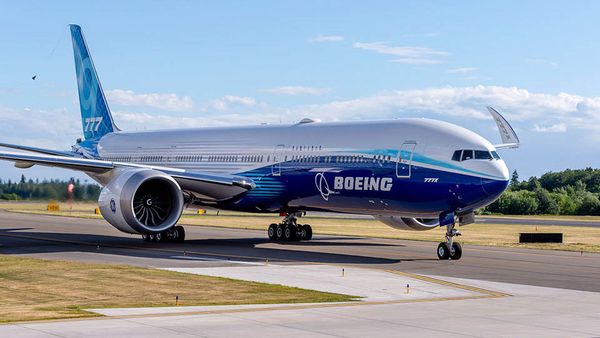
Thirteen years ago, at the 2013 Dubai Airshow, Boeing launched the 777X with a target entry-into-service date of 2020. This week, at the largest Farnborough International Airshow in the event's 78-year history, the aircraft is still not certified, but for the first time in years, the mood around the program has shifted from anxious to genuinely optimistic. The 777-9 test fleet has now logged more than 4,800 flight hours across roughly 1,700 flights, clearing roughly half of its planned certification testing. Regulators are working through the back half of a five-phase authorization process. And Boeing, rather than simply hoping to get the aircraft across the finish line, is already talking publicly about pushing its capabilities well beyond what was promised at launch.
That last part is the story making headlines out of London this week. Boeing Commercial Airplanes chief executive Stephanie Pope told reporters ahead of the show that the company intends to extend the 777X family's range even further, through a combination of maximum take-off weight adjustments and additional thrust from the General Electric GE9X engines that power the jet. It's a remarkable admission for a program still working to get its first variant certified, and it isn't happening in isolation. AeroXplorer reported earlier this month that Boeing had already quietly revised the advertised range figures on its own website, lifting the 777-9's published range from 7,285 nautical miles to 8,000, with the 777-8's climbing even further, from 8,745 to 9,500 nautical miles. No press release accompanied either change.
Put simply: the 777X hasn't entered service yet, and Boeing is already trying to make it better.
The Family, By the Numbers
| Variant | Role | Range (Boeing, July 2026) | Program Status | Launch Customer |
|---|---|---|---|---|
| 777-9 | Passenger | Up to 8,000 nm | ~50% of certification flight testing complete; first delivery targeted early 2027 | Lufthansa (20 firm) |
| 777-8 | Passenger | Up to 9,500 nm | Certification follows the 777-9 | Not yet designated |
| 777-8 Freighter | Cargo | Up to 5,000 nm | Certification expected roughly two years after the 777-9; service entry targeted early 2029 | Qatar Airways (34 firm, 16 options) |
The family now carries more than 650 firm orders, with Emirates alone accounting for roughly 270 of them, nearly half of all 777X passenger commitments and a scale of exposure that, as this week's news out of the show demonstrates, cuts both ways.
Three Airplanes, One Platform
At a product briefing held on the show floor, a Boeing representative walked reporters through how the family's three members relate to one another and to the aircraft they're replacing, the 777-300ER and the current-generation "metal wing" 777 Freighter. The comparisons are the clearest way to understand what Boeing is actually selling.
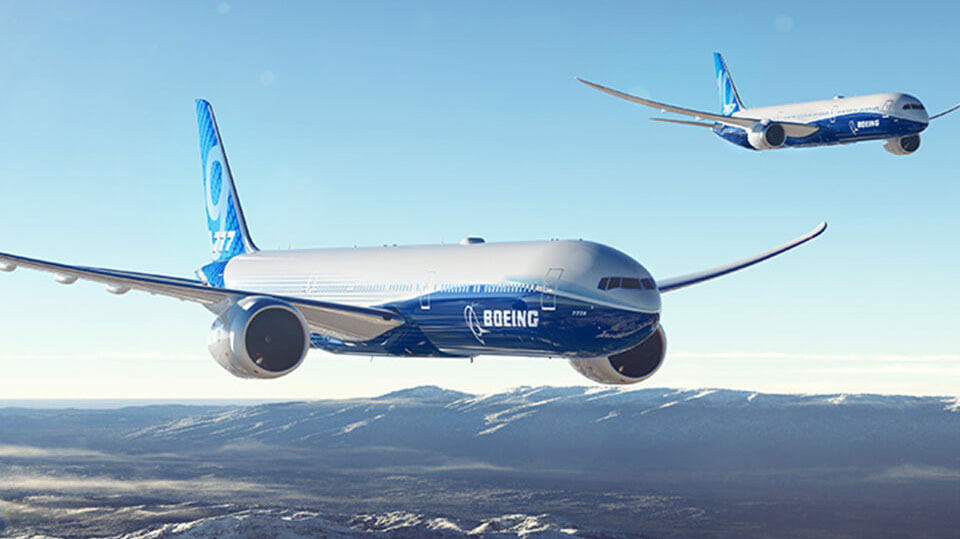
The 777-9, the flagship and by far the most popular variant of the three, is about three meters longer than the 777-300ER and carries roughly 30 more passengers in a typical two-class layout (about three additional rows in a 10-abreast configuration) while matching or slightly beating its predecessor's range. The 777-8 takes the opposite approach: three meters shorter than the 777-300ER, but through a smarter door arrangement it carries the same passenger count in a smaller airframe, with dramatically more range on top. And the 777-8 Freighter shares its airframe entirely with the 777-8 passenger jet (the two are structurally identical, one built for cargo and one for people) while stretching seven meters longer than today's 777 Freighter, adding roughly seven more pallet positions and, according to the briefing, around 11 tons of extra payload capacity.
The strategic logic behind that spread is straightforward. Airlines classify large widebodies as anything above 330 seats, a category now dominated by the 777X and the Airbus A350-1000. Around 1,000 777-300ERs remain in service, most delivered from the mid-2000s onward and now approaching the point where operators must decide whether to replace or retire them. For carriers that don't need additional capacity, the 777-8 is a like-for-like replacement; for those that do, the 777-9 offers roughly 50 more seats than the A350-1000 at a similar mission profile. Boeing is betting on both ends of that replacement cycle simultaneously.
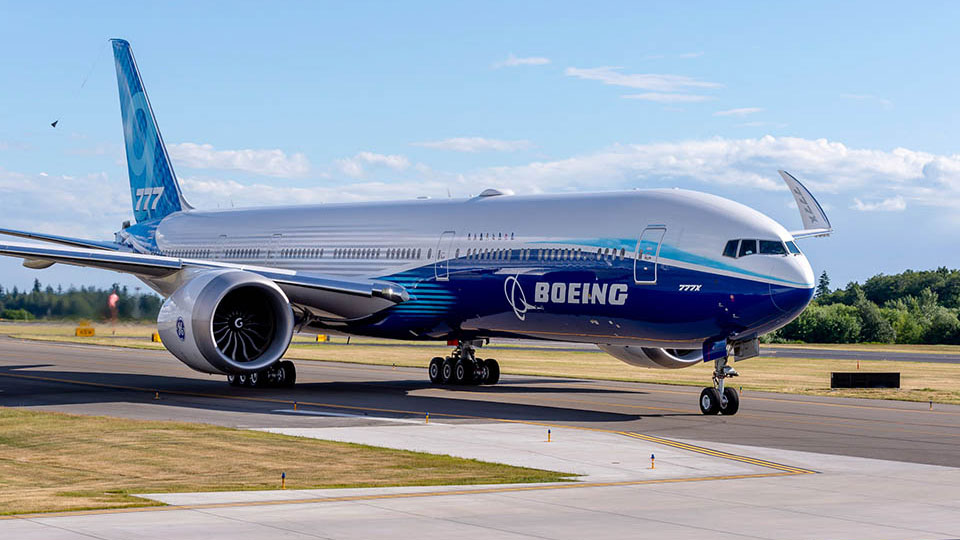
Photo: Boeing
The Engine Doing the Heavy Lifting
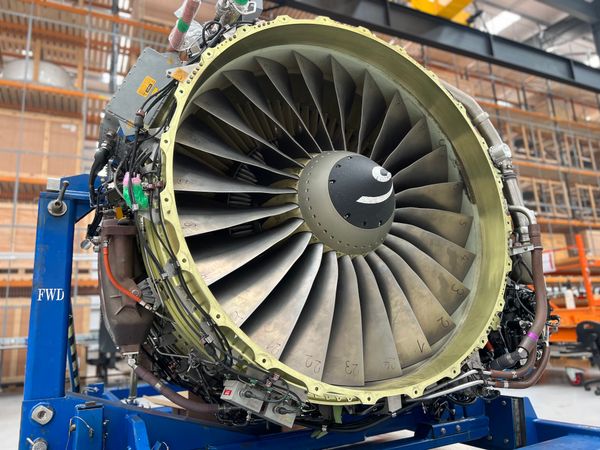
Much of the 777X's efficiency case rests on a single component: the GE9X, the largest and most powerful jet engine ever built for a commercial aircraft. Its fan spans 134 inches: nearly 3.4 meters, wider than the fuselage of a Boeing 737, up from the 128-inch fan on the GE90-115B that powers today's 777-300ER. Ceramic matrix composites allow the GE9X to run at higher internal temperatures than its predecessor without added weight, and GE Aerospace says the engine delivers roughly a 10% improvement in specific fuel consumption as a result.
What makes the GE9X's role unusual is that it doesn't chase raw thrust the way its predecessor did. The current 777-300ER's GE90-115B is certified up to roughly 115,300 pounds of thrust; the GE9X, despite powering a larger airplane, currently operates the 777-9 at around 105,000 pounds. That's possible because the composite wing carrying the aircraft is doing more of the work aerodynamically; Boeing's presentation put the wing itself at roughly 7% more efficient than the outgoing 777-300ER wing, and about 5% more efficient than the wing on the rival A350-1000. Combined, the airframe and engine changes are pitched as cutting fuel use per seat by as much as 20% relative to today's 777, a figure broadly in line with independent industry estimates of the aircraft's per-seat efficiency gains.
That thrust headroom is exactly what's fueling this week's range story. GE has confirmed the GE9X has been run at up to 134,300 pounds of thrust in testing, nowhere near its current certified operating point. "Our intent is to increase the range of that airplane," Pope said, adding that the change would likely require "multiple technologies" working together rather than a single fix. She didn't commit to a timeline.
The wing itself carries its own piece of engineering theater. At 72 meters, the 777-9's span is wide enough that, left rigid, it would be incompatible with the gate infrastructure built for earlier 777s. Boeing's solution: a folding wingtip, unique among in-service commercial aircraft, lets the outer six feet of each wing fold upward automatically once the aircraft slows below go-around speed on landing. By the time it reaches the gate, the jet is operating within the same ICAO Code E footprint as the 777s already flying today, while retaining Code F wingspan performance in the air.
The Cockpit’s Next Revolution: When the Co-Pilot Is a Computer
Inside the Cabin
Passengers, of course, will notice none of that. What they'll notice is a cabin four inches wider than today's 777, achieved by thinning the sidewalls rather than widening the fuselage, enough to preserve genuinely comfortable 10-abreast economy seating. Boeing offers two distinct ceiling treatments: a "V" architecture for economy class, where the ceiling slopes outward to create an illusion of greater width, and an "A" architecture for premium cabins, sloping inward toward a vaulted, more intimate feel. Windows are larger and mounted higher on the sidewall specifically so passengers can see the horizon, a design choice Boeing says measurably reduces jet lag, with a choice between electronic dimmable glass and traditional shades.
At Farnborough this week, Boeing skipped bringing a flying 777X demonstrator altogether, instead building its commercial pitch around a full-size cabin mock-up inside its exhibit pavilion, alongside a T-7 Red Hawk flight-deck simulator and static Chinook helicopters. It's a deliberate contrast to previous shows, when 777X test aircraft flew in the daily display. This year, chief executive Kelly Ortberg framed the company's presence around delivery discipline rather than spectacle, saying in a statement ahead of the show that "every day is an opportunity to continue building trust" with regulators and customers alike.
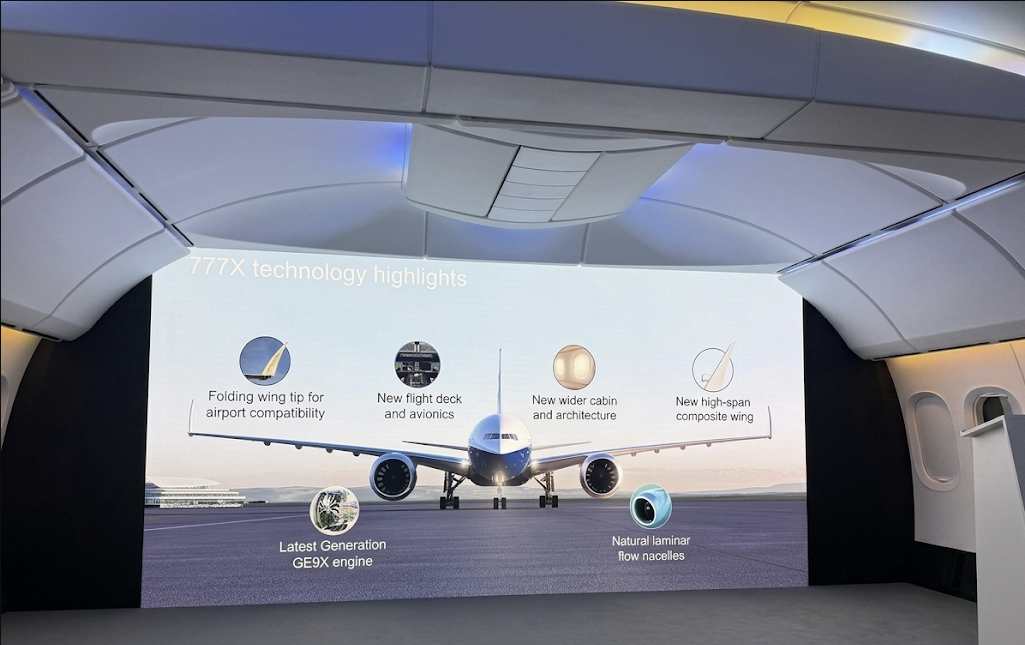
Photo: AeroXplorer/ Shashi
Growing Pains at the Finish Line
Not every conversation at the Boeing stand this week has been about the future. On the show's second day, Emirates president Sir Tim Clark told reporters his airline will not accept delivery of the earliest 777X airframes built for it, roughly 10 to 11 aircraft, some approaching eight years old, that would require extensive "change incorporation" work to bring up to current production standard. Boeing has already scrapped at least one such jet, the seventh 777-9 ever built, rather than absorb the cost of reworking it; the airframe spent roughly six years parked at Paine Field, its folding wingtips already painted in Emirates livery, before being disassembled in 2025. Asked what Boeing should do with the rejected jets instead, Clark didn't hold back: "Heinz would be interested, baked bean cans."
It's a colorful line, but it points to a real structural cost of the program's long delays: Boeing built roughly 40 airframes years ahead of a design that kept changing underneath them, and every one now needs some degree of rework before it can fly a paying passenger. Clark's frustration hasn't dulled Emirates' appetite for the jet overall; the airline remains the program's largest customer by a wide margin, but it's a reminder that "certified" and "ready to fly your specific airplane" are two different milestones.
Elsewhere on the certification side, GE Aerospace disclosed earlier this year that a durability issue had emerged with the GE9X's midseal, a component identified in January. The companies say a fix is already in motion. "We understand the issue, and we're working through the fix," GE Aerospace vice president of commercial engine systems engineering Carlos Perez said, adding that the company does not expect it to affect the 2027 service-entry target.
The Certification Homestretch
The technical path remaining is narrower than it's ever been, even if it isn't short. Boeing's Type Inspection Authorization process, the FAA framework governing certification flight testing, runs in five phases; the company cleared Phase 4B in June, unlocking testing of avionics, stability and control, and human-factors systems. What remains is Phase 5 and, critically, Extended-range Twin-engine Operational Performance Standards (ETOPS) certification, without which the 777-9 cannot fly the long oceanic and polar routes that are the entire point of buying one. Boeing expects its core flight-test campaign to wrap by the end of 2026, with ETOPS work spilling into 2027 as the final gating item. The precedent isn't small: when the 777-300ER earned its own ETOPS approval in 2003, it took 38 dedicated flights and 267 hours, including repeated deliberate shutdowns of one engine mid-flight to prove the aircraft could handle it.
The FAA, for its part, has said certification of the 777-9 will follow, not run parallel to, the agency's ongoing work on the 737 MAX 7 and MAX 10, both of which are further along. That queuing effectively pins 777X certification to early 2027 regardless of how quickly Boeing's own testing wraps. Lufthansa, the officially designated launch customer with 20 jets on firm order, is currently planning around a first-quarter 2027 delivery to begin replacing a 747-400 fleet that now averages 26 years old. Emirates, further back in the queue partly by its own choice, is targeting the second quarter of the same year.
The Order Book Keeps Growing
None of the turbulence has slowed sales. Boeing landed 135 net orders across its commercial lineup in April alone, pushing 2026's year-to-date total to its strongest January-through-April showing since 2014, with 777X demand cited as a meaningful contributor. Farnborough itself has added to the tally: MSC Air Cargo, the logistics group's all-Boeing freighter operator, signed for five 777-8 Freighters on the show's second day, following China Southern's order for five of the same type, plus two current-generation 777 Freighters, in late June. Qatar Airways, which committed to the 777-8F as launch customer back in 2022 with 34 firm orders and 16 options, has since grown its total 777X commitment to 94 aircraft.
That freighter momentum isn't purely about market appetite. A regulatory deadline is doing some of the work: current emissions standards mean freighters that don't meet updated requirements, including the legacy 777 Freighter, cannot be newly produced after December 31, 2027. The 777-8F is arriving just in time to fill that gap, assuming its own certification, pinned roughly two years behind the 777-9's, holds to schedule.
Looking Ahead
There's a version of this story where a program seven years behind its original schedule, still working through engine durability issues, and publicly fielding "baked bean cans" jokes from one of its largest customers would read as pure crisis coverage. That isn't quite where the 777X sits today. The aircraft has cleared more certification ground in the past twelve months than in the several years before it, the order book is growing rather than shrinking, and Boeing's own leadership is confident enough in where the program is headed to be talking publicly about extending its capabilities before the first jet has even reached an airline. Whether "early 2027" holds, a date that has already moved more than once, remains the one number every customer at this year's show is watching most closely. But for the first time in a long while, that date feels like the right question to be asking.
How Delivery Delays Are Reshaping Aviation Sourcing » GPS Jamming Is Now a Daily Airline Problem. Here Is How Bad It Has Gotten » FAA Nears Final Approval of Boeing 737 MAX 10 as Certification Review Concludes »

Comments (0)
Add Your Comment
TAGS
NEWS Boeing 777X 777-9 777-8 777-8 Freighter Farnborough Airshow 2026 GE9X FAA Certification Widebody Aircraft Emirates Lufthansa Qatar Airways Composite Wing Long-Haul Aviation Aircraft OrdersRECENTLY PUBLISHED
 How Delivery Delays Are Reshaping Aviation Sourcing
When Boeing and Airbus can't deliver new aircraft fast enough, someone has to keep the old ones flying. That reality, playing out across airline fleets and MRO shops worldwide, is fueling what industry insiders are now calling a defining moment for the aviation aftermarket.
STORIES
READ MORE »
How Delivery Delays Are Reshaping Aviation Sourcing
When Boeing and Airbus can't deliver new aircraft fast enough, someone has to keep the old ones flying. That reality, playing out across airline fleets and MRO shops worldwide, is fueling what industry insiders are now calling a defining moment for the aviation aftermarket.
STORIES
READ MORE »
 Phillips 66 Aviation Donates $23,928 to CAN in Support of Cancer Patient Flights
Phillips 66 Aviation presented a $23,928 check to Corporate Angel Network at NBAA-BACE 2026, supporting free flights for cancer patients on corporate aircraft.
NEWS
READ MORE »
Phillips 66 Aviation Donates $23,928 to CAN in Support of Cancer Patient Flights
Phillips 66 Aviation presented a $23,928 check to Corporate Angel Network at NBAA-BACE 2026, supporting free flights for cancer patients on corporate aircraft.
NEWS
READ MORE »
 Aegis Air Bets on By-the-Seat Private Jet Flights From Miami to Caracas
A new US start-up is testing whether Caracas can support its own private jet shuttle. Aegis Air, a virtual carrier founded this year, is due to start by-the-seat flights between Miami and the Venezuelan capital today, 20 October, aboard a 16-seat Embraer E135.
NEWS
READ MORE »
Aegis Air Bets on By-the-Seat Private Jet Flights From Miami to Caracas
A new US start-up is testing whether Caracas can support its own private jet shuttle. Aegis Air, a virtual carrier founded this year, is due to start by-the-seat flights between Miami and the Venezuelan capital today, 20 October, aboard a 16-seat Embraer E135.
NEWS
READ MORE »
More than just headlines.
Get unlimited ad-free access to in-depth aviation news, premium stories, and exclusive insights other sites don't cover.
- Ad-free browsing on AeroXplorer
- Unlimited access to premium and exclusive articles
- Higher photo upload limits & commissions on sales
- Free access to Jetstream Magazine on higher tiers
- Ad-free browsing
- Sell aviation photos with 60% commission
- First week free!
- Everything in Basic+
- Unlimited premium articles
- Sell aviation photos with 70% commission
- Free Digital subscription to Jetstream Magazine
- First week free!
- Everything in Basic+ and Pro
- Sell aviaiton photos with 80% commission
- Early access to exclusive stories
- Free Digital+Print subscription to Jetstream Magazine