


Kuwait International Airport suspended flights again this week, less than 48 hours after reopening, as fresh Iranian strikes across the region forced Gulf states to close their airspace and rattled an already fragile aviation network.
The airport had resumed operations earlier in the week following a brief shutdown tied to escalating tensions between Iran, Israel, and the United States. That window of normal service proved short. Within two days, carriers were once again rerouting aircraft, canceling departures, and stranding passengers across the Gulf.
The renewed disruption underscores how quickly commercial aviation in the Middle East can unravel when missile exchanges resume. Kuwait sits in a corridor that handles a significant share of traffic between Europe, South Asia, and East Asia, and even short closures ripple across global schedules.

What triggered the second shutdown
Iran launched a new round of strikes targeting sites in the region, prompting authorities in several Gulf states to restrict or fully close their airspace as a precaution. Kuwait's civil aviation regulator followed suit, halting arrivals and departures at the country's main international gateway.
The closure mirrors a pattern that has played out repeatedly in recent weeks. Airspace opens, airlines rush to resume flights and clear backlogs, and then a new escalation forces operators back to the sidelines. For passengers, the result is repeated cancellations, missed connections, and growing uncertainty about when travel through the Gulf will stabilize.

Airlines pull back across the region
Several carriers that had restored Kuwait service after the first reopening pulled flights again. Regional operators including Kuwait Airways, Jazeera Airways, and foreign carriers that use Kuwait as a stop or destination have been forced to revise schedules on short notice.
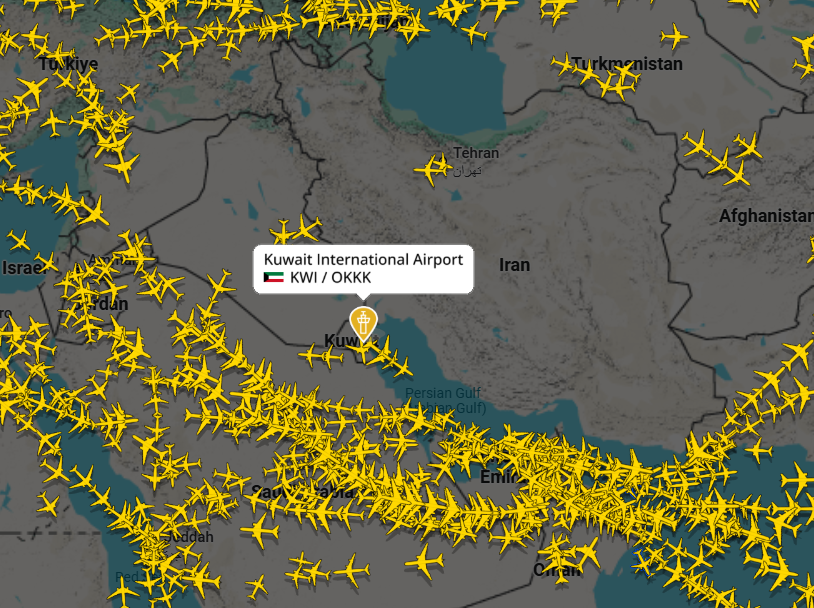
Beyond Kuwait, airlines flying through the wider Gulf have continued to avoid Iranian, Iraqi, and at times Israeli and Jordanian airspace. That has pushed long-haul routes onto longer tracks over the Caspian region or down through Egypt and Saudi Arabia, adding fuel costs and flight times.
Major Gulf hubs in Dubai, Doha, and Abu Dhabi have remained largely operational, though they have absorbed diversions and have warned passengers to expect delays. Smaller airports closer to the conflict, including those in Iraq, Jordan, Lebanon, Syria, and parts of Israel, have faced longer and more frequent closures.
Impact on passengers
Travelers transiting Kuwait have been advised to check directly with airlines before heading to the airport. Carriers are offering rebooking and refunds in many cases, but capacity on alternative routings is tight given how many flights have been displaced.
Insurance providers have also flagged that policies may not cover all scenarios tied to military activity. Passengers booked on flights through affected airspace are being urged to review the terms of their coverage and to keep documentation of any cancellations or delays.
The Cockpit’s Next Revolution: When the Co-Pilot Is a Computer
A wider aviation strain
The closures come at a sensitive moment for the global aviation industry, which has been rebuilding capacity after years of pandemic-era disruption. Middle East carriers, in particular, have invested heavily in fleet expansion and route growth, and the region's geography makes its hubs central to east-west traffic.
Analysts have noted that prolonged instability could push some airlines to reconsider how heavily they rely on Gulf routings. For now, most operators are treating the disruption as temporary, adjusting schedules day by day rather than making structural changes.
Insurers and risk consultants who advise airlines have flagged increased premiums and tighter conditions for flights operating in or near contested airspace. Those costs typically filter through to ticket prices over time, though carriers have so far absorbed much of the immediate impact.

What to watch next
The duration of this second Kuwait shutdown will depend largely on whether Iranian strikes continue and how regional governments respond. Authorities have not given a firm timeline for reopening, and officials have indicated that any resumption will be conditional on security assessments.
If the pattern of brief reopenings followed by fresh closures persists, airlines may begin building longer buffers into their schedules or reducing the number of daily rotations through Kuwait. Cargo operators, which rely heavily on predictable slot times, are also watching closely.
For travelers, the practical guidance remains straightforward. Confirm flight status before leaving for the airport, keep flexible booking options where possible, and monitor updates from both airlines and home government travel advisories. Several countries have issued or updated guidance on travel to and through the Gulf in recent days.
Kuwait's airport authority has said it will provide updates as the situation evolves. Until then, the reopening that lasted barely two days serves as a reminder of how tightly aviation in the region is now tied to the pace of military events.
This Week in Aviation: The 10 Stories That Mattered Most » Chicago Midway Loses One of Its Four Runways for a Month After Jet Blast Damages a Key Safety System » Why Aircraft Towing May Be One of the Last Frontiers of Autonomous Ground Operations »

Comments (0)
Add Your Comment
TAGS
NEWS Kuwait Disrupted Airspace War Airport KWIRECENTLY PUBLISHED
 This Week in Aviation: The 10 Stories That Mattered Most
From major airline developments to aircraft updates and industry shifts, this weekly recap highlights the ten most-read aviation stories from the week of October 18.
INFORMATIONAL
READ MORE »
This Week in Aviation: The 10 Stories That Mattered Most
From major airline developments to aircraft updates and industry shifts, this weekly recap highlights the ten most-read aviation stories from the week of October 18.
INFORMATIONAL
READ MORE »
 Jet2 Boeing 737 Veers Off Birmingham Airport Runway During Landing
A Jet2 Boeing 737-800 veered off the runway at Birmingham Airport during landing, prompting emergency crews to respond.
NEWS
READ MORE »
Jet2 Boeing 737 Veers Off Birmingham Airport Runway During Landing
A Jet2 Boeing 737-800 veered off the runway at Birmingham Airport during landing, prompting emergency crews to respond.
NEWS
READ MORE »
 American Airlines Boeing 787 Makes Emergency Landing at O'Hare After Brake Issue, One Hospitalized
An American Airlines Boeing 787 makes an emergency landing to Chicago O'Hare after a brake problem.
NEWS
READ MORE »
American Airlines Boeing 787 Makes Emergency Landing at O'Hare After Brake Issue, One Hospitalized
An American Airlines Boeing 787 makes an emergency landing to Chicago O'Hare after a brake problem.
NEWS
READ MORE »
More than just headlines.
Get unlimited ad-free access to in-depth aviation news, premium stories, and exclusive insights other sites don't cover.
- Ad-free browsing on AeroXplorer
- Unlimited access to premium and exclusive articles
- Higher photo upload limits & commissions on sales
- Free access to Jetstream Magazine on higher tiers
- Ad-free browsing
- Sell aviation photos with 60% commission
- First week free!
- Everything in Basic+
- Unlimited premium articles
- Sell aviation photos with 70% commission
- Free Digital subscription to Jetstream Magazine
- First week free!
- Everything in Basic+ and Pro
- Sell aviaiton photos with 80% commission
- Early access to exclusive stories
- Free Digital+Print subscription to Jetstream Magazine