
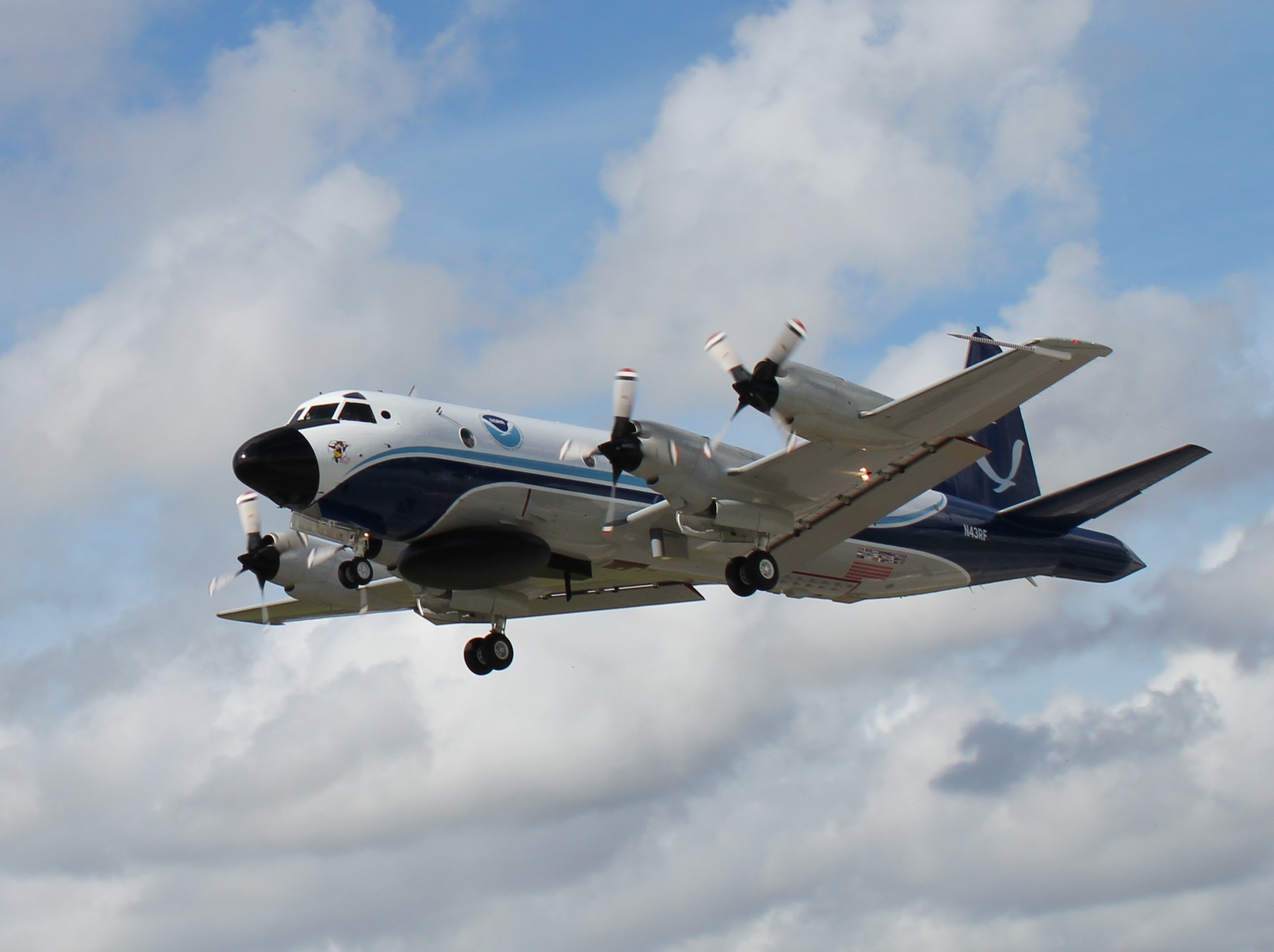


Hurricane Milton ravaged right through the state of Florida this past week, but one crew of The National Oceanic and Atmospheric Administration (NOAA), known as the "Hurricane Hunters" had the duty of flying right into the hurricane aboard an aircraft dubbed "Miss Piggy". The aircraft took flight Monday and came out unscathed, despite winds reaching a pulse-pounding 180 miles per hour.
Leaving The Frog At Home
During the wrath of Hurricane Milton, the NOAA dispatched a WP-3D Orion aircraft which is named after The Muppets' Miss Piggy. The flight occurred on Monday, October 7 over the Gulf of Mexico near the Yucatan Peninsula. A cockpit packed with crew members, led by Lt. Commander Joshua Rannenberg, was looking to gather data on the terrifying storm.
The NOAA Hurricane Hunters shared a video on Facebook featuring footage of the cockpit with crew members stoically monitoring their surroundings as a Miss Piggy plush keychain dangles above the dashboard.
The account had this caption to accompany the video:
"Inside the flight station aboard @NNational Oceanic and Atmospheric Administration (NOAA) WP-3D Orion 'Miss Piggy' as we fly straight into Hurricane #Milton! ⛈️
These flights collect critical data that helps improve forecasts and support hurricane research."
Shortly following the flight, Milton was upgraded to a Category 5 hurricane. Milton made landfall in Florida Wednesday evening at 8:30 p.m. as a Category 3 with winds at 120 miles per hour.

The National Weather Service Director of Public Affairs Susan Buchanan responded to USA Today via email, explaining further why the flight took place on Monday:
"The purpose of these missions is primarily to locate the center of the storm and measure central pressure and surface winds around the eye. The National Hurricane Center then uses that data to monitor a storm's location, strength, and speed and meteorologists create forecasts about the storms' track and intensity based on that information."
About Hurricane Hunters' Miss Piggy
The "Miss Piggy" name came about in the early 1990s when NOAA Director of Maintenance Greg Bast, then the P-3 crew chieftain, wasn't a fan of the WP-3D's design. He referred to the plain as "the pig" to members of the maintenance department. Flight engineer Steve Kirkpatrick agreed with Bast's opinions and entertained the idea of having the design of the plane changed. In the meantime, the aircraft was dubbed "Miss Piggy". The name apparently took a liking to many in the Aircraft Operations Center.
The NOAA contacted The Muppets creator Jim Henson if he was interested in authenticating the idea and providing the administration with designs suitable for the aircraft, with a project spearheaded by Director of Muppets Productions Michael Frith. Henson was very pleased with the idea, and the two parties worked together to come up with a detail for the WP-3D's nose.

However, the NOAA had a second WP-3D that didn't have a name. Frith suggested creating a design featuring Kermit the Frog, as the two aircraft were known to be "close pairs". A Kermit the Frog decal was then designed for the other WP-3D.
In 1996, a third design was created for the Administration's Gulfstream G-IV SP aircraft. The two parties went with Gonzo as the featured Muppet, as the G-IV was built featuring a long nose.
All three aircraft are still active today. Kermit was last used to fly into Hurricane Debby in August, which at the time was a tropical storm.
The NOAA has ordered additional Hurricane Hunter aircraft, which will be Gulfstream G550s. It remains to be seen if these new aircraft will be named after Muppets, but the current Gonzo is expected to be retired once the first of these new aircraft will be delivered in 2025.
The End of Lufthansa's Four-Engine Era as Its Last Airbus A340-600 Lands in Frankfurt for the Final Time After 23 Years » Austrian Airlines Flight Diverts to Sofia Under Fighter Escort After Bomb Threat » British Airways Finishes Starlink Wi-Fi Rollout Across Its A350 Fleet »

Comments (0)
Add Your Comment
TAGS
NEWS NOAANewsRECENTLY PUBLISHED
 Jet2 Boeing 737 Veers Off Birmingham Airport Runway During Landing
A Jet2 Boeing 737-800 veered off the left side of the runway at Birmingham Airport after landing on Sunday, October 25, as Storm Boelo brought strong winds to the UK.
NEWS
READ MORE »
Jet2 Boeing 737 Veers Off Birmingham Airport Runway During Landing
A Jet2 Boeing 737-800 veered off the left side of the runway at Birmingham Airport after landing on Sunday, October 25, as Storm Boelo brought strong winds to the UK.
NEWS
READ MORE »
 This Week in Aviation: The 10 Stories That Mattered Most
From major airline developments to aircraft updates and industry shifts, this weekly recap highlights the ten most-read aviation stories from the week of October 18.
INFORMATIONAL
READ MORE »
This Week in Aviation: The 10 Stories That Mattered Most
From major airline developments to aircraft updates and industry shifts, this weekly recap highlights the ten most-read aviation stories from the week of October 18.
INFORMATIONAL
READ MORE »
 Jet2 Boeing 737 Veers Off Birmingham Airport Runway During Landing
A Jet2 Boeing 737-800 veered off the runway at Birmingham Airport during landing, prompting emergency crews to respond.
NEWS
READ MORE »
Jet2 Boeing 737 Veers Off Birmingham Airport Runway During Landing
A Jet2 Boeing 737-800 veered off the runway at Birmingham Airport during landing, prompting emergency crews to respond.
NEWS
READ MORE »
More than just headlines.
Get unlimited ad-free access to in-depth aviation news, premium stories, and exclusive insights other sites don't cover.
- Ad-free browsing on AeroXplorer
- Unlimited access to premium and exclusive articles
- Higher photo upload limits & commissions on sales
- Free access to Jetstream Magazine on higher tiers
- Ad-free browsing
- Sell aviation photos with 60% commission
- First week free!
- Everything in Basic+
- Unlimited premium articles
- Sell aviation photos with 70% commission
- Free Digital subscription to Jetstream Magazine
- First week free!
- Everything in Basic+ and Pro
- Sell aviaiton photos with 80% commission
- Early access to exclusive stories
- Free Digital+Print subscription to Jetstream Magazine