An Asiana Airlines flight bound for Tokyo experienced an engine failure, prompting its return to Incheon International Airport.
Flight Details
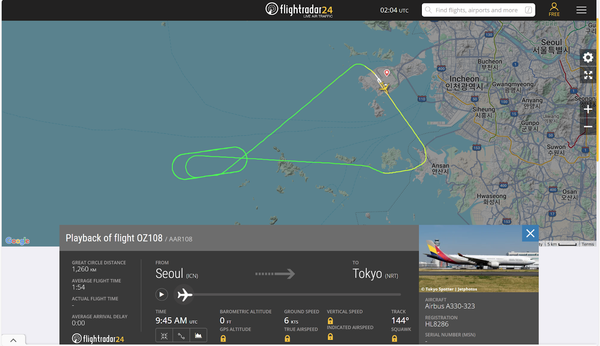
Asiana Airlines flight OZ108 was scheduled from Incheon International Airport (ICN) in Seoul, South Korea to Narita International Airport (NRT) in Tokyo, Japan. The flight was operated on an 11-year-old Airbus A330-300 with registration HL8286. There were 263 passengers on board.
The flight took off at 18:48 KST. However, soon after takeoff, it experienced an engine failure. A witness on the ground, who also managed to take a photo of the aircraft producing dark smoke, reported hearing a loud bang followed by visible flames coming from the left engine.

The aircraft managed to climb to 4200 feet before entering a holding pattern for approximately 20 minutes, likely to dump fuel. The flight landed back at Incheon International Airport safely, 54 minutes after its takeoff.
None of the 263 passengers on board reported any injuries, and at the time of this article, Asiana Airlines is currently working on providing an alternative flight for the passengers.

Asiana Airlines has yet to comment on the details of the incident.
Southwest Airlines Flight Returns to Orlando After Bird Strike on Takeoff » Joby Aviation to Pay $116.9 Million in Trade Secrets Case » British Airways Unveils World's Largest Business Class Cabin With 106 Seats Aboard Refurbished A380 Fleet »

Comments (0)
Add Your Comment
TAGS
NEWS Asiana Engine Failure Asiana Asiana Airlines Engine FailureRECENTLY PUBLISHED
 US State Department Warns of Threats to Airlines and Airports in Saudi Arabia Following Deadly Houthi Attacks
The US State Department has issued a security alert for Saudi Arabia after Houthi air attacks on the kingdom killed three people and injured dozens more.
NEWS
READ MORE »
US State Department Warns of Threats to Airlines and Airports in Saudi Arabia Following Deadly Houthi Attacks
The US State Department has issued a security alert for Saudi Arabia after Houthi air attacks on the kingdom killed three people and injured dozens more.
NEWS
READ MORE »
 Southwest Airlines Becomes First US Carrier to Integrate Flight Booking Into ChatGPT
Southwest Airlines launches a first-of-its-kind ChatGPT plugin, allowing travelers to search and book flights directly through the AI platform.
NEWS
READ MORE »
Southwest Airlines Becomes First US Carrier to Integrate Flight Booking Into ChatGPT
Southwest Airlines launches a first-of-its-kind ChatGPT plugin, allowing travelers to search and book flights directly through the AI platform.
NEWS
READ MORE »
 Joby Aviation to Pay $116.9 Million in Trade Secrets Case
A federal jury found air taxi maker Joby Aviation liable for misappropriating trade secrets, awarding $116.9 million in damages to the plaintiff.
NEWS
READ MORE »
Joby Aviation to Pay $116.9 Million in Trade Secrets Case
A federal jury found air taxi maker Joby Aviation liable for misappropriating trade secrets, awarding $116.9 million in damages to the plaintiff.
NEWS
READ MORE »
More than just headlines.
Get unlimited ad-free access to in-depth aviation news, premium stories, and exclusive insights other sites don't cover.
- Ad-free browsing on AeroXplorer
- Unlimited access to premium and exclusive articles
- Higher photo upload limits & commissions on sales
- Free access to Jetstream Magazine on higher tiers
- Ad-free browsing
- Sell aviation photos with 60% commission
- First week free!
- Everything in Basic+
- Unlimited premium articles
- Sell aviation photos with 70% commission
- Free Digital subscription to Jetstream Magazine
- First week free!
- Everything in Basic+ and Pro
- Sell aviaiton photos with 80% commission
- Early access to exclusive stories
- Free Digital+Print subscription to Jetstream Magazine