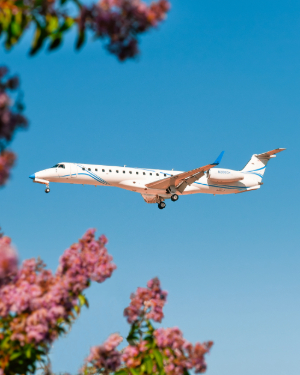


Somewhere over the Midwest, a Learjet completes a charter flight, shutting its engines down with an empty cabin and several hours of fuel remaining. Two states away, a customer is waiting on a quote for a trip departing in six hours.
Connecting that available aircraft with that customer sounds simple. In practice, it is one of business aviation’s oldest and most expensive challenges. Each new trip must be evaluated against aircraft location, crew availability, crew duty limits, maintenance schedules, and dozens of other variables. And all of it must be solved while the operation continues to change in real time.
Tech entrepreneur Roger Zhan spent two decades working inside that problem before deciding to build a solution of his own. Today, his company, Floating Fleet AI, optimizes more than 20,000 flights per month for operators across North America.

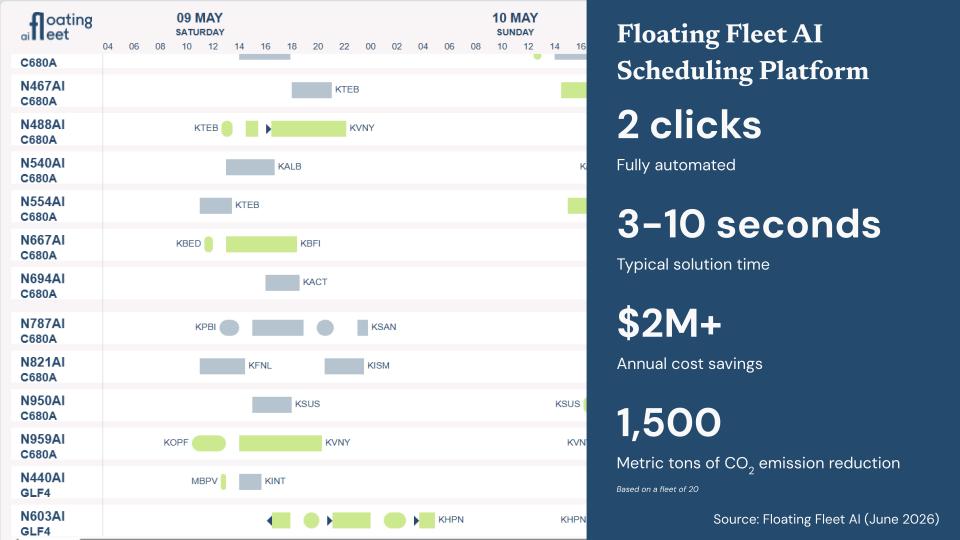
The premise is straightforward: use mathematical optimization to match aircraft and crews to trips faster and evaluate more feasible options than a human scheduler could reasonably consider. More fundamentally, Zhan is applying real-time mathematical optimization to an operational process that remains highly manual.
Learn more about Zhan's company: Floating Fleet AI
From Aviation Operations to Floating Fleet AI
Zhan holds a PhD in Operations Research, a discipline where various algorithms are used to make complex operations run efficiently. He spent seven years at CitationAir, followed by roles within Textron’s operations in Shanghai and Wichita, before he joined Wheels Up in 2016. At the time, Wheels Up was still a young company, operating a fleet of roughly a dozen King Airs. Zhan built the technology behind its real-time pricing and availability, systems that were in place when the company went public on the NYSE in 2021.
“Every stop taught me a different aspect of private aviation, and I met some incredible people along the way. I was set to spend the rest of my professional life in aviation until Wayfair’s opportunity knocked on my door,” Zhan said.
He then left aviation entirely, becoming chief data officer for Wayfair's B2B division, a business generating $2 billion in annual revenue. But he could only stay away from aviation for so long. Former colleagues continued reaching out for help with technology and aviation product design.
“I learned how to run an effective tech team at Wayfair, and I'm grateful for that. But I found myself explaining aircraft scheduling to e-commerce people at dinner, and I realized the problem had never let go of me. Everything sort of lined up for me to start Floating Fleet AI: the unsolved problem, the network, the know-how, and the market opportunity,” Zhan said.
What is Floating Fleet AI?
The company takes its name from the concept of a “floating fleet,” in which a group of aircraft follows demand rather than returning to a fixed home base after each trip. A home-based fleet is comparatively straightforward to schedule: aircraft typically depart and return to a home base, while crews remain closer to their base. A floating fleet is different; aircraft can reposition to follow demand, while crews may remain away from home for days at a time.
Every new booking can affect the position of multiple aircraft and crews, turning the schedule into a constantly shifting puzzle. Floating Fleet AI has since adapted its optimization engine for home-based fleets as well, where Zhan says operators have seen similar results.

Aviation scheduling platforms already exist, but many are primarily designed to manage the flow of data — trips, crews, maintenance records, and aircraft — rather than optimize decisions across those constraints. Zhan saw an opportunity to bridge the gap, building Floating Fleet AI around the idea that scheduling software should do more than organize information – it should help evaluate the operational trade-offs. The company now serves Part 135 and 91 operators, corporate flight departments, and charter brokers, and has recently signaled plans to extend into irregular operations recovery for scheduled airlines.
"People imagine scheduling as a puzzle you solve once. It isn't. It's a puzzle that gets reshuffled every time a trip books, a crew times out, or an aircraft goes into maintenance – and a good scheduler is rebuilding it in their head all day long. For any single request, there might be a hundred feasible ways to fly it. A human can seriously evaluate a few. We look at all of them against every duty limit, maintenance window, positioning cost, and crew rule at once, and we hand the scheduler the best few with the reasoning attached. The scheduler still makes the call. They just make it with the full picture instead of a fraction of it," Zhan said.
Solving the Trust Problem
Ask any charter operator how they feel about AI, and the answer will likely include some degree of skepticism. The rapid adoption of generative AI – and its well-documented tendency to produce plausible but incorrect outputs – has also heightened questions about where AI can be trusted, particularly in an industry where an incorrect recommendation can carry operational, financial, and safety consequences. Zhan built his platform around a concept that is less familiar outside operations research: deterministic AI models.
Unlike generative AI, deterministic AI works from defined inputs, constraints, and objectives to produce repeatable solutions. The system can expose the constraints behind a recommendation, allowing a scheduler to understand why one trip assignment or swap was preferred over another.
“A chatbot can't commit to a trip swap. It can't be held accountable when the duty limit is wrong. Our engine can because it isn't guessing. The same inputs produce the same answer every time, every recommendation is feasible by construction, and the system can show the reasoning behind it. Once a director of operations can audit the reason behind a recommendation, the conversation changes. We stop being 'AI' in their heads and start being a tool, and tools are something this industry has always been comfortable buying," Zhan said.
The Numbers Operators Trust
Some of the company's earliest customers have been on the platform for more than a year. According to the company’s benchmark studies, operators using the platform have recorded cost reductions of 4 to 10 percent.
Just as telling, Zhan says, is what these operators did next: they incorporated the tool into their daily workflow and began requesting additional features, suggesting that the platform had moved beyond a technology trial and into the operators’ day-to-day planning process.
What’s Next for Floating Fleet AI
The company’s subscription pipeline now runs through the United States, Canada, Mexico, Germany, Sweden, and the UAE. For an industry that has watched plenty of AI promises come and go, Floating Fleet AI is betting that optimization can change what a scheduler’s job looks like – not by replacing the scheduler, but by expanding the range of decisions they can evaluate.
Zhan says the company will introduce agentic workflows on top of its deterministic engine in the coming months. For those visiting NBAA-BACE this October, stop by booth 850 or visit https://www.floatingfleet.ai/ to learn more.
Air New Zealand Cancels San Francisco Flight After Pilots Reportedly Fight During Layover » Why Is Turbulence Getting Worse, and Is It Actually Dangerous? » A Laptop Caught Fire at 35,000 Feet. This Device Kept the Flight Going »
Comments (0)
Add Your Comment
TAGS
STORIES Floating Fleet AI Aviation Scheduling Travel Jetstream MagazineRECENTLY PUBLISHED
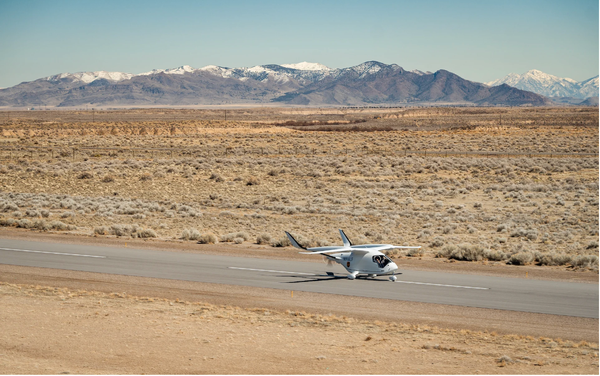 BETA Technologies Begins Electric Aircraft Operations in North Carolina to Support Rural Healthcare Access
BETA Technologies launches its ALIA CTOL electric aircraft in North Carolina under a FAA program aimed at improving rural healthcare logistics.
NEWS
READ MORE »
BETA Technologies Begins Electric Aircraft Operations in North Carolina to Support Rural Healthcare Access
BETA Technologies launches its ALIA CTOL electric aircraft in North Carolina under a FAA program aimed at improving rural healthcare logistics.
NEWS
READ MORE »
 Ryanair Pilot Sent Hijack Code Before Turning Flight FR7073 Back to Porto
A Ryanair captain transmitted the 7500 hijack squawk code before diverting flight FR7073 back to Porto, prompting an emergency response.
NEWS
READ MORE »
Ryanair Pilot Sent Hijack Code Before Turning Flight FR7073 Back to Porto
A Ryanair captain transmitted the 7500 hijack squawk code before diverting flight FR7073 back to Porto, prompting an emergency response.
NEWS
READ MORE »
 Turkish Airlines Confirms Order for 100 Boeing 737 MAX Jets
Turkish Airlines has finalized a major deal with Boeing for 100 737 MAX aircraft, cementing its narrowbody fleet plans through the next decade.
NEWS
READ MORE »
Turkish Airlines Confirms Order for 100 Boeing 737 MAX Jets
Turkish Airlines has finalized a major deal with Boeing for 100 737 MAX aircraft, cementing its narrowbody fleet plans through the next decade.
NEWS
READ MORE »
More than just headlines.
Get unlimited ad-free access to in-depth aviation news, premium stories, and exclusive insights other sites don't cover.
- Ad-free browsing on AeroXplorer
- Unlimited access to premium and exclusive articles
- Higher photo upload limits & commissions on sales
- Free access to Jetstream Magazine on higher tiers
- Ad-free browsing
- Sell aviation photos with 60% commission
- First week free!
- Everything in Basic+
- Unlimited premium articles
- Sell aviation photos with 70% commission
- Free Digital subscription to Jetstream Magazine
- First week free!
- Everything in Basic+ and Pro
- Sell aviaiton photos with 80% commission
- Early access to exclusive stories
- Free Digital+Print subscription to Jetstream Magazine