
A runway inspection comes down to one moment: a crew member walking 8,000 feet of pavement, looking for something the size of a coin. It could be a bolt, a rivet, or even a small rubber shaving flung off a landing gear months earlier that was never recovered.
That single object, if it survives the walk and makes it into an engine intake, can end a flight and cost the airline millions. The industry has a name for these types of objects: foreign object debris, or FOD.
An Unlikely Origin
The answer to this FOD problem came from an unlikely place. In the early 1990s, an Australian engineer named Warwick Tozer had already built a sweeper for tennis courts, a simple device that used friction — rather than brushes or suction — to lift debris off a playing surface. His son Stuart looked at this and asked a bigger question: could this same principle clear a runway, at highway speed, without moving parts to break down, or motors to maintain?
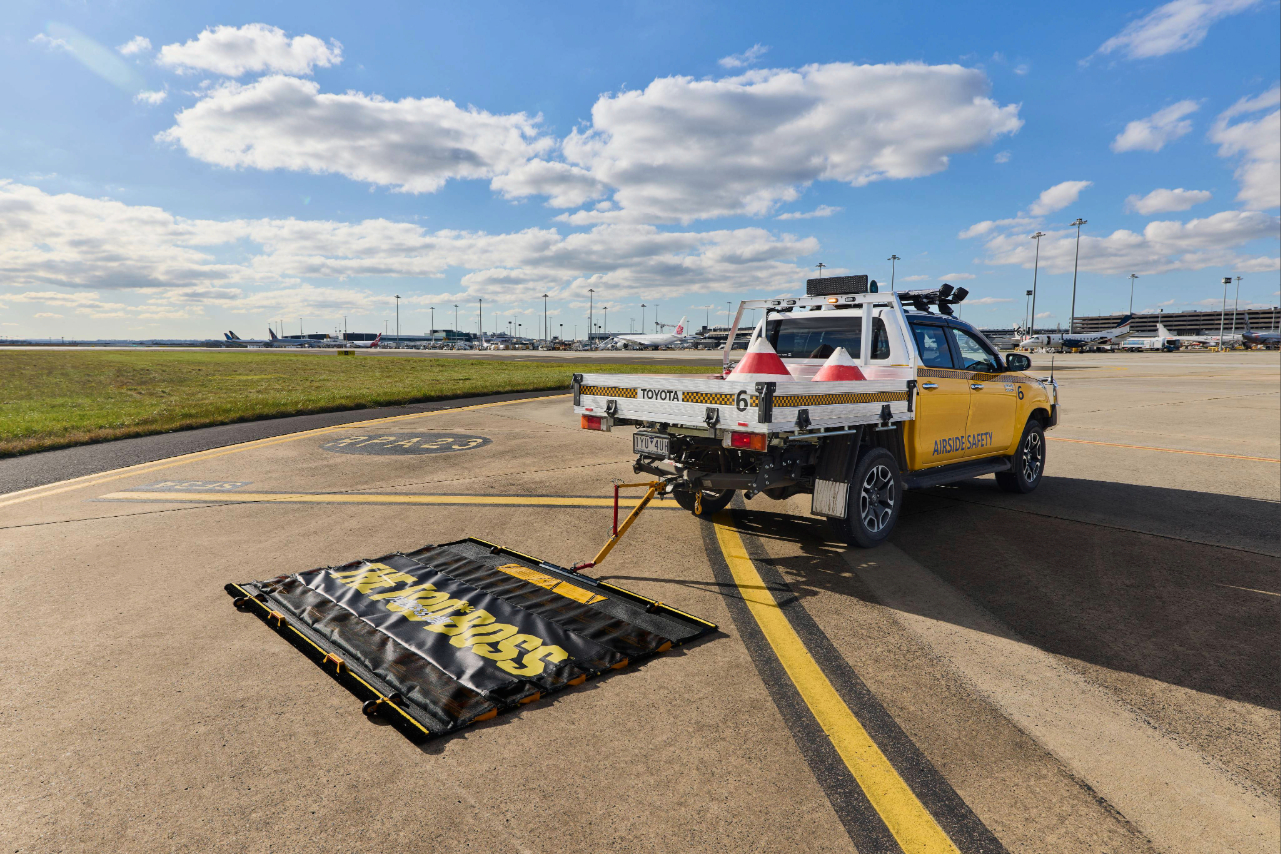
The result, patented in 1994, was the FOD*BOSS. Three decades later, the product, developed by Aerosweep, is used across military and commercial airfields worldwide and remains one of the more counterintuitive success stories in ground support equipment. FOD*BOSS made airfields safer by removing complexity, rather than adding it.
It works as well as it does largely because it isn't complicated.
Learn more about Aerosweep FOD*BOSS.
No Overengineering
Most attempts to improve the airfield debris removal process have followed the same instinct: bigger machines, more suction, more moving parts.
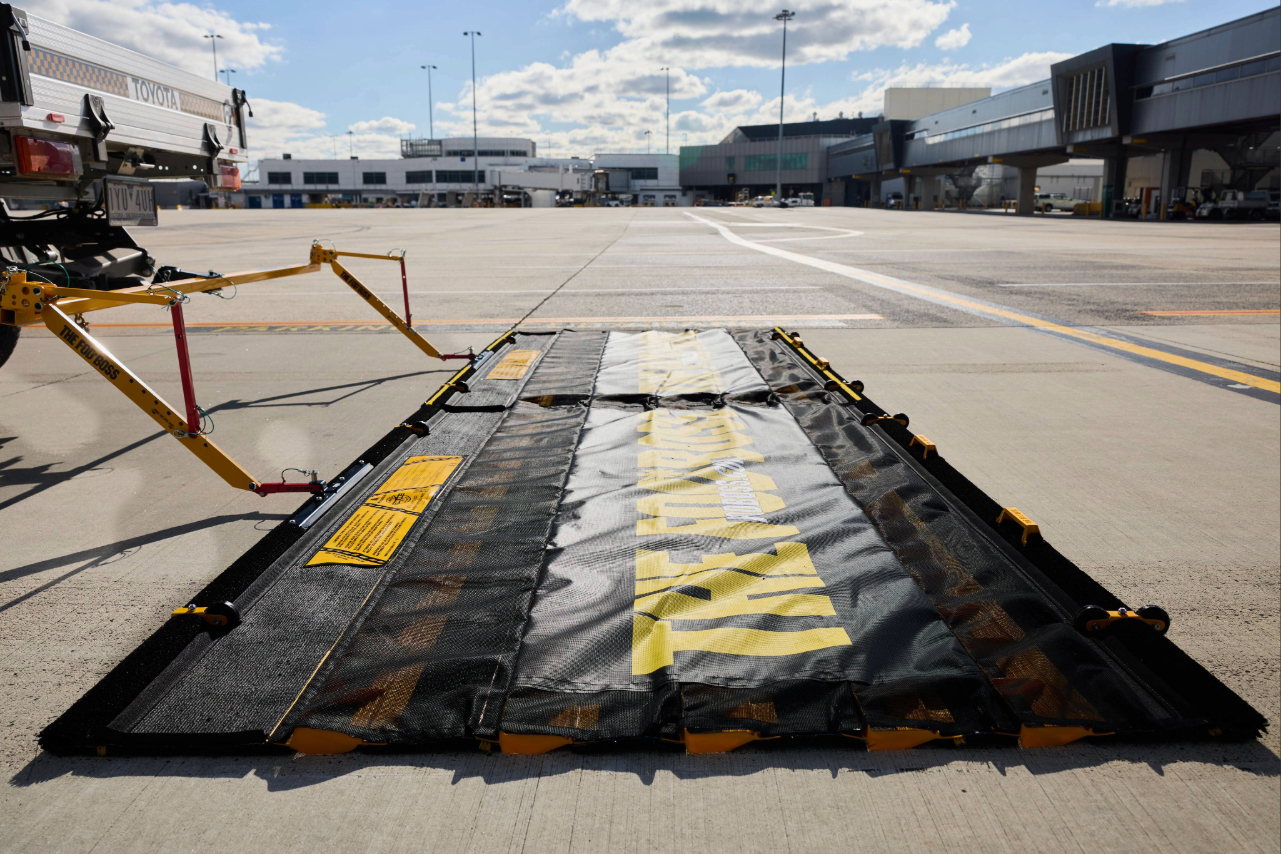
Vacuum trucks and mechanical brush sweepers dominate the FOD-removal market because they look like serious industrial equipment. FOD*BOSS, by contrast, is a tow-behind mat with no electronics and no hydraulics. It uses aerodynamic friction and a set of mechanical steps to lift debris off the pavement and hold it in capture zones as the vehicle moves.
Triple elevator steps guide the small stuff (the bolts and rivets that do the most damage) into those capture zones, even at low towing speeds. A retention blade holds debris behind a raised edge so nothing spills back onto the surface when the tow vehicle brakes or turns. A purpose-built tow hitch keeps the front of the unit grounded in crosswinds, holding a clean line at speeds up to 40 mph.
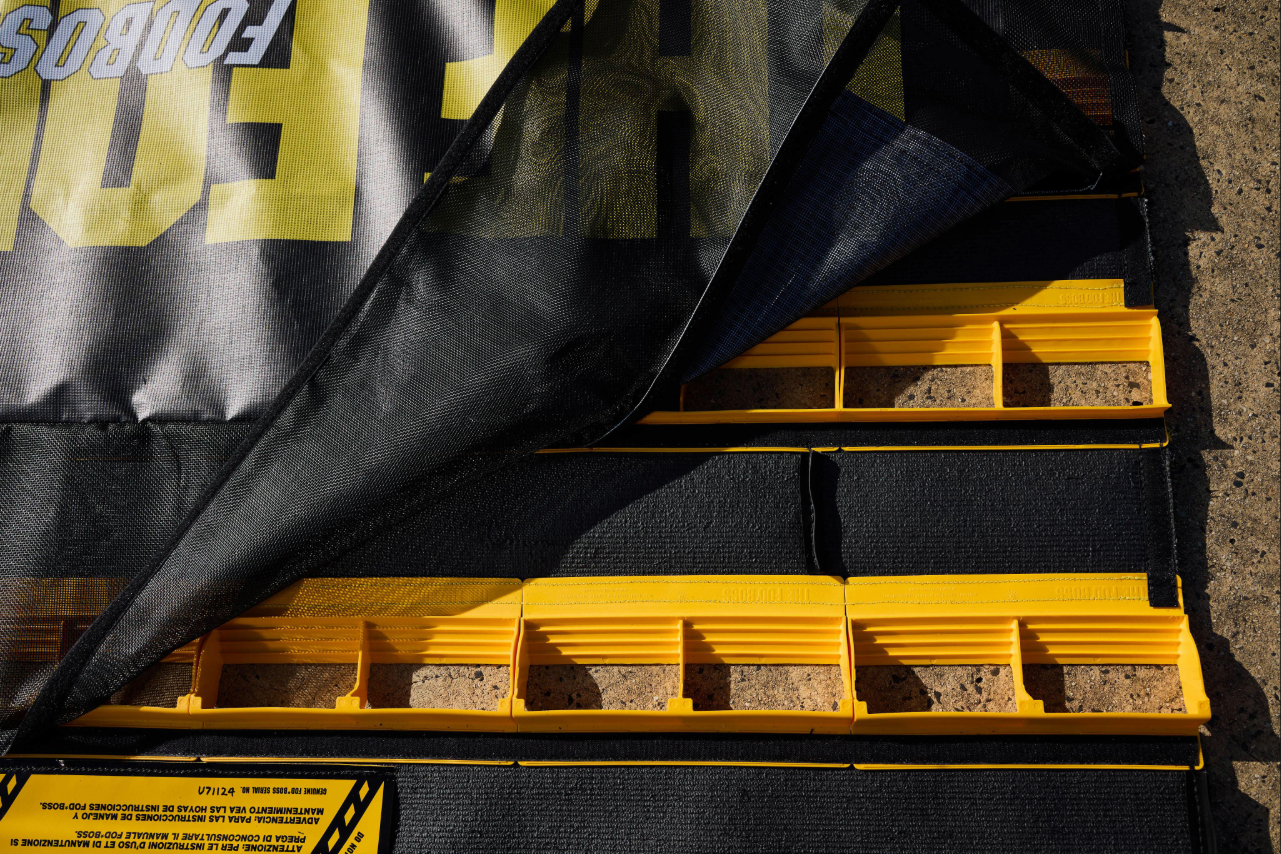
Individually, none of this is a breakthrough. The result is a system that clears an 8,000-foot runway in under 30 minutes at a 99 percent debris collection rate, fast enough that airfields with no room for extended closures have made it part of their regular routine.
The Same Idea, Every Surface
That design philosophy shows up most clearly outside the airfield business, in the other places FOD*BOSS now runs. Motorsports circuits use it because a stray bolt or piece of bodywork threatens a car at speed the same way a rivet threatens a jet engine on takeoff. Sports fields use it because debris on turf can injure a player. Tennis courts still use it too, which is where the idea started in the first place.
Companies that solve a problem well in one industry usually do one of two things: stay put, or keep adding features until the original product isn't simple anymore. Aerosweep resized the same mechanism instead of redesigning it. It's a slower way to grow than filing a new patent, but it has held up for three decades.
Aerosweep Today
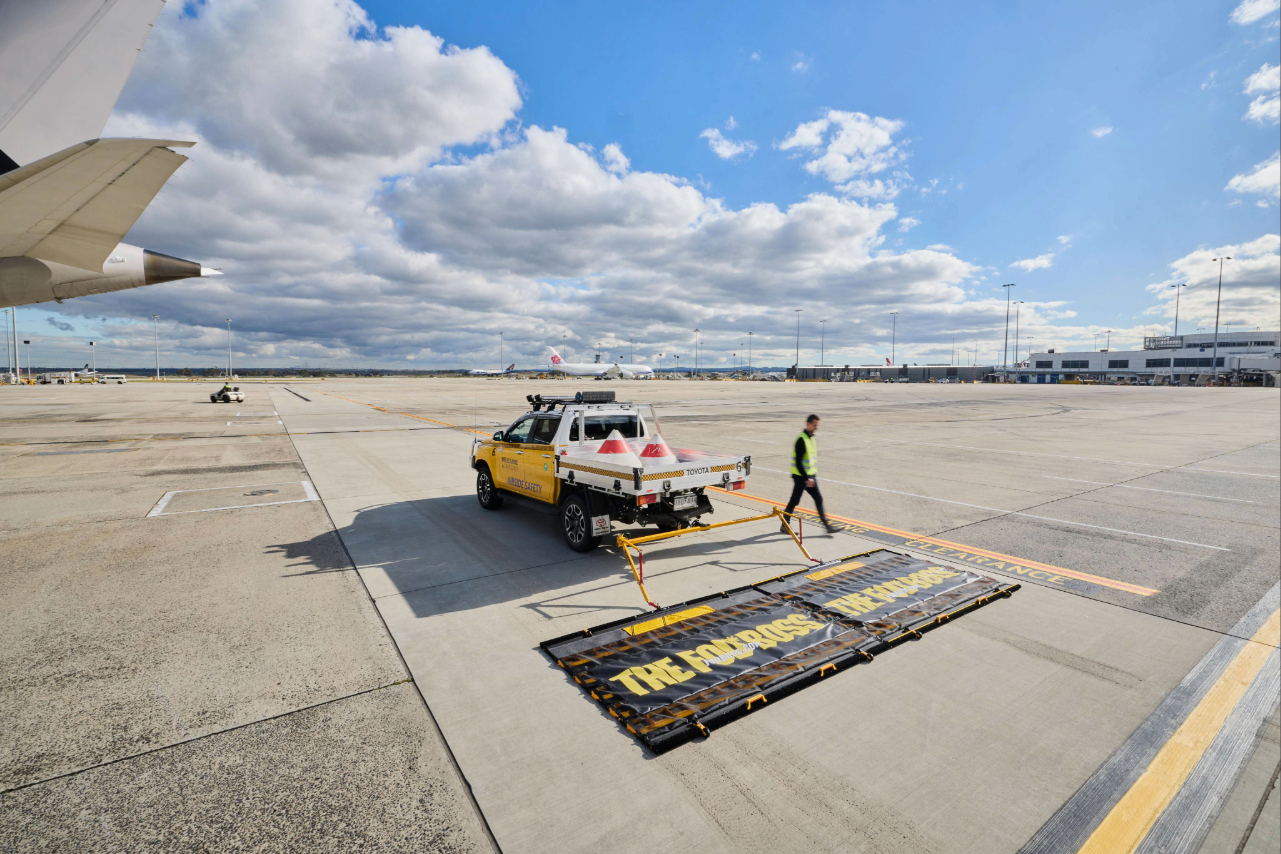
More than three decades after its patent, FOD*BOSS is a fixture at airports worldwide, and the pressure on those airports keeps building. Air travel is busier, schedules are tighter, and every minute a runway sits closed for maintenance is a minute an airline can't get back. A system with no engine to service and a clearing time measured in minutes fits an industry with less room to spare than it had in 1994.
See FOD*BOSS in person at NBAA-BACE, October 20-22 in Las Vegas, Booth 4252. Or visit www.aerosweep.com
Why Aircraft Towing May Be One of the Last Frontiers of Autonomous Ground Operations » Virgin Atlantic Launches Nonstop Heathrow-Phuket Flights » Austrian Airlines Flight Diverts to Sofia Under Fighter Escort After Bomb Threat »

Comments (0)
Add Your Comment
TAGS
INFORMATIONAL FOD*BOSS Aerosweep Airfield innovation Products FODRECENTLY PUBLISHED
 American Airlines Boeing 787 Makes Emergency Landing at O'Hare After Brake Issue, One Hospitalized
An American Airlines Boeing 787 makes an emergency landing to Chicago O'Hare after a brake problem.
NEWS
READ MORE »
American Airlines Boeing 787 Makes Emergency Landing at O'Hare After Brake Issue, One Hospitalized
An American Airlines Boeing 787 makes an emergency landing to Chicago O'Hare after a brake problem.
NEWS
READ MORE »
 Why Aircraft Towing May Be One of the Last Frontiers of Autonomous Ground Operations
Ground support equipment has advanced steadily toward autonomy: baggage carts and pushback tractors, among others, are being designed to operate with minimal human intervention. Yet the aircraft itself – the single most valuable and structurally sensitive asset on the ramp – is still almost universally towed under direct human control.
STORIES
READ MORE »
Why Aircraft Towing May Be One of the Last Frontiers of Autonomous Ground Operations
Ground support equipment has advanced steadily toward autonomy: baggage carts and pushback tractors, among others, are being designed to operate with minimal human intervention. Yet the aircraft itself – the single most valuable and structurally sensitive asset on the ramp – is still almost universally towed under direct human control.
STORIES
READ MORE »
 British Airways Finishes Starlink Wi-Fi Rollout Across Its A350 Fleet
British Airways has installed SpaceX's Starlink Wi-Fi on every Airbus A350 in its fleet, offering passengers free high-speed internet on long-haul flights.
NEWS
READ MORE »
British Airways Finishes Starlink Wi-Fi Rollout Across Its A350 Fleet
British Airways has installed SpaceX's Starlink Wi-Fi on every Airbus A350 in its fleet, offering passengers free high-speed internet on long-haul flights.
NEWS
READ MORE »
More than just headlines.
Get unlimited ad-free access to in-depth aviation news, premium stories, and exclusive insights other sites don't cover.
- Ad-free browsing on AeroXplorer
- Unlimited access to premium and exclusive articles
- Higher photo upload limits & commissions on sales
- Free access to Jetstream Magazine on higher tiers
- Ad-free browsing
- Sell aviation photos with 60% commission
- First week free!
- Everything in Basic+
- Unlimited premium articles
- Sell aviation photos with 70% commission
- Free Digital subscription to Jetstream Magazine
- First week free!
- Everything in Basic+ and Pro
- Sell aviaiton photos with 80% commission
- Early access to exclusive stories
- Free Digital+Print subscription to Jetstream Magazine