

You might think that the most dangerous or fatal cause behind aviation accidents would be weather or mechanical-related events. However, this is not the case.
Today, we will discuss the concept of spatial disorientation, the most fatal cause of aviation accidents.
What is it?
Spatial disorientation is the inability to determine position or relative motion that occurs during periods of challenging visibility, which makes sense as vision is the dominant sense behind orientation.
During periods of challenging visibility, the auditory, vestibular, and proprioceptive systems can struggle to coordinate movement with balance and contribute to illusory nonvisual sensations, resulting in spatial disorientation without solid visual cues.

When flying an aircraft, spatial disorientation can result in improper altitude perception. Proper altitude recognition is always critical, but doing so becomes challenging at night or in poor weather. With this in mind, spatial disorientation occurring in reduced visibility situations is why this phenomenon has led to many fatal aviation accidents.
To calm the nerves, spatial orientation tends to be challenging to achieve in flight as numerous sensory stimuli vary in magnitude, direction, and frequency.
The visual sense is considered the most significant contributor to orientation, as when you look at something, you judge based only on what you see.
During times of low visibility, this can explain why pilots, based on their limited visibility, can misinterpret metrics like speed and altitude and ultimately find themselves in dangerous scenarios.

A Key Contributor
Statistics have shown that 5-10% of all general aviation accidents can be attributed to spatial disorientation. To show how dangerous this phenomenon can be, 90% of those accidents were fatal.
In 2007, Dr David G. Newman, a consultant in aviation medicine, conducted a study published by the Australian Transport Safety Bureau (ATSB). This study was concerned with the prevalence of spatial disorientation incidents, and it concluded that:
“If a pilot flies long enough...there is no chance that he/she will escape experiencing at least one episode of spatial disorientation. Looked at another way, pilots can be considered to be in one of two groups; those who have been disorientated, and those who will be.”
Understandably, regulators are aware of spatial disorientation and its hazards. Back in 1965, the United States Federal Aviation Administration (FAA), back then called the "Federal Aviation Agency", issued Advisory Circular (AC) 60-4. This advisory warned pilots about the hazards of spatial disorientation, which may result from operations under visual flight rules (VFR) in conditions of marginal visibility.

This advisory saw a new version being issued in 1983 called AC 60-4A. This update defined spatial disorientation as "the inability to tell which way is 'up'". That's as simple as it gets. Many notable commercial aviation incidents have occurred because of spatial disorientation. Spatial disorientation was sometimes combined with other factors that led to the crashes.
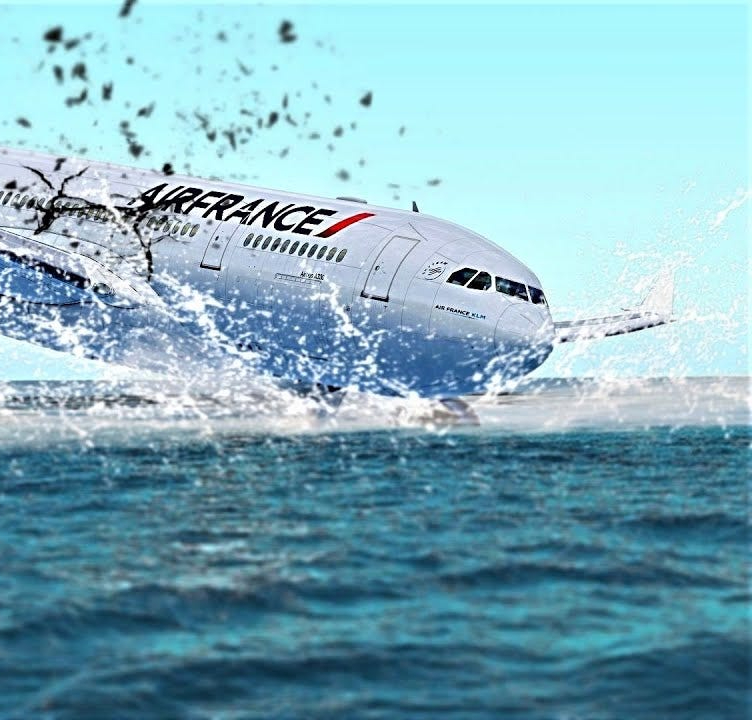
One such example was Air France Flight 447 in 2007. Ice crystals formed on the Airbus A330's pitot tubes, resulting in erroneous airspeed measurements and ultimately causing the autopilot to disconnect. The pilots began reacting incorrectly to the abnormality, and when the aircraft entered a stall, they failed to save the plane from it, leading to the A330 crashing into the Atlantic Ocean.
In more recent years, the incidents of Flydubai Flight 981, Atlas Air Flight 3591, and the 2020 Calabasas helicopter crash involving Kobe Bryant were all attributed to spatial disorientation.
Lufthansa Wins Bid for 44.9% Stake in TAP Air Portugal, Edging Out Air France-KLM » JetBlue Opens Sales for BlueFirst, Its First Domestic First Class Cabin » Why Did Some Air India A320s Have Extra Wheels? Bogie Gear Explained »

Comments (0)
Add Your Comment
TAGS
INFORMATIONAL air crashesspatial disorientationaviation incidentsRECENTLY PUBLISHED
 This Week in Aviation: The 10 Stories That Mattered Most
From major airline developments to aircraft updates and industry shifts, this weekly recap highlights the ten most-read aviation stories from the week of October 11.
INFORMATIONAL
READ MORE »
This Week in Aviation: The 10 Stories That Mattered Most
From major airline developments to aircraft updates and industry shifts, this weekly recap highlights the ten most-read aviation stories from the week of October 11.
INFORMATIONAL
READ MORE »
 GPS Jamming Is Now a Daily Airline Problem. Here Is How Bad It Has Gotten
GPS jamming and spoofing are disrupting airline navigation across Europe, the Middle East and South Asia. Explore how widespread GNSS interference threatens flight safety, affects airline operations, and what pilots and regulators are doing to manage the growing risk.
INFORMATIONAL
READ MORE »
GPS Jamming Is Now a Daily Airline Problem. Here Is How Bad It Has Gotten
GPS jamming and spoofing are disrupting airline navigation across Europe, the Middle East and South Asia. Explore how widespread GNSS interference threatens flight safety, affects airline operations, and what pilots and regulators are doing to manage the growing risk.
INFORMATIONAL
READ MORE »
 Who Is Accountable When an AI Air Traffic Tool Gets It Wrong?
Who is liable when an AI air traffic control tool gets it wrong? The FAA’s SMART system faces scrutiny over safety testing, controller oversight, and legal accountability as lawmakers question its use in U.S. airspace.
INFORMATIONAL
READ MORE »
Who Is Accountable When an AI Air Traffic Tool Gets It Wrong?
Who is liable when an AI air traffic control tool gets it wrong? The FAA’s SMART system faces scrutiny over safety testing, controller oversight, and legal accountability as lawmakers question its use in U.S. airspace.
INFORMATIONAL
READ MORE »
More than just headlines.
Get unlimited ad-free access to in-depth aviation news, premium stories, and exclusive insights other sites don't cover.
- Ad-free browsing on AeroXplorer
- Unlimited access to premium and exclusive articles
- Higher photo upload limits & commissions on sales
- Free access to Jetstream Magazine on higher tiers
- Ad-free browsing
- Sell aviation photos with 60% commission
- First week free!
- Everything in Basic+
- Unlimited premium articles
- Sell aviation photos with 70% commission
- Free Digital subscription to Jetstream Magazine
- First week free!
- Everything in Basic+ and Pro
- Sell aviaiton photos with 80% commission
- Early access to exclusive stories
- Free Digital+Print subscription to Jetstream Magazine