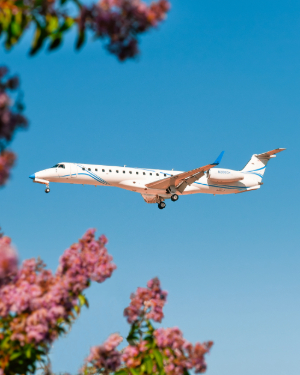


Have you ever been on a flight from Cleveland to Atlanta that lasted two hours? How about from China to Atlanta in two hours? That's what engineers in China's Fujian Province are looking to make this a possibility in the future with a revolutionary new jet.
(Much) Faster Than The Speed Of Sound
China is moving forward with building a new hypersonic passenger jet, codenamed "Nanqiang No. 1", that could fly to anywhere in the world in two hours or less.
A small prototype of the jet recently passed flight tests, and now a full-sized prototype has begun. This new prototype is expected to be finished and conduct test flights some time in the next year.

"Nanqiang" is reported to have the capabilities to achieve Mach 6, which is noticeably faster than the Concorde, which was known for being the world's fastest passenger jet for decades.
This Mach 6 speed is said to be possible with a combination of engines built into one, specifically in the turbofan, rocket, and ramjet varieties. China has dubbed these new engines "MUTTER" engines, which stand for "Multi-ducted twin-turbine ejector-ramjet".
Lead project scientist Yin Zeyong has described the project as a "breakthrough in travel and technology" and he claims the plan can "change human civilization".
In terms of how the jet will be able to slow down during flights, Zeyong has yet to reveal how "Nanqiang" will be able to achieve this.
"Nanqiang" has been in the works since 2019, with early versions of the prototype reaching speeds only close to Mach 1 (767 mph).
The actual jet is said to not be completed until around 2035. The final version of the aircraft is slated to seat ten passengers.

About The Legendary Concorde
First built in early 1969, the Concorde had a max speed of 1,354 mph, achieving Mach 2, a speed that's twice the speed of sound, making it a rare feat to be able to photograph the plane itself mid-flight.
In comparison with China's claims of two-hour global flights, British Airways owns a world record for the fastest transatlantic crossing involving a flight from Heathrow International Airport in London to JFK International Airport in New York. This Concorde flight on February 7, 1996 lasted two hours, 52 minutes, and 59 seconds. A typical commercial flight from London to New York takes about eight hours.
The Concorde ceased production in 2003, and of the 20 that were made, none of them are active today, with most being preserved and on display.
NASA is also developing what it dubs the "Son of Concorde", which is the X-59. While not a hypersonic jet, it's said to be a more efficient and quieter supersonic jet. The X-59 has passed safety inspections back in May, with its first flight yet to be scheduled.
With promising developments from China, you can expect other companies to join the race to be the first to debut a hypersonic jet by 2035.
But what are your thoughts? Would you travel on a jet that could reach Mach 6? Let us know your thoughts in the comments below!
Why Engine Lease Rates Are Still Climbing as Values Level Off » What the September NATS outage teaches passengers about flight compensation » Lawmakers Press FAA to Suspend AI Air Traffic Control Tool at Washington-Area Airports »

Comments (0)
Add Your Comment
TAGS
NEWS nanqiangnasaconcordenewschina british airways mach 6RECENTLY PUBLISHED
 FlyUSA Opens 50,000-Square-Foot Owner-Exclusive Hangar and Lounge at Tampa International Airport
FlyUSA has opened a 50,000-square-foot private hangar and lounge at Tampa International Airport, serving aircraft owners and charter clients.
NEWS
READ MORE »
FlyUSA Opens 50,000-Square-Foot Owner-Exclusive Hangar and Lounge at Tampa International Airport
FlyUSA has opened a 50,000-square-foot private hangar and lounge at Tampa International Airport, serving aircraft owners and charter clients.
NEWS
READ MORE »
 Federal Grand Jury Indicts Passenger Duct-Taped to Seat on American Airlines Flight
A passenger restrained with duct tape after a violent outburst on an American Airlines flight to Newark faces federal charges and up to 20 years in prison.
NEWS
READ MORE »
Federal Grand Jury Indicts Passenger Duct-Taped to Seat on American Airlines Flight
A passenger restrained with duct tape after a violent outburst on an American Airlines flight to Newark faces federal charges and up to 20 years in prison.
NEWS
READ MORE »
 JetBlue Opens Sales for BlueFirst, Its First Domestic First Class Cabin
JetBlue begins selling seats in its new BlueFirst domestic first class cabin, with service starting in 2026 on select transcontinental routes.
NEWS
READ MORE »
JetBlue Opens Sales for BlueFirst, Its First Domestic First Class Cabin
JetBlue begins selling seats in its new BlueFirst domestic first class cabin, with service starting in 2026 on select transcontinental routes.
NEWS
READ MORE »
More than just headlines.
Get unlimited ad-free access to in-depth aviation news, premium stories, and exclusive insights other sites don't cover.
- Ad-free browsing on AeroXplorer
- Unlimited access to premium and exclusive articles
- Higher photo upload limits & commissions on sales
- Free access to Jetstream Magazine on higher tiers
- Ad-free browsing
- Sell aviation photos with 60% commission
- First week free!
- Everything in Basic+
- Unlimited premium articles
- Sell aviation photos with 70% commission
- Free Digital subscription to Jetstream Magazine
- First week free!
- Everything in Basic+ and Pro
- Sell aviaiton photos with 80% commission
- Early access to exclusive stories
- Free Digital+Print subscription to Jetstream Magazine