
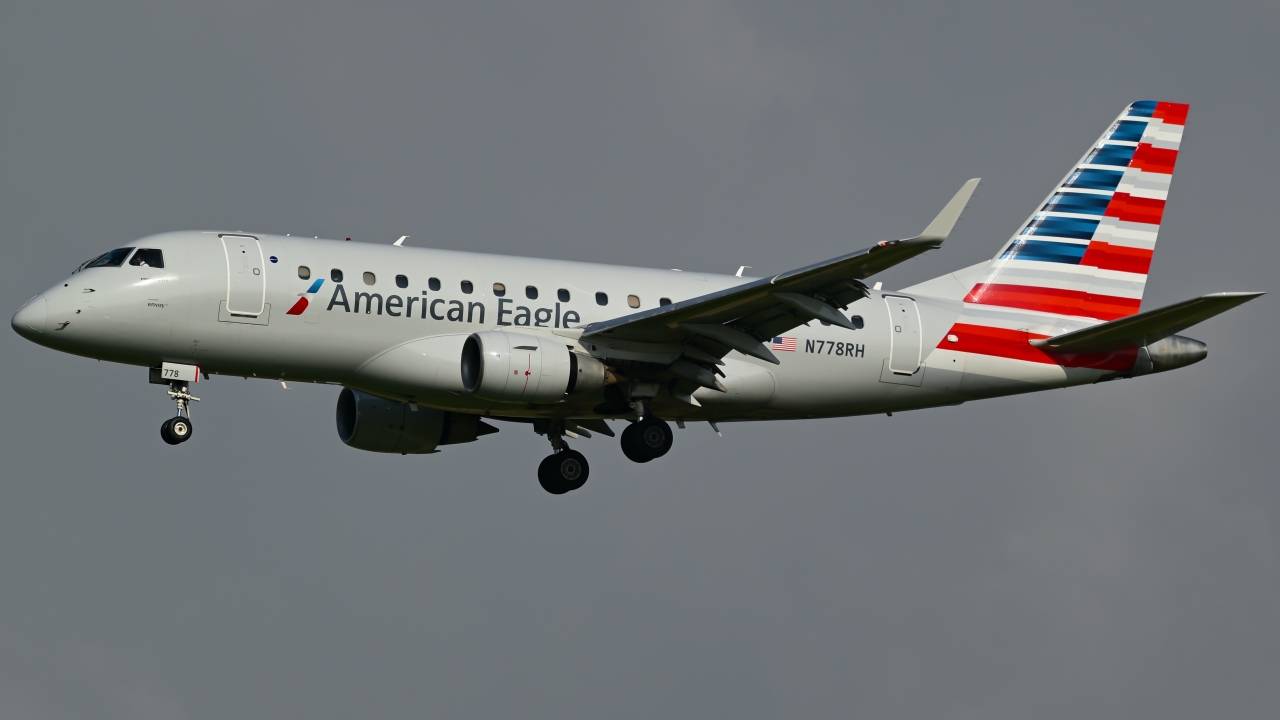

An American Eagle regional jet declared a fuel emergency after pilots failed to land the aircraft on three separate attempts at two different airports amid severe thunderstorms, forcing the flight crew to divert to a third, unplanned airport before finally touching down safely.
The incident involved American Eagle Flight AA3927, operated by Envoy Air on behalf of American Airlines, flying from Dallas Fort Worth (DFW) to Blue Grass Airport in Lexington, Kentucky (LEX) on August 11. The aircraft attempted to land at its destination and then at its planned alternate, encountering severe thunderstorms at both, before the crew determined fuel reserves had dropped to a level requiring an emergency declaration.

What Happened During the Flight
The regional jet, an Embraer E175LR registered N285NN, departed DFW around 2:09 p.m. on a scheduled two-hour flight. As it neared Lexington, storms and reduced visibility forced a go-around. Rather than try Lexington again, the crew diverted to their planned alternate, Louisville Muhammad Ali International Airport (SDF), roughly 60 miles away. Storms had also reached Louisville by then, forcing two further missed approaches on different runways – three in total across the two airports. Each go-around burned additional fuel, eroding the crew's safety margin.
After the third failed attempt, the crew declared a fuel emergency, with roughly 30 minutes of fuel remaining, and squawked transponder code 7700, signaling a general emergency. The declaration gave the aircraft priority over other traffic and let controllers clear a direct path for landing. Controllers vectored the jet to a third airport, Evansville Regional Airport (EVV) in Indiana, where it landed safely roughly three hours after departing Dallas.
No injuries were reported. Flight tracking data shows the same aircraft flew passengers on to Lexington shortly after landing in Evansville, a roughly 30-minute hop, before later operating its scheduled return service to Dallas, delayed just over three hours.
Understanding Fuel Emergencies
Under FAA rules, commercial flights must carry enough fuel to reach their destination, fly to an alternate, and hold for an additional 45 minutes. When pilots believe they can't land with that reserve intact, they declare "minimum fuel"; if conditions worsen, a full fuel emergency follows, triggering mandatory ATC priority, post-flight reporting, and typically an internal airline investigation.
Fuel emergencies remain relatively rare, since airlines build significant reserves into flight planning for weather delays, holding, and diversions. When crews still run low, it often reflects a combination of factors – unexpected weather at both destination and alternate, extended holding, or multiple missed approaches, as appears to have happened here.
Why Missed Approaches Occur
Pilots go around for reasons including poor visibility, wind shear, runway obstructions, unstable approaches, or ATC instructions. Here, severe thunderstorms drove it at both airports. Each go-around requires climbing, reconfiguring, and re-entering an approach sequence, burning considerably more fuel than a normal landing.
Three consecutive missed approaches across two airports typically point to persistent conditions making landing difficult, prompting a diversion somewhere more favorable – as this crew ultimately did by continuing to Indiana. The choice between another attempt and diverting depends on fuel state, nearby weather, and whether conditions seem likely to improve.
Airline and Regulatory Response
American Airlines has not released a detailed public statement. Regional carriers flying under the American Eagle brand follow the same safety standards required of all Part 121 operators. The FAA typically reviews fuel emergency declarations to assess whether flight planning, dispatch decisions, and in-flight actions complied with regulations.
Passengers rarely realize the seriousness of a fuel emergency in real time; the landing itself often looks routine from the cabin, even as controllers clear other traffic and emergency crews stage near the runway as a precaution, as they reportedly did at Evansville.
The Cockpit’s Next Revolution: When the Co-Pilot Is a Computer
What Comes Next
The airline will likely conduct an internal review of crew decisions, dispatcher communications, and fuel loading. For now, the crew's decision to declare an emergency after the third missed approach ensured the aircraft received the priority handling needed to land safely at Evansville. Passengers continued on to Lexington shortly after, and the flight ended without harm to anyone on board.
United 777 Diverts to Dublin After Cockpit Windscreen Cracks Over the Atlantic » Southwest Airlines Blames Brief System Outage for Boarding Delays and Checked Bag Disruptions » Delta Passenger Arrested After Allegedly Stealing Airport Tug »

Comments (0)
Add Your Comment
TAGS
NEWS American Airlines FAA Embraer E175LR N285NN DFW LEXRECENTLY PUBLISHED
 NetJets Expands US Footprint With Three New Private Terminals and Larger Palm Beach Facility
NetJets announces exclusive-use terminals in Dallas, Washington, and Palm Beach, expanding private aviation infrastructure across key US markets.
NEWS
READ MORE »
NetJets Expands US Footprint With Three New Private Terminals and Larger Palm Beach Facility
NetJets announces exclusive-use terminals in Dallas, Washington, and Palm Beach, expanding private aviation infrastructure across key US markets.
NEWS
READ MORE »
 Army Report Points to Systemic Failures in Deadly Black Hawk Collision Near Reagan National
A new Army report identifies systemic failures behind the January collision between a UH-60L Black Hawk and American Airlines Flight 5342 near Washington.
NEWS
READ MORE »
Army Report Points to Systemic Failures in Deadly Black Hawk Collision Near Reagan National
A new Army report identifies systemic failures behind the January collision between a UH-60L Black Hawk and American Airlines Flight 5342 near Washington.
NEWS
READ MORE »
 Why Did Some Air India A320s Have Extra Wheels? Bogie Gear Explained
Why Air India operated select Airbus A320s with an unusual bogie landing gear.
INFORMATIONAL
READ MORE »
Why Did Some Air India A320s Have Extra Wheels? Bogie Gear Explained
Why Air India operated select Airbus A320s with an unusual bogie landing gear.
INFORMATIONAL
READ MORE »
More than just headlines.
Get unlimited ad-free access to in-depth aviation news, premium stories, and exclusive insights other sites don't cover.
- Ad-free browsing on AeroXplorer
- Unlimited access to premium and exclusive articles
- Higher photo upload limits & commissions on sales
- Free access to Jetstream Magazine on higher tiers
- Ad-free browsing
- Sell aviation photos with 60% commission
- First week free!
- Everything in Basic+
- Unlimited premium articles
- Sell aviation photos with 70% commission
- Free Digital subscription to Jetstream Magazine
- First week free!
- Everything in Basic+ and Pro
- Sell aviaiton photos with 80% commission
- Early access to exclusive stories
- Free Digital+Print subscription to Jetstream Magazine