
Most safety equipment coverage focuses on what is new: a lighter alloy, a smarter sensor, a chemical formulation no one has tried. This is a different kind of story. It is about a company that kept an existing, proven technology in production long after most of the industry walked away.
That is the story of H3R Aviation, a Petaluma, California-based company that has spent more than three decades keeping Halon 1211 fire extinguishers in circulation — years after most of the industry assumed it was finished.
A Market Almost Everyone Left
In 1994, the Montreal Protocol on Substances that Deplete the Ozone Layer halted new production of Halon 1211 in developed nations, initiating a global phaseout of aviation’s most effective fire extinguishing agent. For most manufacturers, that was the end. California entrepreneur, Stephen Berg, saw opportunity.
Berg learned of the coming production ban in 1993 from a fellow passenger on a commercial flight. What caught his attention was that the Montreal Protocol didn't just tolerate Halon's continued use after the production cutoff; it explicitly encouraged recovering and recycling existing Halon back into new equipment. Berg founded a company to buy back retired Halon extinguishers, Recover the agent, Recycle it to specification, and Redeploy it into newly manufactured units. “H3R” - Halon and the three R's was born.
Halon Still Earns Its Place
The reason Halon has been so hard to replace isn't nostalgia — it's chemistry. Halon 1211 interrupts the chemical chain reaction that keeps a fire burning, rather than smothering or cooling it. This lets a small charge do an outsized job. Alternative agents need more charge to match Halon's fire rating, which means a bigger, heavier extinguisher. That’s a design constraint in the confines of a cockpit.
Halon’s ozone-depleting properties must be acknowledged, however. They are higher than most of the chemicals typically associated with the original ozone-layer scare. But H3R urges deeper analysis. A handheld extinguisher containing recycled Halon 1211 stops a fire faster than any alternative. And what burns if nothing stops it, isn't clean either. Cabin materials release black carbon, CO2, and toxic byproducts when they combust. A fire that isn't caught in time can mean burned fuel, destroyed composites and batteries, and even a total loss. Judged against that alternative, the company argues, a fast, effective knockdown is the better environmental outcome.
The reality, too, is that very little Halon 1211 is actually used in aviation. Fires are relatively rare, and regulations ban the discharge of halon for non-emergency use, such as training.

A 30-Year-Old Myth
Ask around a flight line today and a common assumption comes up fast: Halon extinguishers were banned years ago. It's an understandable mix-up — the 1994 production cutoff got real attention at the time, and three decades is long enough for “production halted” to blur into “banned outright” in industry memory.
It isn't true for most of the world. The United States and Canada still permit Halon 1211 with no retirement date. Most other countries allow it too, generally with conditions tied to when an aircraft entered service. The European Union and United Kingdom are the exception, having phased Halon 1211 out of aircraft from 2026. Everywhere else sits somewhere on a spectrum.
H3R says the confusion isn't hypothetical. Operators have nearly grounded aircraft unnecessarily or paid for replacements based on a rule that didn't actually apply to them.
“We regularly receive inquiries from operators who are surprised to learn that Halon 1211 fire extinguishers are not only still available and still allowed, but less expensive than the alternatives.”
— Chris Dieter, Senior Vice President, H3R Aviation
No Sunset After All
The Montreal Protocol isn't the only source of confusion. UL Solutions' own listing history has added to it. Fire extinguishers must be UL listed to gain FAA approval. UL had more than once set withdrawal dates for Halon 1211 listings, the most recent, January 1, 2025. This led many to expect Halon's exit from aviation, but in November 2024, UL updated its position, confirming that extinguishers charged with reclaimed Halon 1211 remain eligible for the UL Listing Mark indefinitely. The FAA continues to allow the use of Halon 1211 fire extinguishers in existing and new installations. Therefore, fire extinguishers containing recycled Halon 1211 remain a compliant, supportable choice for U.S. operators, with no change on the horizon.
One Guide, Every Country's Rules
To cut through the confusion, H3R built a step-by-step decision guide that walks operators through the questions that determine their answer: Where is the aircraft registered? Was its Certificate of Airworthiness — or, in Brazil's case, its Type Certificate — issued before or after the relevant cutoff date? Has the operator's country adopted the ICAO Annex 6 Halon-replacement standard into law?
Click here to view H3R's decision guide.
The guide distills a regulatory picture spanning the FAA, EASA, the UK's Ozone-Depleting Substances Regulations, Australia's CASR 90.150, China's CAAC Airworthiness Directive CAD2021-MULT-80, and Brazil's ANAC into four questions and a handful of answers.
Halon-Free Options
None of this makes H3R a Halon-only shop. The company offers factory-new Halon 1211 extinguishers for operators who can use them, and two Halon-free agents for those who can’t.
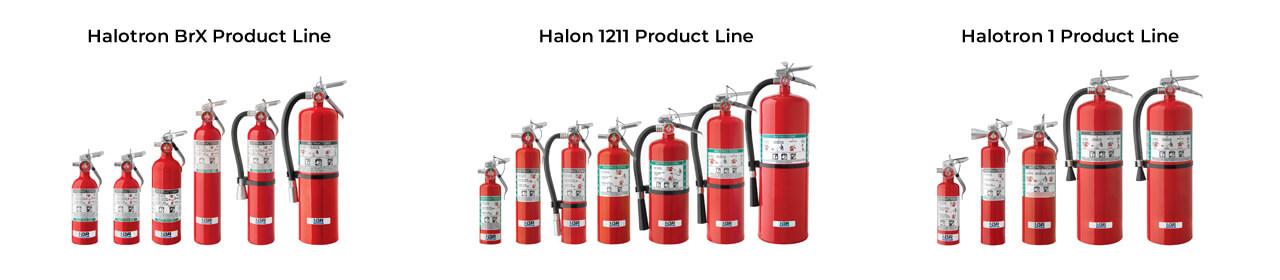
Halotron® BrX is the newest, most widely accepted, and closest agent in performance to Halon 1211. It carries EASA, FAA, UL, ISO, and EN recognition and is the only option in the EU and UK. Halotron® 1 is the established, more economical option for operators in markets without the EU's HCFC restrictions. Between the three product lines, H3R can equip an aircraft whether it's grandfathered under a decades-old airworthiness certificate or was delivered last month.
Built for Every Operator
General aviation shops recharging a single cockpit extinguisher, Part 135 and Part 91 corporate flight departments managing mixed fleets across multiple registries, and OEMs specifying fire protection equipment for aircraft still in production each has a different version of the same question — what do the rules require for this particular aircraft, in this particular country? The company’s decision guide was built to help with four simple questions.

How the Guide Works
Picture a corporate flight department with a mixed fleet: one aircraft on a U.S. registry, one recently added to a European registry after a cross-border sale. Under the old assumption — that Halon is simply banned — the operator might replace both extinguishers preemptively, at a cost and for no regulatory reason. Working through H3R's guide instead, the U.S.-registered aircraft clears Step 1 immediately: still legal, no action needed. The EU-registered aircraft reaches Step 2, where the answer is direct — Halon 1211 is not permitted, and the operator needs Halotron BrX, the only agent approved for that side of the fleet.
Click here to view the decision guide.
That's one example, but it's illustrative of the calls H3R fields every week: not “is Halon legal,” but “is Halon legal for this aircraft.” The distinction is the entire premise behind the guide — and, increasingly, how the company talks about its own product line.
Still Flying, Still Explained
Three decades after the Montreal Protocol threatened to end Halon's run in aviation, the agent is still flying — recovered, recycled, and is still widely misunderstood. For H3R Aviation, staying in a market most of the industry assumed was closing turned out to be a wise move.
What Operators Should Know
- Halon 1211 remains fully legal in the U.S. and Canada, with no retirement date in place.
- Most other countries permit it, often with conditions tied to when a given aircraft was certificated.
- The EU and UK are the exception, having banned Halon 1211 from aircraft from 2026.
- Recycled global supply is projected to remain healthy for decades.
- Where Halon isn't an option, Halotron BrX and Halotron 1 are proven, currently manufactured alternatives.
About H3R Aviation
H3R Aviation, Inc. is based in Petaluma, California, and sells Halon 1211, Halotron® BrX, and Halotron® 1 fire extinguishers for aircraft operators, OEMs, and MROs worldwide through its aviation distributor partners.
A summary of Halon 1211 regulations by country and H3R's decision guide is available at h3raviation.com.
Ryanair Boeing 737 Aborts Takeoff at Alicante Airport, Civil Aviation Commission Launches Investigation » KLM Welcomes Its First Airbus A350 to Schiphol Fleet » United Express Flight Returns to Houston After Cockpit Windshield Shatters Mid-Flight »

Comments (0)
Add Your Comment
TAGS
INFORMATIONAL H3R Aviation Halon 1211 Aircraft Fire Extinguishers Aviation Safety Fire Protection Aircraft Maintenance HalotronRECENTLY PUBLISHED
 American Airlines Swaps Landline Buses for CRJ-700 Flights on 84-Mile South Bend to Chicago Route
American Airlines replaces its South Bend to Chicago Landline bus service with CRJ-700 regional jet flights starting today, cutting travel to 84 miles by air.
ROUTES
READ MORE »
American Airlines Swaps Landline Buses for CRJ-700 Flights on 84-Mile South Bend to Chicago Route
American Airlines replaces its South Bend to Chicago Landline bus service with CRJ-700 regional jet flights starting today, cutting travel to 84 miles by air.
ROUTES
READ MORE »
 Aviation Fuel Prices Hit Six-Month High in September
Aviation fuel prices surged to their highest level in six months during September 2026, with jet-A and avgas posting notable gains.
NEWS
READ MORE »
Aviation Fuel Prices Hit Six-Month High in September
Aviation fuel prices surged to their highest level in six months during September 2026, with jet-A and avgas posting notable gains.
NEWS
READ MORE »
 British Airways Unveils World's Largest Business Class Cabin With 106 Seats Aboard Refurbished A380 Fleet
British Airways reveals a record-setting 106-seat Club Suite business class cabin as part of a multi-billion pound A380 refurbishment program.
NEWS
READ MORE »
British Airways Unveils World's Largest Business Class Cabin With 106 Seats Aboard Refurbished A380 Fleet
British Airways reveals a record-setting 106-seat Club Suite business class cabin as part of a multi-billion pound A380 refurbishment program.
NEWS
READ MORE »
More than just headlines.
Get unlimited ad-free access to in-depth aviation news, premium stories, and exclusive insights other sites don't cover.
- Ad-free browsing on AeroXplorer
- Unlimited access to premium and exclusive articles
- Higher photo upload limits & commissions on sales
- Free access to Jetstream Magazine on higher tiers
- Ad-free browsing
- Sell aviation photos with 60% commission
- First week free!
- Everything in Basic+
- Unlimited premium articles
- Sell aviation photos with 70% commission
- Free Digital subscription to Jetstream Magazine
- First week free!
- Everything in Basic+ and Pro
- Sell aviaiton photos with 80% commission
- Early access to exclusive stories
- Free Digital+Print subscription to Jetstream Magazine