
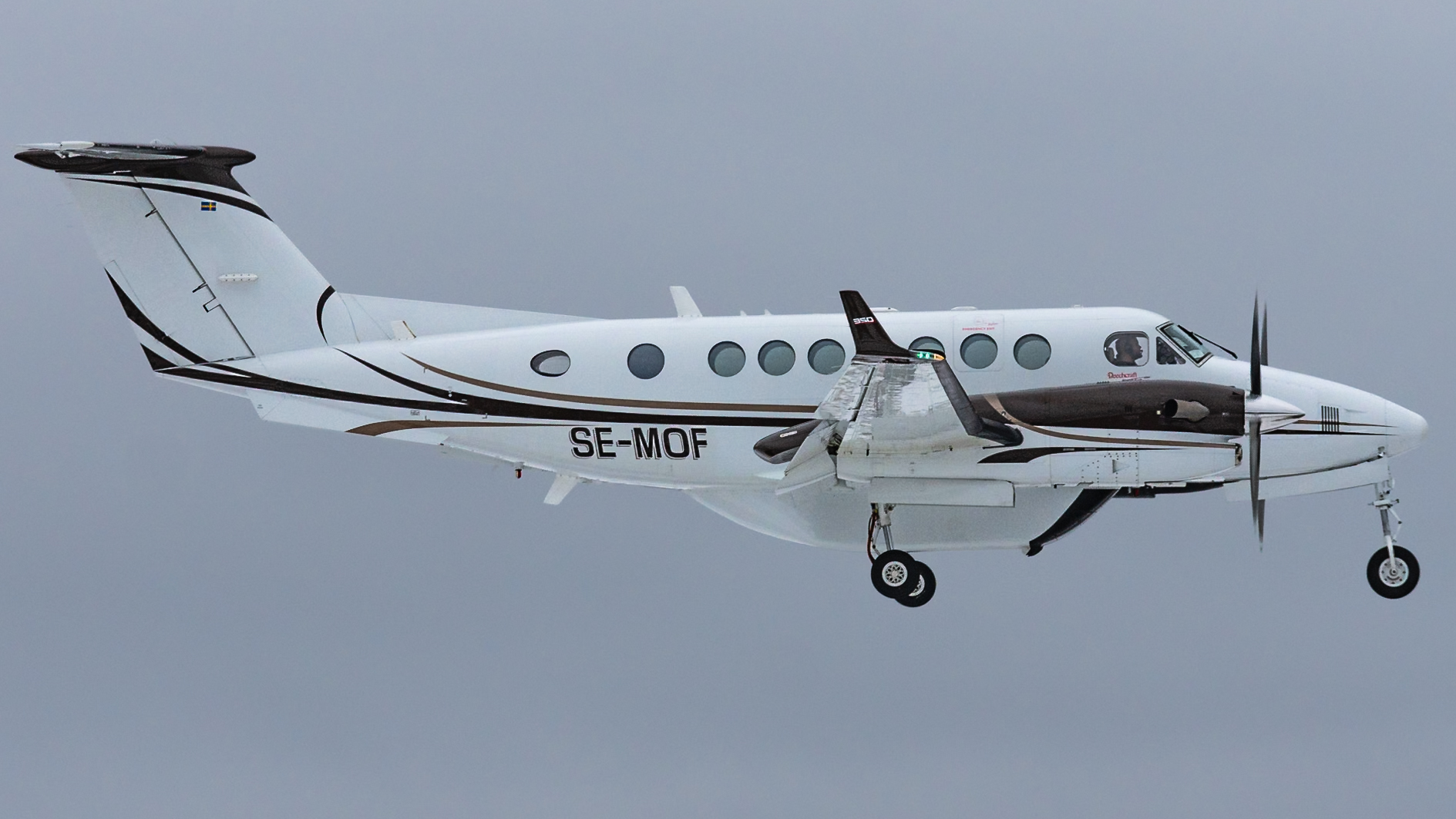

The National Transportation Safety Board has released its preliminary report on a fatal Beechcraft King Air crash, and investigators flagged GPS jamming as a notable factor during the flight. The report adds to growing concerns within aviation about the rising frequency of navigation signal interference and how it can affect general and business aviation operations.
What Happened
According to the NTSB preliminary report, the King Air went down during a flight that crossed regions where GPS jamming has been reported. Preliminary reports document the basic facts of an accident without assigning probable cause, which the NTSB typically determines in a final report months or even years later.
Investigators noted that the aircraft experienced navigation anomalies consistent with GPS interference during the flight. The crew faced conditions in which satellite-based navigation could not be relied on as the primary means of position fixing.
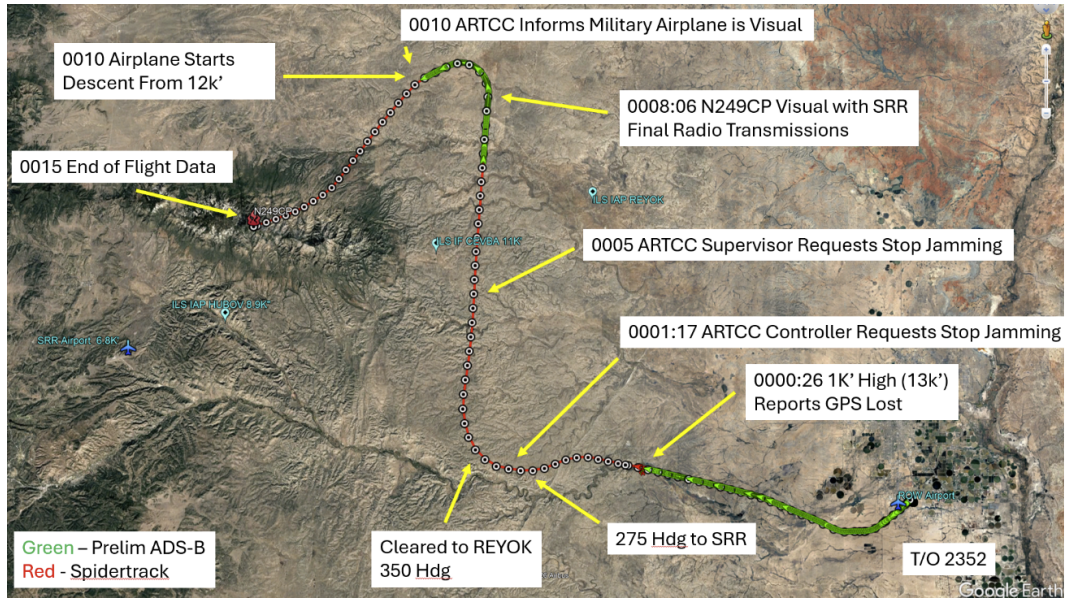
Photo: NTSB/ Preliminary report WPR26FA186
Why GPS Jamming Matters
GPS jamming involves the transmission of radio signals on the same frequencies used by Global Positioning System satellites, drowning out the weak signals from space. Spoofing, a related threat, sends false GPS data that can trick avionics into showing incorrect positions. Both have surged in recent years, particularly near conflict zones and along certain international air corridors.
For modern turbine aircraft like the King Air, GPS underpins much of the navigation, flight management, and approach guidance systems. When the signal becomes unreliable, pilots must revert to older techniques such as VOR navigation, dead reckoning, or radar vectors from air traffic control. Cockpit workload increases, and situational awareness can degrade quickly if crews are not prepared for the loss.
Industry Concerns About Interference
Aviation safety organizations have been sounding the alarm about GPS interference for some time. Reports from operators flying near the Middle East, the Black Sea region, the Baltic, and parts of Asia describe sudden navigation failures, false position indications, and disrupted terrain warning systems. The International Civil Aviation Organization, EASA, and IATA have all issued advisories urging operators to plan for the possibility of GPS denial.
The concern is no longer limited to high-altitude commercial routes. Business jets, turboprops, and even general aviation aircraft are now reporting incidents in regions where jamming was once rare. Pilots flying single-pilot operations face particular challenges because they may have less bandwidth to manage a sudden navigation problem while also flying the airplane.
The Cockpit’s Next Revolution: When the Co-Pilot Is a Computer
What the NTSB Report Reveals
NTSB preliminary reports usually contain limited information. They establish the timeline, weather conditions, aircraft type, crew details, and any immediately apparent factors. In this case, the inclusion of GPS jamming as a documented element of the flight is significant because it shows that investigators are taking the issue seriously as a potential contributor to the accident chain.
The report does not state that GPS jamming caused the crash. That determination, if it is made at all, will come later. But the explicit mention puts jamming squarely on the table as something the investigation team is examining alongside other factors such as weather, crew actions, mechanical condition, and air traffic control communications.

Photo: AeroXplorer/ Philip Wiklander
How Pilots Are Adapting
Training programs have started to incorporate GPS denial scenarios more aggressively. Simulator sessions now routinely include exercises where pilots lose GPS during an approach or in cruise. The goal is to keep traditional navigation skills sharp and to make sure crews recognize the signs of interference quickly.
Operators flying in regions known for interference often brief their crews on which areas to expect problems, what backup procedures to use, and how to communicate the issue to air traffic control. Some have updated their flight planning software to flag affected airspace automatically.
Avionics manufacturers are working on solutions as well. Inertial reference systems, which use accelerometers and gyroscopes to track position without external signals, provide a degree of independence from GPS. Multi-constellation receivers that can use signals from GLONASS, Galileo, or BeiDou offer some redundancy, though they remain vulnerable to broad-spectrum jamming.
The Broader Safety Picture
Aviation has long relied on layered safety systems. No single failure should bring down an aircraft, and pilots are trained to manage degraded equipment scenarios. GPS jamming tests that philosophy because it can affect multiple systems at once, including terrain awareness, traffic alerts, and autopilot modes that depend on accurate position data.
The NTSB investigation will likely look at how the crew responded to the navigation anomalies, what backup procedures were available, and whether the aircraft's systems behaved as designed in the presence of interference. Those findings could influence training standards, procedures, and equipment requirements going forward.
What Comes Next
A final NTSB report typically takes 12 to 24 months to complete after a preliminary report. During that time, investigators will examine wreckage, review flight data, interview witnesses, and consult with the manufacturer, the FAA, and any other relevant parties. The probable cause statement, when it comes, will represent the agency's official conclusion.
For now, the preliminary report serves as a reminder that GPS jamming is no longer a theoretical concern for aviators. It is a real-world factor that investigators are examining in the context of an actual fatal accident. Operators, pilots, and regulators will be watching this investigation closely.
If you fly or work in aviation, the takeaway is straightforward. Know your backup navigation procedures, expect interference in regions where it has been reported, and treat GPS as a tool that can fail rather than an infallible source of truth.
Airbus Uncovers Coating Flaw on A321neo Fuselage Stringers, Threatening September Delivery Targets » Why Statistics Matters for Future Aviation Professionals » Southwest Airlines Flight Returns to Orlando After Bird Strike on Takeoff »

Comments (0)
Add Your Comment
TAGS
NEWS NTSB Preliminary Report GPS Jamming Beechcraft King Air Fatal Crash Aviation Safety Aircraft Accident Navigation Systems GPS Interference Flight Operations Accident Investigation Safety InvestigationRECENTLY PUBLISHED
 IATA's New Passenger Data Shows Global Air Travel Demand Shrinking for the First Time This Year
Global air travel just hit a reverse that has not been seen in months -- the numbers point to something more interesting than a simple slowdown.
INFORMATIONAL
READ MORE »
IATA's New Passenger Data Shows Global Air Travel Demand Shrinking for the First Time This Year
Global air travel just hit a reverse that has not been seen in months -- the numbers point to something more interesting than a simple slowdown.
INFORMATIONAL
READ MORE »
 The $30 Billion Question: Why America's Air Traffic Control Overhaul Keeps Getting More Expensive
The U.S. government is seeking $30 billion more to modernize America’s aging air traffic control system. Explore the rising $42.5 billion price tag, GAO oversight concerns, and where the new funding would go.
INFORMATIONAL
READ MORE »
The $30 Billion Question: Why America's Air Traffic Control Overhaul Keeps Getting More Expensive
The U.S. government is seeking $30 billion more to modernize America’s aging air traffic control system. Explore the rising $42.5 billion price tag, GAO oversight concerns, and where the new funding would go.
INFORMATIONAL
READ MORE »
 Embraer Posts Record 66 Aircraft Deliveries in Q3 2026 as Commercial Jets Climb 10%
Embraer delivered 66 aircraft in Q3 2026, its strongest third quarter on record, with commercial jets up 10% and business jets rising 41%.
NEWS
READ MORE »
Embraer Posts Record 66 Aircraft Deliveries in Q3 2026 as Commercial Jets Climb 10%
Embraer delivered 66 aircraft in Q3 2026, its strongest third quarter on record, with commercial jets up 10% and business jets rising 41%.
NEWS
READ MORE »
More than just headlines.
Get unlimited ad-free access to in-depth aviation news, premium stories, and exclusive insights other sites don't cover.
- Ad-free browsing on AeroXplorer
- Unlimited access to premium and exclusive articles
- Higher photo upload limits & commissions on sales
- Free access to Jetstream Magazine on higher tiers
- Ad-free browsing
- Sell aviation photos with 60% commission
- First week free!
- Everything in Basic+
- Unlimited premium articles
- Sell aviation photos with 70% commission
- Free Digital subscription to Jetstream Magazine
- First week free!
- Everything in Basic+ and Pro
- Sell aviaiton photos with 80% commission
- Early access to exclusive stories
- Free Digital+Print subscription to Jetstream Magazine