
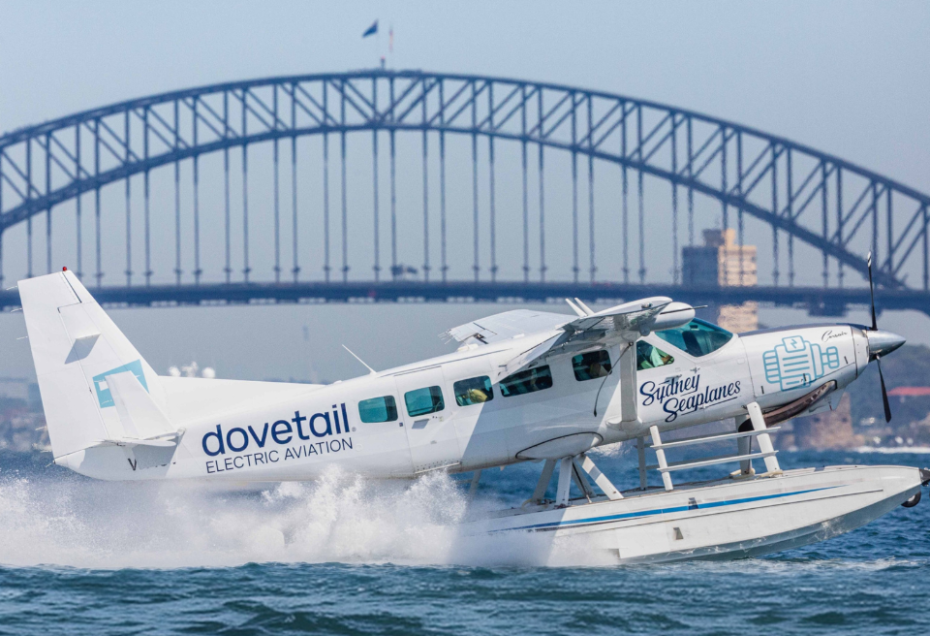
Electrification was one of the defining stories of this year's Farnborough International Airshow. GE Aerospace, working with NASA, Boeing and BETA Technologies, used the week to announce the first hybrid-electric flight above 30,000 feet. Airbus talked up its electrified-systems research. BETA signed a deal to bring battery aircraft into a UK regional carrier's network within a few years. Amid that fast company, one name kept coming up on the show floor for a very different reason: Dovetail Electric Aviation had just landed its first paying customer.
Dovetail, the Australian-Spanish company converting Cessna Caravans and Beechcraft King Airs into zero-emission, battery- and hybrid-electric aircraft, announced at the show that Norwegian operator Ludens Aviation is its launch customer. It's a milestone five years in the making, and a clear signal that the company's technology and its business model are ready to move from promise to production.
AeroXplorer sat down with the CEO and Co-founder of Dovetail, Mr David Doral, on the show floor to talk through the Ludens deal, the company's roadmap to first flight, and the sharp strategic choices propelling Dovetail toward zero-emission regional flight.
A Tipping Point, Five Years in the Making
The Ludens Aviation agreement, announced July 22, gives the Norwegian aircraft-leasing and skydiving-linked operator a pathway to acquire and fly the first Dovetail-converted electric Caravan once the aircraft clears an EASA Supplemental Type Certificate. It also brings Ludens in as a partner on conversion, testing and pre-certification work as Dovetail's program advances, turning the company's first customer into a genuine development ally.
It's the latest, and most concrete, step in a Norwegian relationship Dovetail has been building since at least 2024, when it agreed to convert several Cessna 208s for Skydive Voss and partnered separately with Scandinavian Seaplanes on Europe's first electric seaplane ambitions. Dovetail CEO David Doral called the Ludens contract a tipping point, saying in a statement that it marked the moment the company's pipeline of letters of intent began converting into binding agreements. Ludens CEO Kjetil Kriken, for his part, described the order as more than an aircraft purchase:
“Electric aircraft and skydiving are a perfect match: short cycles, fixed patterns above the same field, and a community that cares about noise and emissions. With this agreement we are not just ordering an aircraft, we are building the operating model, the charging infrastructure and the financing template that will put electric Caravans to work commercially in Norway. We look forward to seeing the first one climb above Voss”
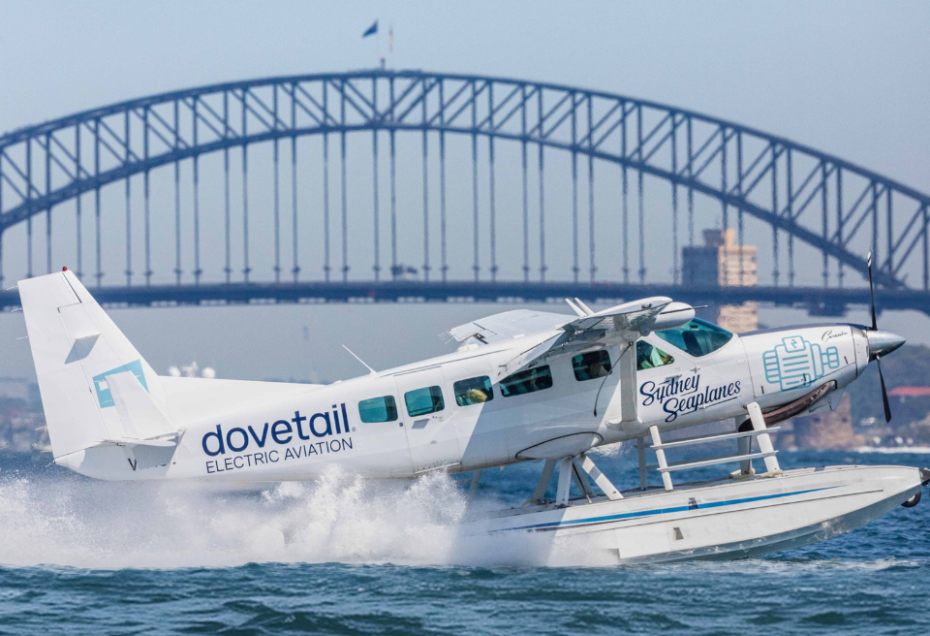
Photo: Dovetail Electric Aviation
Charting the Course to First Flight
At Farnborough, Doral laid out the company's flight-test roadmap with confidence: first flight in the fourth quarter of 2027, with certification and entry into service targeted for late 2029. It's a schedule the company has sharpened as it brings on senior engineering talent and finalizes its production design, the kind of deliberate, methodical refinement that comes from five years of prototyping and flight-test learning, not a step backwards.
That refinement follows the high-profile arrival of Michele D'Ercole as Chief Technology Officer and Head of Engineering. A 30-year veteran of turbomachinery and electric propulsion, D'Ercole has held senior roles at Fiat Avio, GE Oil & Gas and GE Aviation's Czech turboprop operations, and previously served as chief operating officer, and later acting chief executive, at electric-motor pioneer magniX. It's worth noting the depth of bench strength Dovetail has assembled around him: the executive he succeeded in that magniX role, Roei Ganzarski, now sits on Dovetail's own board of advisors. D'Ercole is now putting three decades of propulsion experience directly to work, finalizing the DovePower system ahead of its debut flight.
Mr David Doral was upbeat about where the hardware stands. Dovetail has already built a second-generation electric motor and is now finishing a third, flight-standard version. Battery pack technology has been validated at the individual-module level, and the team is now scaling up to full production packs of 25 to 30 modules per aircraft, a manufacturing and supply-chain milestone the company is well-positioned to hit, rather than an open technical question. On maintenance economics, David Doral added;
“In terms of TBO (time between overhauls), Dovetail is targeting initially 10,000 hours. That could be close to three times the time between overhauls for a conventional (turboprop) engine.”
With overhaul costs it believes could run at least an order of magnitude lower, figures the company itself cautions are still preliminary. Certification is being pursued in a clear, sequential order: a pre-certification contract with Europe's EASA first, followed by Australia's CASA and, eventually, the US FAA.
“From a certification point of view, in the end what we need to do is to demonstrate that all this technology is safe and is robust, and that we can prove that it's capable of meeting the stringent standards from regulators.” David Doral said.
Funding, too, is falling into place. Dovetail said it is finalizing a new investment round, with the bulk of the capital it needs to reach first flight already committed, targeting a close in September or October, which puts the company on a clear glide path toward its 2027 milestone.
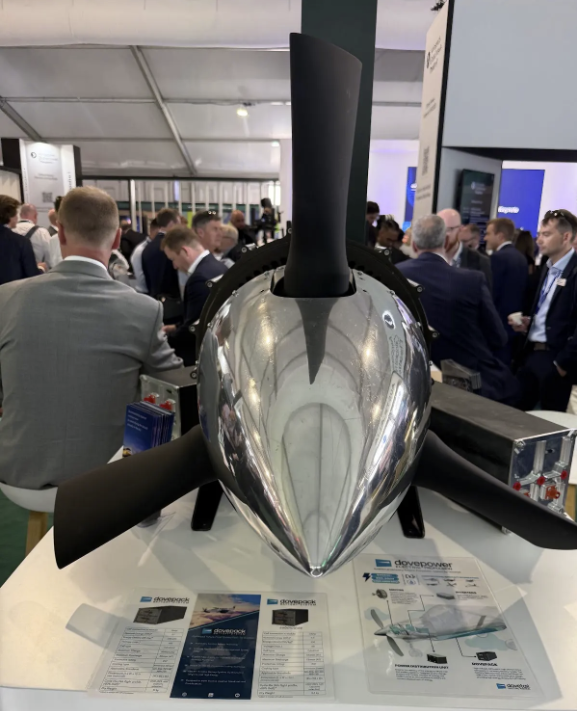
Photo: AeroXplorer/ Shashi
A Pragmatic, Confident Roadmap
Few companies have built as broad a base of zero-emission propulsion expertise as Dovetail. Over the past several years, the company has demonstrated hydrogen-electric powerplant prototypes in Spain, partnered with Hyundai's HTWO on fuel-cell supply, and, as recently as last November, used financing from CaixaBank to advance a €5.5 million, CDTI-backed hybrid-electric program with Spanish partners Aciturri and ITP Aero. Isidoro Ruiz, Dovetail's director of European operations, called that CaixaBank support "a powerful endorsement of Spain's capacity to lead the decarbonisation of regional aviation."
At Farnborough, Doral explained how that deep technology base is now being channeled into the fastest, most certifiable path to market. Propulsion stays 100% electric across every platform, powered by the company's own DovePower motor and DovePack battery system. For extended-range missions, rather than waiting on a hydrogen refueling ecosystem that the company expects will take the better part of a decade to mature at scale. Dovetail is integrating a turbogenerator, a compact gas-turbine generator, in a series-hybrid configuration that recharges batteries or feeds the electric motor directly, particularly in cruise. It's the same proven, fast-to-certify hybrid-electric architecture Dovetail has already been advancing with Dutch operator Zeusch Aviation on the King Air program since mid-2025. It reflects a company choosing speed and certainty over a longer, less predictable path. The company's earlier hydrogen-electric research remains part of its broader technology portfolio, ready to be drawn on as that ecosystem matures in parallel.
The platform sequencing stays clear and disciplined. The Cessna Caravan remains the beachhead- battery-only, purpose-built for the shortest missions: skydiving, island-hopping, scenic flights. The King Air, a larger and longer-range aircraft, is being engineered as hybrid-electric from day one, giving operators the extra range those missions demand right out of the gate.
The Shape of Disaster: The Plane That Kept Falling Apart Mid-Air
A Growing Global Customer Base
Dovetail's own figures put the global fleet of Cessna 208s at roughly 3,000 aircraft, with a serviceable obtainable market for conversions the company values at $1.3 billion, including what it calls a de facto lock on the roughly 176 Cessna 208s flying across Australia and New Zealand. The Beechcraft King Air, the company's next platform, is a larger prize still: FlightGlobal has put the addressable fleet, focused on 200- and 300-series variants, at around 7,000 aircraft.
The customer list is a testament to how much traction Dovetail has already built: Ludens Aviation and Skydive Voss in Norway, Scandinavian Seaplanes, Dutch charter and medevac operator Zeusch Aviation for the King Air program, and South Korea's MintAir, which has an agreement covering up to ten converted aircraft starting with battery Caravans for cargo. Aircraft-leasing specialist MONTE committed back in 2022 to purchasing up to 50 conversions across both platforms, one of several deals that have helped Dovetail amass more than $170 million in cumulative pre-orders and letters of intent, according to figures cited by the University of New South Wales, one of the company's research partners.
As turbogenerator-equipped variants come online, the mission set only grows. Dovetail says a hybridized Caravan could reach roughly 300 km of range, opening the door to cargo operators, while a hybridized King Air, per the Zeusch partnership, could fly 400–500 km (215–270 nm) with at least eight passengers aboard; enough for scheduled charter, medevac and special-mission work. The company's ownership base reinforces that growing institutional confidence: Nasdaq-listed Air T, Inc. inherited Regional Express's 20% equity stake in Dovetail when it completed its acquisition of the Australian carrier in December 2025, giving Dovetail a US-listed public company as a shareholder and opening new relationships with American turboprop freighter operators.
Dovetail's momentum also reflects an industry-wide shift now well underway: alongside efforts from companies like Ampaire, ZeroAvia and Heart Aerospace, the push toward electrified regional aviation that Dovetail bet on five years ago is now a global movement, and Dovetail, with a binding customer order already in hand, is out in front of it.
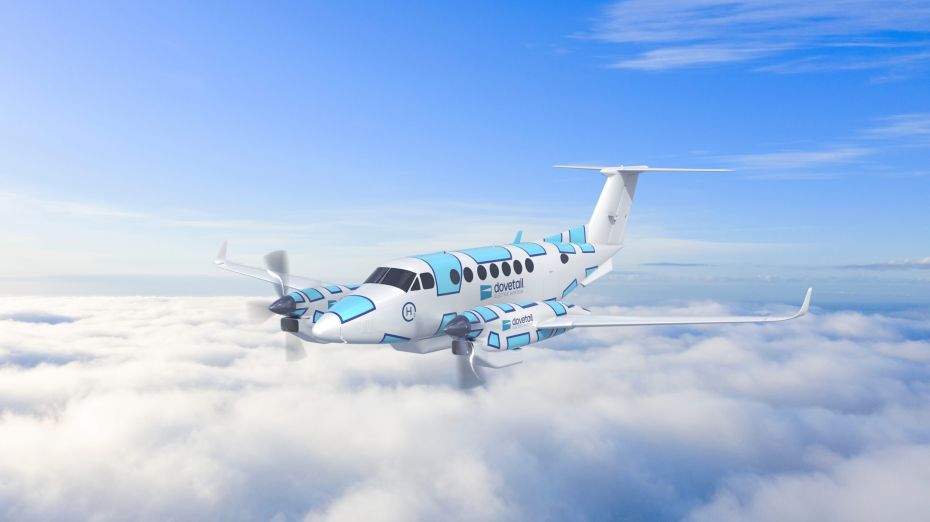
Photo: Dovetail Electric Aviation
Funding the Final Stretch to First Flight
Dovetail's funding story is one of steadily deepening backing from governments, airlines and industrial partners across two continents: an early A$3 million (about US$2 million) Australian government grant in 2023; a roughly $7.5 million seed round split into two tranches, the first backed by regional carrier Rex alongside Spanish airlines Volotea and Air Nostrum, the second led by Spanish aerostructures group Aciturri in 2024; non-dilutive support from Victoria's state government; a job-creation grant from the regional government of Andalusia, where Dovetail has built out its European engineering base; and, most recently, CaixaBank financing to bridge €1.7 million of a Spanish government innovation grant.
The company's cap table strengthened further at the end of last year, when Rex's 20% Dovetail stake, taken in 2023 in exchange for a board seat, passed to Air T, Inc. as the Nasdaq-listed logistics and aviation-services company completed its full acquisition of the Australian carrier. That gives Dovetail a US-listed public company among its major shareholders, a relationship the company sees as a springboard into the American market.
What's left, by the company's own account, is closing out the round it needs to reach first flight, a raise the Farnborough representative said is substantially subscribed already, with a final close targeted for September or October and room, potentially, for one more strategic addition to the cap table.
A Track Record of Discipline and Realism
Asked what stands between Dovetail and the finish line, the company's representative gave a refreshingly candid answer. Funding, historically the harder of Dovetail's two central challenges, particularly in Europe and Australia, is now largely in hand, the company says, thanks to years of relationship-building with airlines, governments and industrial partners. Certification is the other, and Dovetail describes it as a matter of methodical execution: working hand-in-hand with EASA to demonstrate, step by step, that its technology meets the same rigorous standards applied to any commercial aircraft modification.
What comes through most clearly is the company's discipline. Dovetail's representative was direct that promising figures like 1,000 km of pure battery range "is not going to happen for a long time," and framed the retrofit approach, adapting proven, in-service aircraft with near-term battery chemistry rather than chasing a clean-sheet design or an unproven hydrogen ecosystem, as the most realistic path to a certified, flying product this decade. It's exactly the kind of engineering-first, promises-you-can-keep culture that has helped Dovetail win the confidence of operators, regulators and now its first paying customer.
What's Next
With a first paying customer now under binding contract, a strengthened engineering team, and a clear-eyed roadmap to first flight in the fourth quarter of 2027, Dovetail Electric Aviation heads into the next chapter of its journey with real momentum. If the company delivers on the plan it laid out at Farnborough, the skies above Voss, Norway, and eventually island-hopping routes, medevac corridors and scenic flights around the world, could soon carry the sound of nothing at all: the quiet hum of zero-emission flight.
Air Cairo Places Landmark Order for 15 Airbus A320neo Jets at El Alamein Airshow » Malaysian Flying Doctor Service Helicopter Crashes in Borneo, Killing All Five Aboard » GA-ASI Introduces Purpose-Built Wildfire UAS for Aerial Firefighting Missions »

Comments (0)
Add Your Comment
TAGS
NEWS Dovetail Electric Aviation Electric Aviation Hybrid-Electric Propulsion Cessna Caravan Beechcraft King Air Farnborough Airshow 2026 Sustainable Aviation EASA Certification DovePower Regional Aviation Zero-Emission Flight Ludens AviationRECENTLY PUBLISHED
 How Ryanair and Alaska Airlines Are Using AI to Make Real Decisions, Not Just Predictions
Airlines are moving beyond AI predictions and letting artificial intelligence make real operational decisions. Explore how Ryanair, Alaska Airlines and Cathay Pacific are using AI for crew scheduling, overbooking and contrail avoidance and what this means for the future of airline operations.
INFORMATIONAL
READ MORE »
How Ryanair and Alaska Airlines Are Using AI to Make Real Decisions, Not Just Predictions
Airlines are moving beyond AI predictions and letting artificial intelligence make real operational decisions. Explore how Ryanair, Alaska Airlines and Cathay Pacific are using AI for crew scheduling, overbooking and contrail avoidance and what this means for the future of airline operations.
INFORMATIONAL
READ MORE »
 Why Do Some Flights Take Longer Than Others on the Same Route?
Why do some flights take longer than others on the same route? From jet streams and seasonal winds to ATC congestion, great-circle routing, and airline schedule padding, several factors influence flight duration. Here's how flight paths, weather, and air traffic control affect your journey.
INFORMATIONAL
READ MORE »
Why Do Some Flights Take Longer Than Others on the Same Route?
Why do some flights take longer than others on the same route? From jet streams and seasonal winds to ATC congestion, great-circle routing, and airline schedule padding, several factors influence flight duration. Here's how flight paths, weather, and air traffic control affect your journey.
INFORMATIONAL
READ MORE »
 This Week in Aviation: The 10 Stories That Mattered Most
From major airline developments to aircraft updates and industry shifts, this weekly recap highlights the ten most-read aviation stories from the week of September 06.
INFORMATIONAL
READ MORE »
This Week in Aviation: The 10 Stories That Mattered Most
From major airline developments to aircraft updates and industry shifts, this weekly recap highlights the ten most-read aviation stories from the week of September 06.
INFORMATIONAL
READ MORE »
More than just headlines.
Get unlimited ad-free access to in-depth aviation news, premium stories, and exclusive insights other sites don't cover.
- Ad-free browsing on AeroXplorer
- Unlimited access to premium and exclusive articles
- Higher photo upload limits & commissions on sales
- Free access to Jetstream Magazine on higher tiers
- Ad-free browsing
- Sell aviation photos with 60% commission
- First week free!
- Everything in Basic+
- Unlimited premium articles
- Sell aviation photos with 70% commission
- Free Digital subscription to Jetstream Magazine
- First week free!
- Everything in Basic+ and Pro
- Sell aviaiton photos with 80% commission
- Early access to exclusive stories
- Free Digital+Print subscription to Jetstream Magazine