
This year's Farnborough International Airshow arrived as the largest edition in the show's 78-year history, organizers say. Exhibition space sold out twice over, a newly built sixth exhibition hall, and roughly a fifth of this year's 1,600-plus exhibitors walking Farnborough's halls for the very first time.
Between the static line of business jets and the roar of the flying display overhead, though, some of the show's most consequential engineering is easy to miss entirely, because it's designed to be.
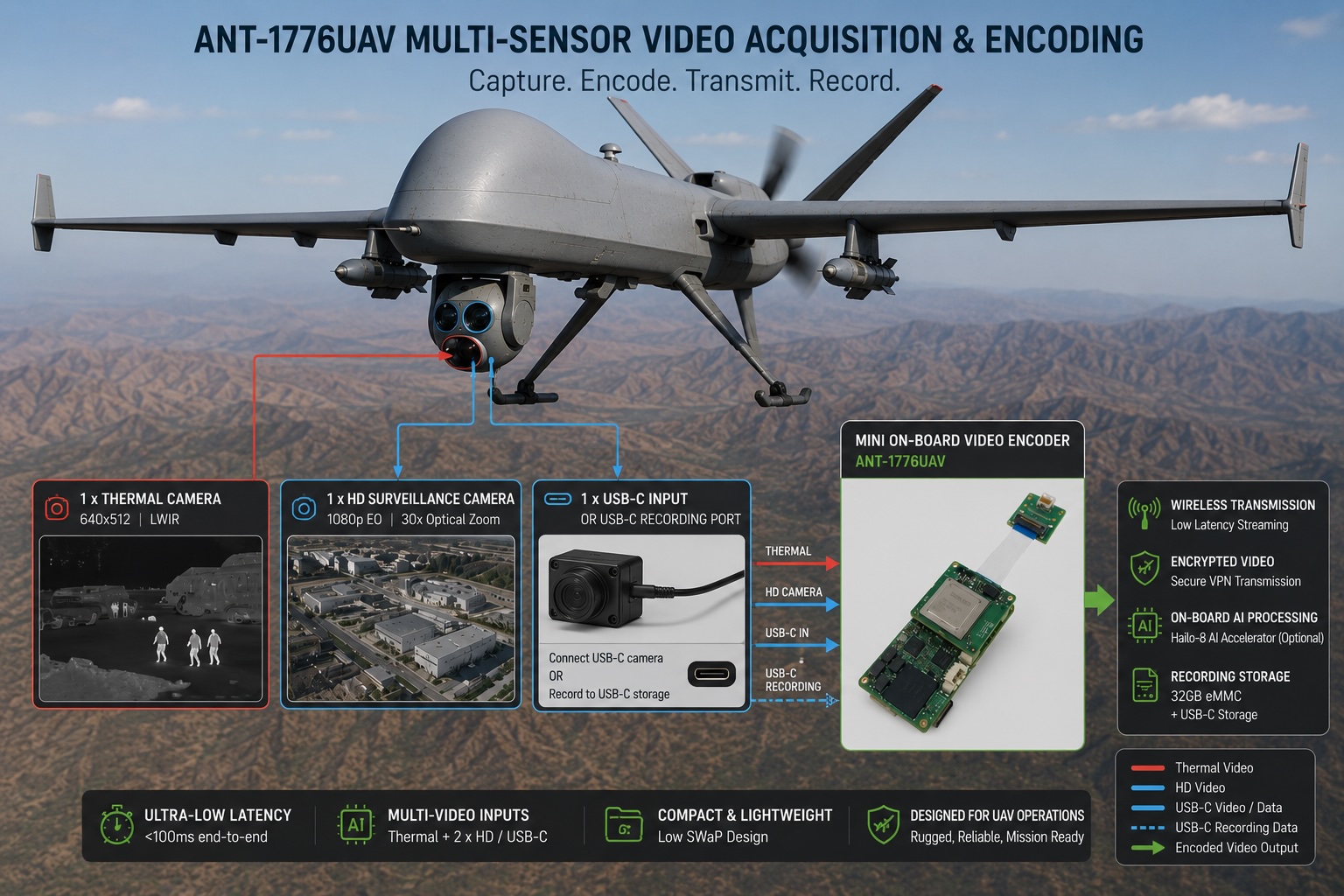
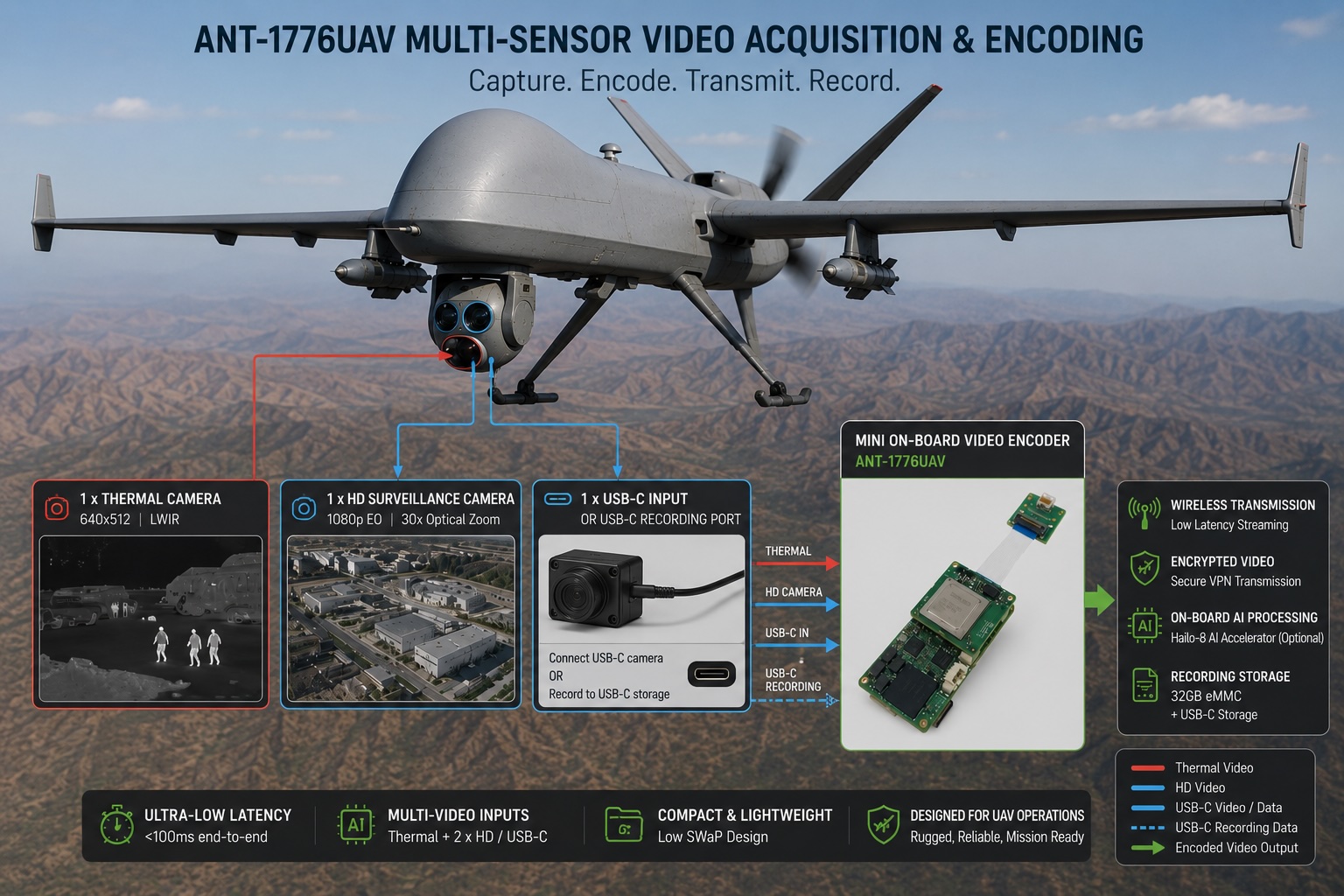
At the Antrica stand, that's precisely the point. The UK-based video encoding specialist has spent two decades building hardware that shrinks video pipelines down to board level, and this year the company is showing off just how far that miniaturization has come: boards small enough to disappear inside a drone's fuselage that can take in feeds from an FPV camera, a thermal sensor, and a secondary HD source simultaneously, compress them in real time, and stream the result to the ground with AI processing built in, without adding meaningful weight to the airframe carrying them.
Fast Facts: Antrica
- Headquarters: Bracknell, Berkshire, United Kingdom
- In business: 20+ years, video encoding & decoding
- Core AI chipset: Hailo-8 accelerator
- Claimed latency: ~100ms glass-to-glass
- Compliance: NDAA-compliant chipsets, MIL-STD-810G tested, ISO 9001:2015 certified
- New for 2026: Maris-branded defense systems:- Diamond, Coral, and Onyx
- Web: antrica.com
AeroXplorer caught up with Antrica's Carly Loke on the show floor last week to talk through the company's video technology, its approach to cybersecurity, and where the unmanned systems market is heading next.
One Board, Every Camera
Antrica's business splits cleanly in two. There's the company's long-standing commercial line, encoders and decoders sold into CCTV, broadcast, and control-room markets. Then there's the half of the business Farnborough is really here for: miniature encoder boards purpose-built for drones and other unmanned platforms.
The pitch is simple, but the payoff compounds quickly once a system leaves the ground. Rather than fitting a UAV with a separate encoder for every camera onboard, Antrica's boards accept multiple simultaneous video inputs: HDMI from an FPV camera, composite from a thermal payload, a secondary HD feed over USB-C, and consolidate them onto a single board. "Obviously they can create a much lighter payload solution by utilizing one of our products rather than having an encoder per camera," Carly Loke explained. Every gram not spent on redundant encoding hardware is a gram available for fuel, sensors, or flight time.
Once captured, video is compressed to H.264 or H.265 and streamed to the ground, where Antrica's own software player is built to achieve roughly 100 milliseconds of measured glass-to-glass latency, notably as total system latency rather than just the encode-side figure. For an operator flying beyond visual line of sight, that gap between what the camera sees and what the pilot sees is the whole ballgame.
The hardware carries credentials to back up its defense ambitions, too. Antrica's UAV boards are built on non-Chinese chipsets to meet NDAA compliance requirements. They are tested to the MIL-STD-810G standard, with an operating range Antrica's own specifications put at -40°C to +85°C, cold enough for a high-altitude ISR mission, hot enough for a desert deployment. Firmware-level features add further polish: onboard logic can automatically adjust bitrate and resolution in real time based on radio signal strength, keeping a video feed alive and watchable as a drone flies toward the edge of its link budget, rather than dropping the feed outright.
Locking It Down
Ask any hardware vendor selling into defense markets about their biggest technical headache, and encryption comes up fast, not because the cryptography itself is difficult, but because every customer wants to do it differently. Carly was candid about the tension. "Everybody's using different things: different software that they want to use," she said, describing how Antrica initially built proprietary point-to-point AES encryption tied to its own video player, only to find that plenty of customers had no interest in standardizing on a single vendor's playback software.
The company's answer was to build flexibility into the silicon itself. Antrica's boards ship with AES-encrypted recording as standard, insurance against a worst-case scenario in which a downed aircraft's storage falls into the wrong hands, but for live transmission, the company now carves out space on the chipset to host a VPN client, typically OpenVPN, directly on the board. Customers can then sync the encoder to whatever secure endpoint their broader system already relies on, rather than being locked into Antrica's own ecosystem. It's a small architectural choice that says a lot about how the company thinks about defense buyers: less "trust our stack," more “fit into yours.”
The AI Calculus
Pressed on where she sees the biggest challenges ahead for aerospace and defense suppliers, Carly didn't point to a single technology gap so much as a moving target. "AI is coming into its own at the moment," she said, "but it's really finding the right AI solution that works for you."
Antrica's own answer has been the Hailo-8 accelerator, now built into several of its newer encoder boards, including the recently introduced ANT-1776AI and ANT-1776ZBAI, enabling onboard object detection and classification, running YOLOv5 as standard with an upgrade path to YOLOv8, without offloading processing to the ground or the cloud. The choice wasn't about chasing the most powerful chip on the market; it was about chasing the most efficient one. "We utilize Hailo-8 as a chipset on our boards, and we do that because it's incredibly low power," Carly said, contrasting it with Nvidia-class alternatives that draw considerably more current for a marginal capability gain. In a UAV, that tradeoff cascades: lower power draw allows for a smaller battery, a smaller battery means a lighter airframe, and a lighter airframe means more time aloft. "Sometimes it's the smallest components that can have the biggest effect on the end result," she said.

Were Halon Fire Extinguishers Actually Banned, or Is That an Aviation Myth?
From Components to Complete Systems
That logic increasingly extends beyond the encoder board itself. Alongside its UAV encoder range, Antrica has spent the past several months expanding into ready-to-deploy situational-awareness hardware under a Maris-branded defense line, developed with partner Maris-Tech. Three products anchor the range.
Diamond is a retrofit, vehicle-mounted platform that stitches together as many as eleven camera feeds into a 360-degree, AI-processed picture, aimed at armoured fighting vehicles and fixed observation posts that need to spot airborne and ground threats without relying on a single sensor.
Onyx is a palm-sized, IP67-rated edge computing unit that pairs dual USB cameras with a Hailo-8 chip running at up to 26 TOPS, plus 4G and GPS connectivity, for AI processing in locations with no fixed network.
Coral, weighing roughly 200 grams and drawing under 1.5 watts in its lowest-power mode, is built for beyond-line-of-sight tactical use where battery life and a small footprint matter as much as image quality.
Together, the three products mark a shift for a company that has traditionally sold components into other people's systems: Antrica is increasingly building the systems, too. The move follows a run of other milestones for the company this year, including ISO 9001:2015 certification and a stand at Intersec Dubai in January, part of what looks like a deliberate push into markets where security and defense buyers are consolidating spend with fewer, more trusted suppliers.
Two Decades In, Staying Small on Purpose
For all its expansion, Antrica has kept its footprint deliberately compact. The company has operated out of the UK for more than 20 years, and Carly was clear that staying lean is a feature, not a limitation. "We're a small, agile company, so we like to have one-to-one conversations with our customers," she said. "We're not so big that you can't pick up the phone and contact us." In a defense supply chain increasingly dominated by primes with layers of account management between engineer and customer, Antrica is betting that direct access is itself a competitive advantage: one reason, Carly suggested, the company has been able to take on low-volume OEM customization work that larger competitors typically turn away.
Looking Ahead
Farnborough's organizers have leaned hard into the idea that this year's show reflects an industry in transition, more first-time exhibitors, a dedicated finance track backed by Barclays, growing floor space for advanced air mobility and autonomy. Antrica's own trajectory, from board-level encoders toward complete AI-enabled situational-awareness systems, tracks that same shift in miniature. Whether that bet pays off will depend on how quickly defense and UAV customers move from evaluating edge AI to deploying it at scale. Still, on the evidence at Antrica's stand last week, the company isn't waiting around to find out.
FlyUSA CEO Barry Shevlin on Chartering the World Cup, How the Fastest Growing Private Aviation Company is Handling a 300% Demand Spike » United Airlines Boeing 737-900 Makes Rare Emergency Landing at Fighter Base After Storms Force Low Fuel Diversion Over Phoenix » NTSB Finds Bird Strike Evidence in Fatal New York Helicopter Crash That Killed Six »

Comments (0)
Add Your Comment
TAGS
INFORMATIONAL Antrica Farnborough Airshow 2026 UAV Video Encoders Edge AI Hailo-8 Cybersecurity NDAA Compliance Defense Technology Unmanned Systems Situational Awareness UK Aerospace Miniaturized ElectronicsRECENTLY PUBLISHED
 FAA Warns Boeing 737 MAX Seat Failure Could Endanger Passengers
The FAA issued a proposed airworthiness directive over faulty passenger seat tracks on Boeing 737 MAX aircraft that could fail during flight.
NEWS
READ MORE »
FAA Warns Boeing 737 MAX Seat Failure Could Endanger Passengers
The FAA issued a proposed airworthiness directive over faulty passenger seat tracks on Boeing 737 MAX aircraft that could fail during flight.
NEWS
READ MORE »
 This Week in Aviation: The 10 Stories That Mattered Most
From major airline developments to aircraft updates and industry shifts, this weekly recap highlights the ten most-read aviation stories from the week of July 19.
INFORMATIONAL
READ MORE »
This Week in Aviation: The 10 Stories That Mattered Most
From major airline developments to aircraft updates and industry shifts, this weekly recap highlights the ten most-read aviation stories from the week of July 19.
INFORMATIONAL
READ MORE »
 British Airways Relocates Crew From Hyderabad Hotel After Three Pilots Fall Violently Ill With Food Poisoning
British Airways is moving crew out of a Hyderabad hotel after three pilots suffered severe food poisoning on a flight back to London Heathrow.
NEWS
READ MORE »
British Airways Relocates Crew From Hyderabad Hotel After Three Pilots Fall Violently Ill With Food Poisoning
British Airways is moving crew out of a Hyderabad hotel after three pilots suffered severe food poisoning on a flight back to London Heathrow.
NEWS
READ MORE »
More than just headlines.
Get unlimited ad-free access to in-depth aviation news, premium stories, and exclusive insights other sites don't cover.
- Ad-free browsing on AeroXplorer
- Unlimited access to premium and exclusive articles
- Higher photo upload limits & commissions on sales
- Free access to Jetstream Magazine on higher tiers
- Ad-free browsing
- Sell aviation photos with 60% commission
- First week free!
- Everything in Basic+
- Unlimited premium articles
- Sell aviation photos with 70% commission
- Free Digital subscription to Jetstream Magazine
- First week free!
- Everything in Basic+ and Pro
- Sell aviaiton photos with 80% commission
- Early access to exclusive stories
- Free Digital+Print subscription to Jetstream Magazine