

Tension in the Middle East reached a kinetic flashpoint today, February 3, 2026, as a U.S. Navy F-35C Lightning II stealth fighter intercepted and destroyed an Iranian unmanned aerial vehicle (UAV) that posed a direct threat to the USS Abraham Lincoln (CVN-72) carrier strike group. The encounter marks a significant escalation in the ongoing maritime shadow war between Washington and Tehran.
The engagement occurred early Tuesday as the USS Abraham Lincoln was transiting international waters in the Arabian Sea, approximately 500 miles (800 kilometres) from Iran’s southern coast. According to U.S. Central Command (CENTCOM), a sophisticated Iranian Shahed-139 drone, a medium-altitude, long-endurance (MALE) platform recently unveiled by Tehran, was detected on a high-speed, aggressive flight path toward the nuclear-powered supercarrier.
Despite multiple attempts by the strike group to warn the aircraft away through established de-escalatory channels, the drone maintained its intercept course, forcing the scramble of a 5th-generation stealth fighter from Marine Fighter Attack Squadron (VMFA) 314, currently embarked on the Lincoln.

A Decisive Response in Self-Defence
The shootdown was characterised by military officials as a necessary act to ensure the safety of the thousands of sailors and aviators aboard the flagship.
“The drone, a Shahed-139, ‘aggressively approached’ the Lincoln with unclear intent,” stated Captain Tim Hawkins, a spokesperson for U.S. Central Command. “The Iranian drone continued to fly toward the ship despite deescalatory measures taken by U.S. forces operating in international waters.”
Captain Hawkins confirmed that the F-35C ultimately “shot down the Iranian drone in self-defence and to protect the aircraft carrier and personnel on board.” No American troops were harmed, and no U.S. equipment sustained damage during the brief engagement.
Tactical Context and Regional Friction
The destruction of the Shahed-139 was not an isolated event. Just hours later, the USS McFaul (DDG 74) was forced to intervene in the Strait of Hormuz when two IRGC fast boats and an Iranian Mohajer drone harassed the M/V Stena Imperative, a U.S.-flagged and crewed merchant tanker.
White House spokeswoman Karoline Leavitt addressed the day’s events during a briefing, noting that CENTCOM acted “appropriately and necessarily” under the direction of the President.
“So, CENTCOM did make the decision to shoot down that Iranian drone. It was unmanned; it was acting aggressively towards our USS Lincoln, which we know that aircraft carrier is in the region -- at the direction of President Trump,” Leavitt said, adding that while the U.S. remains open to diplomacy, “it takes two to tango.”
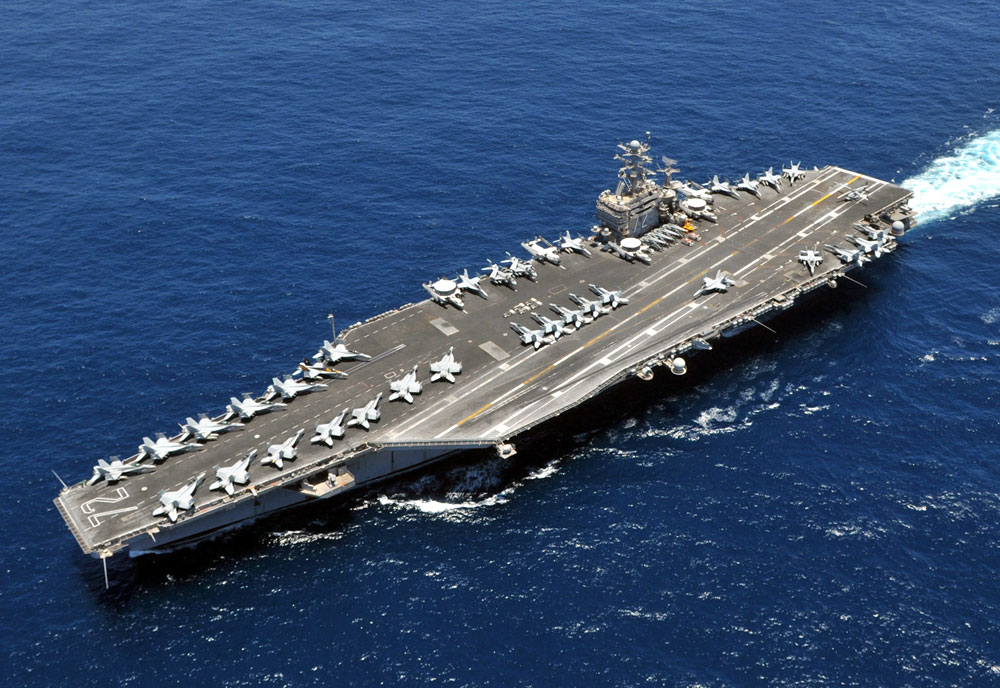
Photo: Military Factory
The Shahed-139
Aerospace analysts describe the Shahed-139 as a significant leap in Iranian drone technology. Visually similar to the U.S.-made MQ-1 Predator, it features a rear-mounted pusher propeller and is believed to be capable of carrying a payload of up to four precision-guided missiles.
| Feature | Details of the February 3 Engagement |
|---|---|
| Interceptor Aircraft | Lockheed Martin F-35C Lightning II (VMFA-314) |
| Target Drone | Iranian Shahed-139 (MALE UAV) |
| Location | Arabian Sea (Approx. 500 miles off Iran's coast) |
| Strike Group | Carrier Strike Group 3 (USS Abraham Lincoln) |
| Outcome | Target destroyed; zero U.S. casualties |
| Weapon System | Undisclosed (Likely AIM-9X or 25mm Gun Pod) |

Only Way Out: Private Aviation in a Region at War
Geopolitical Brinkmanship
The incident comes at a delicate moment for the Trump administration, which has reinstated a "maximum pressure" policy on Tehran following domestic unrest in Iran last month. Despite the military flare-up, reports suggest that American and Iranian officials are still scheduled to meet in Ankara this Friday for high-level talks concerning Iran's nuclear program.
However, as President Trump warned earlier this week, “bad things would happen” if a deal cannot be reached while U.S. carrier groups remain on station. For now, the Abraham Lincoln continues its patrol with an increased combat air patrol (CAP) tempo, ready to respond to any further provocations in the volatile Arabian Sea.
Why Airliners Pump Nitrogen Into Their Fuel Tanks » Delta Passenger Arrested After Allegedly Stealing Airport Tug » US Air Force Pulls All 12 B-1B Bombers from RAF Fairford Following Attempted Attack »

Comments (0)
Add Your Comment
TAGS
NEWS F35C Air To Air Drone US Navy Military AviationRECENTLY PUBLISHED
 Boeing's Touchscreen Flight Controls for 737 Draw Sharp Criticism from Pilots
Boeing's plan to introduce Touchscreen Control Display Units on the 737 has sparked backlash from pilots who warn of safety and usability concerns.
NEWS
READ MORE »
Boeing's Touchscreen Flight Controls for 737 Draw Sharp Criticism from Pilots
Boeing's plan to introduce Touchscreen Control Display Units on the 737 has sparked backlash from pilots who warn of safety and usability concerns.
NEWS
READ MORE »
 Southwest Airlines Blames Brief System Outage for Boarding Delays and Checked Bag Disruptions
Southwest Airlines confirms a brief technology outage disrupted boarding and checked bag operations, forcing gate agents to process travelers manually.
NEWS
READ MORE »
Southwest Airlines Blames Brief System Outage for Boarding Delays and Checked Bag Disruptions
Southwest Airlines confirms a brief technology outage disrupted boarding and checked bag operations, forcing gate agents to process travelers manually.
NEWS
READ MORE »
 Southwest Airlines Considers Boeing 787 Order for Long-Haul International Expansion
Southwest Airlines is evaluating the Boeing 787 Dreamliner as it explores a shift into long-haul international flying, sources tell Reuters.
NEWS
READ MORE »
Southwest Airlines Considers Boeing 787 Order for Long-Haul International Expansion
Southwest Airlines is evaluating the Boeing 787 Dreamliner as it explores a shift into long-haul international flying, sources tell Reuters.
NEWS
READ MORE »
More than just headlines.
Get unlimited ad-free access to in-depth aviation news, premium stories, and exclusive insights other sites don't cover.
- Ad-free browsing on AeroXplorer
- Unlimited access to premium and exclusive articles
- Higher photo upload limits & commissions on sales
- Free access to Jetstream Magazine on higher tiers
- Ad-free browsing
- Sell aviation photos with 60% commission
- First week free!
- Everything in Basic+
- Unlimited premium articles
- Sell aviation photos with 70% commission
- Free Digital subscription to Jetstream Magazine
- First week free!
- Everything in Basic+ and Pro
- Sell aviaiton photos with 80% commission
- Early access to exclusive stories
- Free Digital+Print subscription to Jetstream Magazine