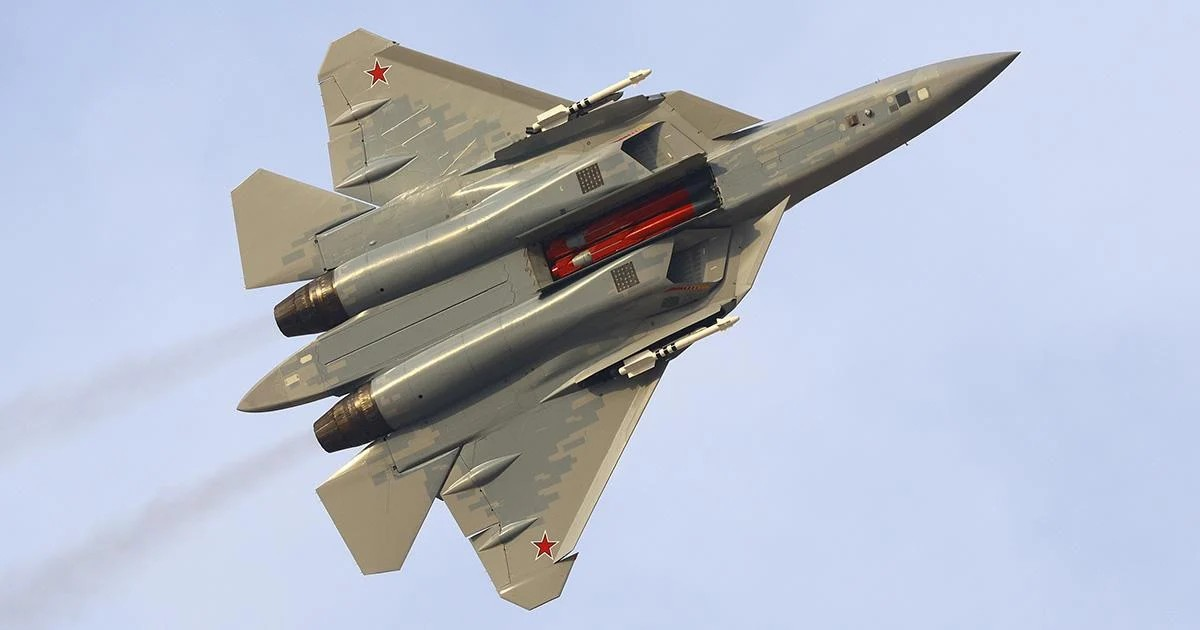
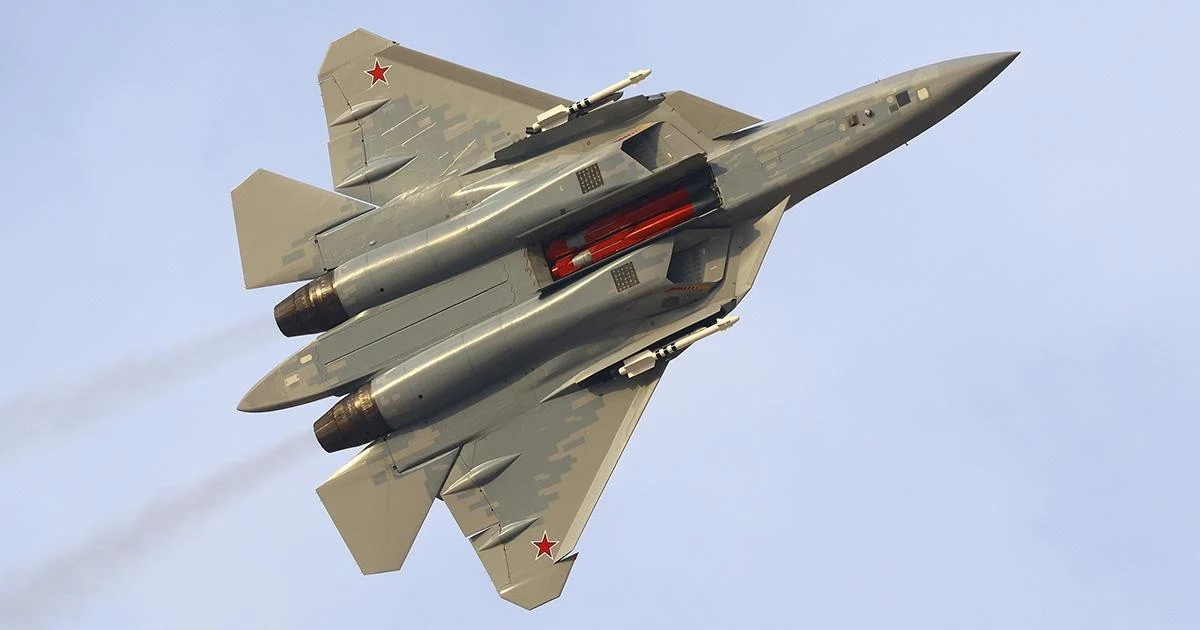
Russia is continuing to promote its Su-57E stealth fighter on the international market, insisting that export interest remains strong despite India's decision not to pursue the aircraft. The renewed push highlights Moscow's determination to find foreign buyers for its only fifth generation combat jet, even as questions mount about the platform's maturity and production pace.
Officials from Rosoboronexport, Russia's state arms exporter, recently confirmed that discussions with several countries remain active. The agency said the Su-57E, the export variant of the Su-57 Felon, is being offered to partners across Asia, the Middle East, Africa, and Latin America. According to Russian statements, contracts are either under negotiation or in advanced stages with unnamed foreign governments.
The promotional campaign comes at a sensitive moment. India, long considered the most likely major customer for a Russian stealth fighter, has made clear it will not acquire the Su-57. New Delhi walked away from a joint development program tied to the aircraft back in 2018, citing concerns about performance, stealth characteristics, engine technology, and the level of technology transfer offered by Moscow. Recent reporting indicates India has reaffirmed that position, choosing instead to focus on its own Advanced Medium Combat Aircraft project and weigh Western options for an interim fifth generation capability.
Why India Passed
Indian defense planners have raised several objections to the Su-57 over the years. The aircraft's radar cross section, engine performance, and sensor suite did not meet the requirements the Indian Air Force set for a next generation fighter. India had initially partnered with Russia on the Fifth Generation Fighter Aircraft program, which was based on the Su-57 airframe, but pulled out after investing significant funds without receiving what it considered adequate access to source code, design data, and critical subsystems.
Indian officials have also pointed to the slow pace of Su-57 production inside Russia itself. The Russian Aerospace Forces have received only a limited number of serial aircraft, and the planned transition to the more powerful Izdeliye 30 engine has faced repeated delays. For a country that expects to operate any new fighter for decades, those issues weighed heavily against the purchase.
India is now evaluating alternatives. Reports suggest the Indian Air Force is examining the possibility of leasing or co-producing a Western fifth generation platform while its domestic AMCA program progresses. The service is also expanding its fleet of Rafale fighters and upgrading existing Su-30MKI jets.
Moscow's Export Pitch
Despite the Indian setback, Russian officials have continued to describe the Su-57E as a competitive offering. They highlight its supercruise capability, internal weapons bays, advanced avionics, and what they describe as a lower price tag compared to Western fifth generation jets like the F-35.
Algeria is widely reported to be the first confirmed export customer, with deliveries said to have begun. Russian media and some industry outlets have suggested additional interest from countries that already operate Russian equipment and face restrictions on buying American aircraft. However, independent confirmation of firm contracts beyond Algeria remains limited.
Analysts note that sanctions imposed on Russia since the invasion of Ukraine in 2022 complicate any export deal. Buyers risk secondary sanctions under US law, and payment mechanisms for large defense purchases have become more difficult. These factors have narrowed the pool of realistic customers.

Ten Minutes to Manhattan: Inside Joby’s Air Taxi Ambitions
Production Questions
Another challenge for the Su-57E program is Russia's ability to deliver aircraft on schedule. The United Aircraft Corporation has been working to increase output at the Komsomolsk-on-Amur plant where the fighter is built. Russian officials have claimed production is accelerating, but Western analysts remain skeptical given the demands of the ongoing war in Ukraine and sanctions on components.
Some of the Su-57's advanced systems rely on microelectronics and materials that were previously sourced from Western suppliers. Replacing those inputs with domestic or alternative foreign sources has taken time, and this directly affects both the capability of the aircraft and the speed at which it can be manufactured for export.
What Comes Next
For Russia, the Su-57E remains a flagship offering and a symbol of its continued relevance in high end defense technology. Securing additional foreign orders would help justify further investment in the program and provide revenue for the state defense industry.
For prospective buyers, the decision involves balancing cost, capability, geopolitical consequences, and long term support. India's choice to walk away removes the single biggest potential customer from the equation and raises the stakes for Russia's outreach to smaller air forces.
Whether Moscow can convert its promotional campaign into firm contracts will depend on how quickly it can demonstrate production reliability, address technical concerns, and offer terms that overcome the sanctions environment. For now, the Su-57E remains on offer, with its export future still largely undefined.
Five Major Airlines Face Fresh Lawsuit Over Alleged Secret Fare Data Sharing Scheme » NTSB Recovers Learjet 60 Elevator Miles From Florida Crash Site, Pointing to In-Flight Breakup » American Airlines Restores Daily Miami to Cap-Haitien Flights, Reopening US Air Link to Haiti »

Comments (0)
Add Your Comment
TAGS
NEWS Su-57E Russia India Air ForceRECENTLY PUBLISHED
 This Week in Aviation: The 10 Stories That Mattered Most
From major airline developments to aircraft updates and industry shifts, this weekly recap highlights the ten most-read aviation stories from the week of November 01.
INFORMATIONAL
READ MORE »
 Why Did the F-14 Tomcat's Variable Sweep Wings Move?
The F-14 Tomcat swept its wings forward for slow carrier landings and back for Mach 2 flight, and this article explains why and how they moved.
INFORMATIONAL
READ MORE »
 Five Major Airlines Face Fresh Lawsuit Over Alleged Secret Fare Data Sharing Scheme
American, Delta, United, Southwest and Alaska Airlines face accusations of using a data clearinghouse to coordinate fares and inflate ticket prices.
NEWS
READ MORE »
More than just headlines.
Get unlimited ad-free access to in-depth aviation news, premium stories, and exclusive insights other sites don't cover.
- Ad-free browsing on AeroXplorer
- Unlimited access to premium and exclusive articles
- Higher photo upload limits & commissions on sales
- Free access to Jetstream Magazine on higher tiers
- Ad-free browsing
- Sell aviation photos with 60% commission
- First week free!
- Everything in Basic+
- Unlimited premium articles
- Sell aviation photos with 70% commission
- Free Digital subscription to Jetstream Magazine
- First week free!
- Everything in Basic+ and Pro
- Sell aviaiton photos with 80% commission
- Early access to exclusive stories
- Free Digital+Print subscription to Jetstream Magazine