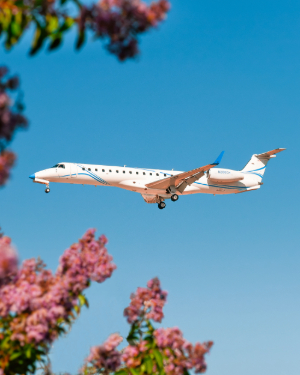


There are three main ways to fly privately in the United States. Charter, fractional ownership and full ownership can all put a traveler on the same light jet at the same private terminal. What changes is how much money is tied up, how long the agreement lasts and who carries the cost when the aircraft sits on the ground.
The answer for most travelers comes down to one question: how often, and how predictably, do they actually fly?

Private Jet Charter Means Paying by the Trip
Charter is the simplest of the three models. A traveler books a specific trip, pays for that trip and walks away with no share to buy, no monthly fee and no contract to renew. For people who fly privately a handful of times a year, the usual approach is to book through an air charter service, which arranges a suitable aircraft and crew for each trip without any long-term commitment.
That arrangement makes it easy to change aircraft from one trip to the next. A light jet covering up to around 1,500 miles suits a hop from New York to Florida, while a heavy jet with roughly 7,000 miles of range can handle a nonstop transatlantic family vacation. Check-in at a private terminal can take as little as 15 minutes before departure, whichever aircraft is chosen. Nothing is owed between flights, so a year where you don’t travel as often doesn’t cost you more.

What a Fractional Share Actually Buys
Fractional ownership adds a commitment in exchange for guaranteed access. Instead of booking trip by trip, the buyer purchases a share of a specific aircraft within a managed program and receives an annual allocation of flight hours.
In the US, these programs are governed by Part 91 Subpart K of the federal aviation regulations. Under the rule, a fractional ownership program needs at least two aircraft and a single program manager, and the smallest share an owner can hold in a fixed-wing aircraft is one-sixteenth. A 1/16 share is generally linked to about 50 occupied hours a year, with larger shares scaling up from there.
The costs come in three layers. There is the upfront price of the share, a monthly management fee covering crew, hangar, insurance and maintenance, and an hourly rate charged when the owner flies. The monthly fee is fixed, so it is due whether or not the owner flies that month.
Agreements usually run for several years, with five being the typical number of years. At the end of the term, the share is generally sold back at its market value at that point, minus a remarketing fee. For someone flying 50 hours or more every year on a steady pattern, that structure delivers consistent access. For someone flying far less, much of the cost goes toward access they don't use.
Full Ownership Brings Total Control
Buying an aircraft outright removes sharing annual flying hours altogether. The owner decides the cabin layout, the schedule and where the aircraft is based, and it is available whenever they want it.
That control, however, comes with every bill attached. Crew salaries, hangar space, insurance, maintenance and training all belong to the owner, and most of those costs continue whether the aircraft flies 50 hours a year or 400. Many owners hand day-to-day running to a management company, but the fixed costs stay theirs.
Tax policy has shifted recently. Under the One Big Beautiful Bill Act, signed on July, 2025, qualifying aircraft acquired and placed in service on or after January, 2025 may be eligible for 100 percent bonus depreciation, and the deduction is no longer being phased out. It covers both new and pre-owned aircraft, provided they’re used more than 50 percent of the time for qualified business purposes, as Flying Magazine reported. Whether a particular purchase qualifies depends on how the aircraft is used, so buyers typically take professional tax advice. For a company already flying several hundred hours a year, the change can make ownership considerably more attractive.

Matching Flight Hours to the Right Plan
With all three models laid out, annual flight hours are the most common way to choose between them. A long-standing industry guide suggests full ownership above about 200 hours a year, a fractional share between roughly 50 and 200 hours, and flight-by-flight charter below about 25 hours.
The guide is a starting point rather than a rule. Trip patterns matter as much as total hours. A family that flies to the same vacation home twice a year and stays for weeks has very different needs from an executive making short one-way trips every week. Aircraft size is also important, since one owned or fractional aircraft type has to suit most of the owner's trips to make financial sense.
That is why many travelers who could afford a share still choose charter. It allows them to pick a midsize jet for a business trip and a larger cabin for a vacation with the extended family, all without committing to a single aircraft type for five years.

Choosing the Right Model for How You Fly
Full ownership suits heavy use and regular flyers who want total control and can put the tax position to work. Fractional ownership suits people who fly a steady 50 hours or more a year and want guaranteed availability without running an aircraft themselves.
For everyone flying less often than that, charter remains the most adaptable choice. There is no capital outlay, no monthly fee and no long-term agreement, and each trip gets the aircraft that fits it best.
British Airways 787-10 Declares Emergency Over Atlantic After Second Oil Leak in 10 Days » Lockheed Martin Delivers X-59 Supersonic Jet to NASA Following Flight Tests Above Mach 1.5 » LATAM Unveils Private Suites on New Airbus A321XLR, Bringing Widebody Luxury to a Narrowbody Jet »

Comments (0)
Add Your Comment
TAGS
INFORMATIONAL Private Jet Charter Business Aviation Fractional Ownership Private Travel Luxury TravelRECENTLY PUBLISHED
 What Is the 'Brake to Vacate' Feature on Airbus Aircraft?
How Airbus’ Brake to Vacate system makes runway exits faster and more efficient.
INFORMATIONAL
READ MORE »
 British Airways Expands Larger Overhead Bins to More Aircraft, Easing the Battle for Cabin Space
British Airways will retrofit 22 A320 family aircraft with larger overhead bins, giving passengers more room for carry-on bags starting in 2026.
NEWS
READ MORE »
 Western Global Boeing 747 Stuck In Soft Ground Closes Runway For 14 Hours
A Western Global Airlines Boeing 747 freighter got stuck in soft ground at Yokota Air Base in Tokyo, shutting down operations for 14 hours.
NEWS
READ MORE »
More than just headlines.
Get unlimited ad-free access to in-depth aviation news, premium stories, and exclusive insights other sites don't cover.
- Ad-free browsing on AeroXplorer
- Unlimited access to premium and exclusive articles
- Higher photo upload limits & commissions on sales
- Free access to Jetstream Magazine on higher tiers
- Ad-free browsing
- Sell aviation photos with 60% commission
- First week free!
- Everything in Basic+
- Unlimited premium articles
- Sell aviation photos with 70% commission
- Free Digital subscription to Jetstream Magazine
- First week free!
- Everything in Basic+ and Pro
- Sell aviaiton photos with 80% commission
- Early access to exclusive stories
- Free Digital+Print subscription to Jetstream Magazine