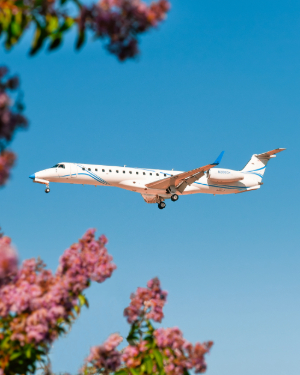


Passengers likely do not think about certain factors affecting an aircraft's performance as the plane takes off. Elevation is one such factor, with an airport's elevation playing a significant role in how easily an aircraft can get off the ground.
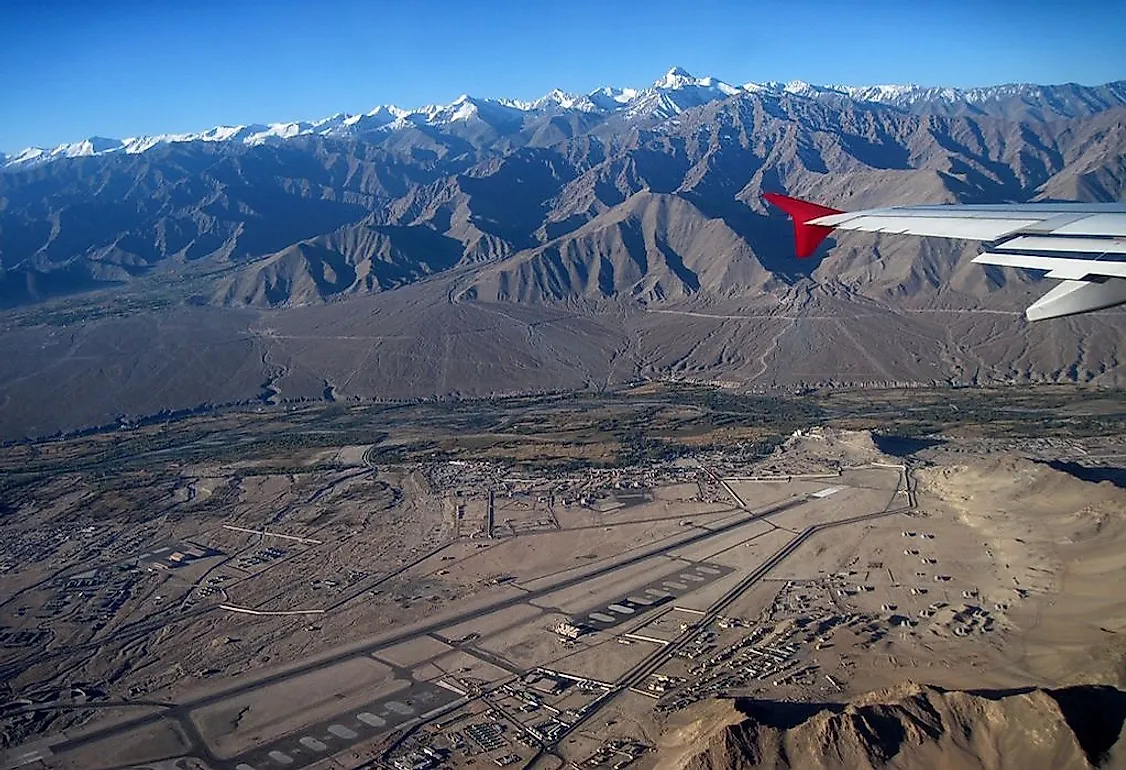
Density Altitude
Density altitude measures how thick the air is and is based on atmospheric pressure, temperature, and humidity. Understanding these principles is important before moving into discussing elevation. Atmospheric pressure has to do with the idea that the lower the pressure, the fewer air molecules surrounding the aircraft. Lower pressure can be found on hot days as warmer air is lighter and thus less dense.
The less dense the air, the longer it will take for the aircraft to get airborne. This is why planes take longer to lift off during the summer due to the decreased air density. Temperature's effects on aircraft performance were briefly discussed earlier. The air is less dense when hotter because air molecules have more energy. As such, they spread further apart.
In contrast, the air is more dense in cold climates. The air molecules have less energy and are clustered close together. Aircraft can generate lift easier in such climates and thus can get off the ground faster. Humidity has a small effect on density altitude. However, when humidity is high, the air is less dense. Humid conditions are normally found in areas known for hotter weather, such as Houston.

Elevation Impacts
Air always becomes less dense the higher you go. Therefore, airports at higher elevations are usually more challenging to take off. This is because, with such low density, the aircraft will require higher rotation (liftoff) speeds and, thus, longer takeoff rolls. In these scenarios, airlines know the aircraft operating at higher-elevation airports.
Perfect examples of these include airports like Aspen, Colorado (ASE), Eagle, Colorado (EGE), and Jackson Hole, Wyoming (JAC). These airports sit at 7,820 feet (2,384 meters), 6,547 feet (1,996 meters), and 6,451 feet (1,966 meters) above mean sea level, respectively. Given their proximity to such locations, these three airports are most popular for travel to ski resorts.
However, their high elevation and very short runways in Jackson Hole and Aspen mean that not just any passenger jet can operate there. This is why aircraft like Boeing 757-200s, 737-700s, and Airbus A319s are the most common mainline aircraft operating into Eagle and Jackson Hole. These planes are very overpowered and get airborne without issue, making them optimal choices for high-elevation destinations.
Regional jets used at these airports include the Bombardier CRJ-700 and Embraer E175. These are the best choices when it comes to maneuverability and engine performance. The CRJ-700 is the largest plane serving Aspen Airport.

The Case of Addis Ababa
Addis Ababa's Bole International Airport (ADD) in Ethiopia is 7,625 feet above mean sea level. This means that operations at the airport have to be such that they account for longer takeoff rolls because this is very high up, so the air is less dense, which means the planes take longer to lift off. Addis Ababa Airport has two runways, both of which exceed 12,000 feet in length.
However, this is insufficient to allow the airport's hub carrier, Ethiopian Airlines, to maximize its route potential. Ethiopian Airlines has a sizable route network, including many destinations in North America. However, the airline cannot fully fuel its planes in Addis Ababa to fly nonstop to North American cities. This is because if these planes were fully fueled, they would not be able to get off the ground even despite the runways being so long.
This is because of the airport's high elevation. To compensate, Ethiopian Airlines flights bound for the United States and Canada must stop over somewhere to refuel. These stopovers usually last an hour, and passengers do not deplane.

Previously, Dublin Airport (DUB) in Ireland was used as a refueling stopover. Dublin has since been replaced with Rome Fiumicino (FCO) for Ethiopian flights bound for Atlanta (ATL), Chicago (ORD), Washington Dulles (IAD), and Toronto Pearson (YYZ). These stopovers usually last an hour, and passengers neither deplane nor do new passengers board. Ethiopian Airlines does not have fifth-freedom rights to solely transport passengers between the U.S. and European countries or vice versa.
It is not just Rome that's used as a stopover point. Lomé, Togo (LFW) is used as a refueling stop for Ethiopian Airlines flights going to Newark (EWR) and Washington Dulles (IAD). Abidjan, Ivory Coast (ABJ) is the refueling stop for Ethiopian's New York (JFK) route. It is worth noting that the stopover only exists for the routing towards North America; all flights back to Addis Ababa are nonstop.
How Aging Aircraft Fleets Are Reshaping the Way Airlines Operate » The Engineering Behind the 777X's Folding Wingtips » Delta Air Lines Moves to Claim Top Spot at LAX With New Routes and Expanded Schedule »

Comments (0)
Add Your Comment
TAGS
INFORMATIONAL Elevation Altitude Science Airport Ethiopia Addis Ababa Ethiopian Airlines ColoradoRECENTLY PUBLISHED
 One-Millisecond Software Defect Identified as Cause of UK Air Traffic Control Collapse That Grounded Thousands of Flights
A new NATS report reveals a one-millisecond software defect triggered the UK air traffic control failure, causing thousands of cancellations.
NEWS
READ MORE »
One-Millisecond Software Defect Identified as Cause of UK Air Traffic Control Collapse That Grounded Thousands of Flights
A new NATS report reveals a one-millisecond software defect triggered the UK air traffic control failure, causing thousands of cancellations.
NEWS
READ MORE »
 AirAsia Pushes Back on Collapse Rumors as Fuel Costs Squeeze Budget Airline
AirAsia CEO Tony Fernandes denies the airline faces collapse, saying travel demand stays strong despite rising jet fuel prices pressuring margins.
NEWS
READ MORE »
AirAsia Pushes Back on Collapse Rumors as Fuel Costs Squeeze Budget Airline
AirAsia CEO Tony Fernandes denies the airline faces collapse, saying travel demand stays strong despite rising jet fuel prices pressuring margins.
NEWS
READ MORE »
 Delta Air Lines Moves to Claim Top Spot at LAX With New Routes and Expanded Schedule
Delta Air Lines plans its largest-ever schedule at Los Angeles International Airport, adding routes and premium seating to overtake rivals.
NEWS
READ MORE »
Delta Air Lines Moves to Claim Top Spot at LAX With New Routes and Expanded Schedule
Delta Air Lines plans its largest-ever schedule at Los Angeles International Airport, adding routes and premium seating to overtake rivals.
NEWS
READ MORE »
More than just headlines.
Get unlimited ad-free access to in-depth aviation news, premium stories, and exclusive insights other sites don't cover.
- Ad-free browsing on AeroXplorer
- Unlimited access to premium and exclusive articles
- Higher photo upload limits & commissions on sales
- Free access to Jetstream Magazine on higher tiers
- Ad-free browsing
- Sell aviation photos with 60% commission
- First week free!
- Everything in Basic+
- Unlimited premium articles
- Sell aviation photos with 70% commission
- Free Digital subscription to Jetstream Magazine
- First week free!
- Everything in Basic+ and Pro
- Sell aviaiton photos with 80% commission
- Early access to exclusive stories
- Free Digital+Print subscription to Jetstream Magazine