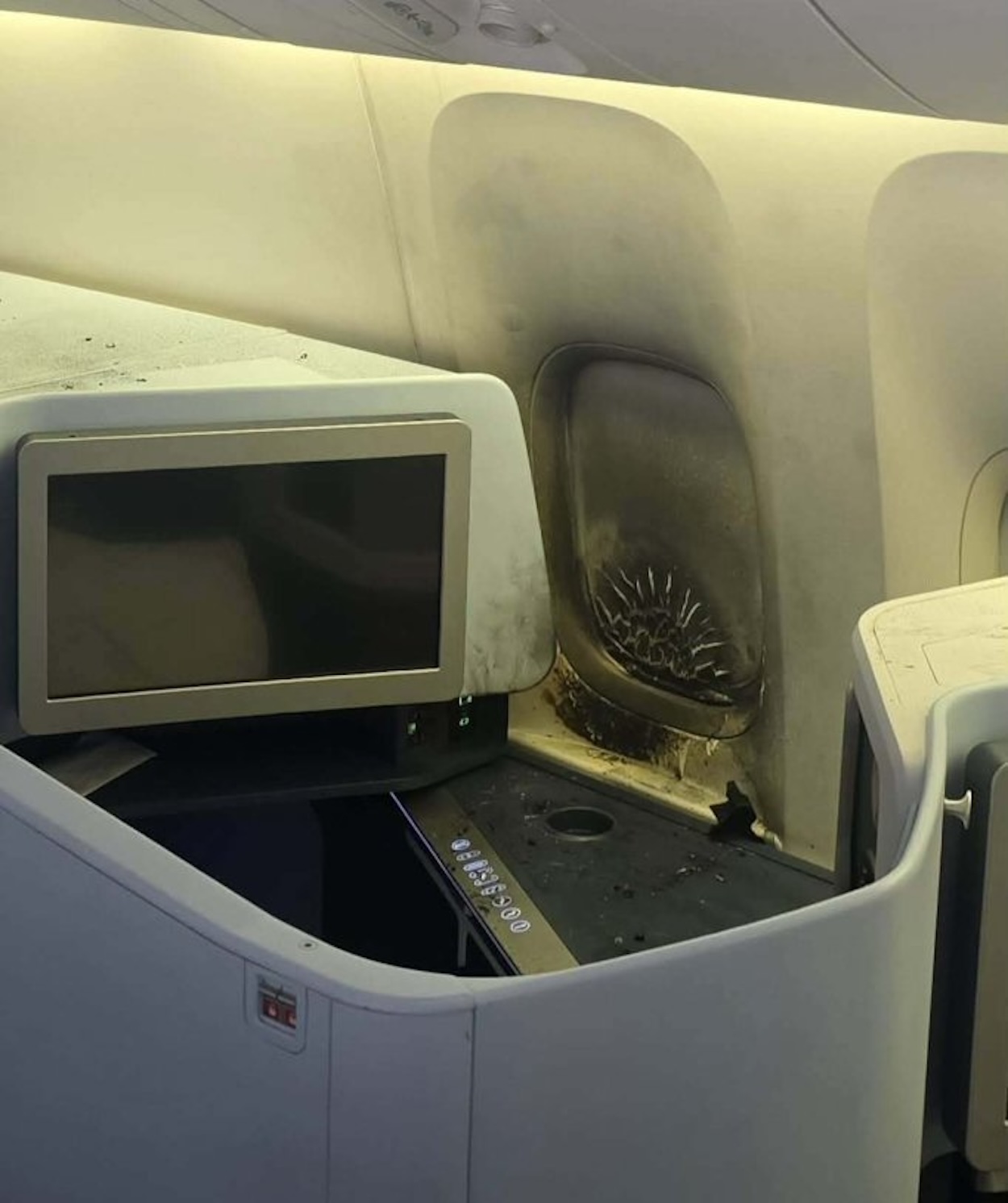
A KLM flight bound for Curaçao turned back to Amsterdam Schiphol Airport on Thursday after a lithium-ion power bank overheated, caught fire, and exploded in the Business Class cabin at cruising altitude. The device reportedly belonged to Camiel Eurlings, who served as President and CEO of KLM itself from July 2013 to October 2014, before being succeeded.
The incident happened on KLM flight KL735, a Boeing 777-300ER (registration PH-BVP) carrying 322 passengers, which departed Schiphol around 3:20 PM local time for what should have been a roughly nine-hour flight to Curaçao. About 5.5 hours in, while flying at approximately 30,000 feet over the Atlantic, the power bank overheated, smoked, and burst into flames, leaving scorch marks across the seat console and up the window blind and sidewall.
A nearby passenger told Dutch broadcaster RTL Nieuws there was "suddenly a loud bang," followed immediately by flames shooting up from above the seat. "The bang was the power bank exploding and instantly catching fire," the passenger said, adding that everyone had a significant fright but cabin crew reacted quickly and reassured passengers.
KLM permits passengers to carry up to two power banks in hand luggage, but they must remain visible and cannot be used or charged during the flight. Eurlings had reportedly been charging the device when it failed, in violation of that rule.
Cabin crew extinguished the fire before it could spread. Eurlings suffered minor injuries and was described as "terribly shaken" afterward. "He feels awful about the situation and all the inconvenience caused to everyone," the passenger said. "He was extremely upset." The captain turned the aircraft around, landing safely back at Schiphol around 8:40 PM, nearly 11 hours after departure.
Multiple passengers confirmed to RTL Nieuws that the power bank belonged to Eurlings. Given his background overseeing the airline and the fact that KLM briefs passengers on the no-charging rule at the start of every flight, some passengers online were less than sympathetic, noting he of all people would likely have known the policy. A KLM spokesperson said the airline would not fine Eurlings:
We give the message at the beginning of the flight that [power bank usage] is not allowed. We do not hand out any further fines.
Lithium-ion battery fires have become a serious concern for carriers worldwide. Power banks, laptops, and other electronics can overheat due to manufacturing defects, physical damage, or heat exposure, entering a state known as thermal runaway that produces intense heat, flames, and toxic smoke. This was reportedly not the first time a power bank has caused trouble aboard a KLM flight in the past year. Several carriers have tightened power bank rules recently, with some banning in-flight charging outright and others requiring devices to stay visible. International regulations already prohibit spare lithium batteries in checked luggage; they must be carried in the cabin, where fires can be spotted immediately.
Commercial aircraft carry specialized fire containment bags and thermal-resistant pouches for burning electronics, and crew are trained to douse a failing device with water or another non-flammable liquid to cool the surrounding cells and prevent the fire from spreading. In this case, the response worked as intended: the fire was extinguished quickly, and the aircraft returned to its origin without further incident.

If you travel with a power bank, keep it visible in your carry-on, and check your airline's charging policy before you fly. Inspect devices for swelling, damage, or unusual heat, and avoid cheap or uncertified brands. If a device feels hot, smokes, or hisses in flight, alert cabin crew immediately rather than handling it yourself.
{{REC}}
KLM deployed a replacement aircraft for the Curaçao route the following day, though not all affected passengers could rebook onto it given the route's popularity. Remaining passengers are being rebooked onto later services. KLM has not released a detailed statement on the cause beyond confirming the device was being charged in violation of airline policy.